Ever received a text that made you think, “What does that mean?” You’re not alone. Online conversations move quickly, and people constantly create new abbreviations, slang terms, acronyms, and shortened expressions.
You may see one term in a text message, another in a TikTok comment, and something completely different in a Snapchat conversation. Some expressions are easy to understand, while others can have multiple meanings depending on who uses them and how they appear in a sentence.
This guide explains the most important types of internet slang and texting abbreviations, how they differ, and how to figure out what an unfamiliar term means from context. It also connects you with detailed Meaning Genie explanations for specific expressions.
What Are Internet Slang and Texting Abbreviations?
Internet slang is an informal type of language associated with particular groups and communities, and it is widely used in online conversations and social media. Merriam-Webster describes slang as an informal vocabulary associated with particular groups or communities.
Texting abbreviations are a narrower category. They shorten words or phrases to make communication quicker or more casual.

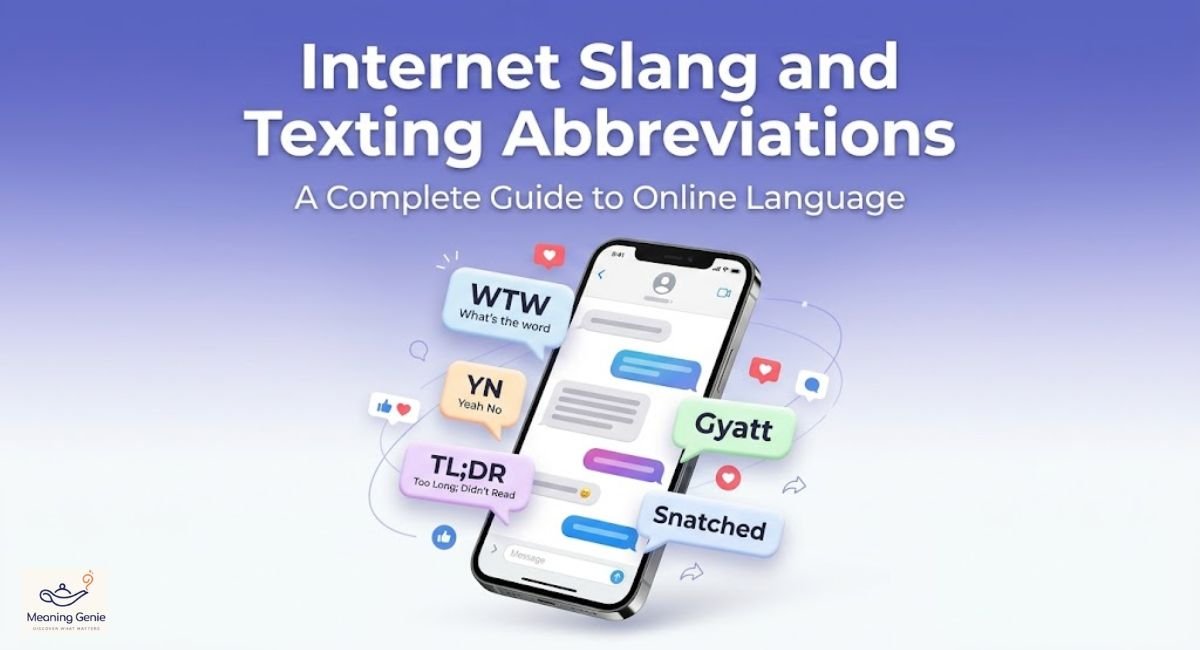
For example, TL;DR is a well-known internet abbreviation, while terms such as Gyatt and Snatched are better understood as slang expressions rather than simple shortened forms.
These categories often overlap, which is why people sometimes use the terms “internet slang,” “texting slang,” and “online abbreviations” interchangeably.
The important thing is not to memorize labels. What matters is understanding what the expression means, how people use it, and whether the context changes its meaning.
Internet Slang vs. Texting Abbreviations vs. Acronyms
These terms are related, but they aren’t identical.
| Type | What it means | Example |
| Internet slang | Informal language that develops or spreads through online communities | Gyatt |
| Texting abbreviation | A shortened form used in messages or chats | WTW |
| Acronym | A shortened expression formed from letters of a longer phrase | TL;DR |
| Slang expression | An informal word or phrase with a particular cultural meaning | Snatched |
The boundaries aren’t always strict. An abbreviation can become slang when people start using it as part of casual online culture.
That’s why understanding the actual usage is more useful than worrying too much about which category a term belongs to.
Why Do People Use Abbreviations and Slang Online?
Speed is one reason. Typing a few letters can be easier than writing a longer phrase, especially during fast conversations.
But convenience isn’t the whole story.
Online expressions can also make conversations feel more casual, humorous, familiar, or expressive. Certain terms become a kind of shared language within a group. Using one can signal that someone understands the community, trend, meme, or platform where it became popular.
Social media has accelerated this process. A phrase can begin in a small online community, appear in viral content, and eventually spread to millions of users.
Some expressions remain popular for years. Others disappear almost as quickly as they appeared.
Common Texting Abbreviations to Know
The following terms are examples of the kind of abbreviations and short expressions you may encounter in texting, chats, and social media.
WTW Meaning in Text
WTW is a casual abbreviation that can appear in text messages, chats, and social media conversations. Its intended meaning can depend on the context in which someone uses it.
If you receive WTW by itself, don’t immediately assume that one interpretation is definitely correct. Look at the messages before it, the subject of the conversation, and the relationship between the people communicating.
For the different meanings, examples, and platform-specific uses of WTW, read our complete WTW Meaning in Text guide.
YN Meaning in Texting
YN is another short expression that can appear in texting and social media conversations. Like many online abbreviations, its meaning can depend on context.
An unfamiliar abbreviation is easier to understand when you consider the entire message rather than trying to decode the letters individually.
If someone sends you YN and you’re unsure what they mean, the surrounding conversation can usually provide useful clues.
For a detailed explanation, examples, and social-media usage, see our complete YN Meaning guide.
AMAO Meaning in Text and Social Media
AMAO is an online abbreviation that can appear in casual digital conversations. It may be unfamiliar if you haven’t encountered the communities or platforms where it is used.
This is a useful example of why internet language can be difficult to understand from the letters alone. The same expression can feel confusing without the surrounding conversation.
If you want to understand AMAO more thoroughly, including its meaning in text and social media, read our detailed AMAO Meaning Slang guide.
CLFS Meaning in Chat
CLFS is another abbreviation you may encounter in online conversations.
Less familiar abbreviations can be particularly difficult because they may not have one universally understood interpretation. When you encounter CLFS, consider the topic being discussed and the other person’s wording before deciding what it means.
Our detailed CLFS Meaning in Text guide explains the term and its use in chat and social media.
TL;DR Meaning
TL;DR is one of the most recognizable internet abbreviations. It commonly stands for “too long; didn’t read” and is used when someone wants to provide or introduce a shorter version of a longer piece of information.
You may see TL;DR before a short summary of an article, post, discussion, or message.
For example, someone might write:
TL;DR: The main idea is that the update improved the app’s performance.
The reader can then understand the main point without going through the entire discussion.
For more examples and a complete explanation, visit our TL;DR Meaning guide.
Popular Internet Slang Terms
Not every online expression is an abbreviation. Some are ordinary words or phrases that have developed new meanings, tones, or cultural associations online.
Gyatt Meaning
Gyatt is an internet slang term strongly associated with social media and Gen Z online culture.
It can be confusing when you encounter it for the first time because its meaning and tone depend on how someone uses it.
Like many slang expressions, it can also be used differently across communities. Understanding the context is therefore important before assuming exactly what someone intends.
For its meaning, background, and usage in online conversations, read our detailed Gyatt Meaning guide.
Snatched Meaning in Slang
Snatched is an interesting example of a word whose modern slang usage differs from its ordinary dictionary meanings.
In some online and conversational contexts, “snatched” can be used as a compliment for someone’s appearance, outfit, styling, or overall look.
For example, someone might describe an impressive outfit by saying it looks “snatched.”
The intended meaning depends on the conversation, but the slang usage is generally positive in these contexts.
You can learn more about its usage in our complete Snatched Meaning Slang guide.
Prince Albert Meaning in Slang
Prince Albert is an example of a phrase that can refer to different things depending on context.
This is important when researching online terminology because not every phrase has one universal meaning. A person could use the same words in a historical, geographical, cultural, or slang-related context.
When you encounter an unfamiliar term, always consider the surrounding subject before deciding what the speaker means.
For the different uses and slang meaning of the term, see our detailed Prince Albert Meaning Slang guide.
Coffee Slang Meaning
Coffee normally refers to the familiar drink, but words can sometimes develop additional meanings within specific online communities or slang contexts.
If the ordinary meaning doesn’t make sense in a conversation, the surrounding words can help you determine whether the person is using the term literally or as slang.
Our detailed Coffee Slang Meaning guide explores this usage and explains how the meaning can change in text and online conversations.
How Context Changes the Meaning of Internet Slang
Context is one of the biggest clues when you’re trying to understand an unfamiliar expression.
Imagine someone sends you:
“WTW?”
By itself, the message may not give you enough information.
But imagine the conversation is about weekend plans. Suddenly, the intended meaning becomes easier to determine.
The same principle applies to slang.
When you’re trying to understand a term, consider the sentence, previous messages, platform, topic, relationship between the people, and overall tone.
A term used between close friends may be playful. The same expression in a serious conversation could sound completely different.
In other words, don’t decode the word alone; decode the conversation around it.
How Internet Slang Changes Across Platforms
Online language doesn’t develop in one central place. Different platforms can help popularize different expressions.
A phrase may begin in a TikTok video, spread through Instagram comments, appear in Snapchat messages, and eventually become common in ordinary text conversations.
The meaning doesn’t necessarily change when the term moves between platforms, but its popularity, tone, or frequency of use can.

Slang on TikTok
TikTok has become an important place for new expressions to spread. Viral videos, comments, memes, and trends can introduce terms to huge audiences.
Some expressions remain closely associated with TikTok, while others move into mainstream online language.
This rapid spread is one reason TikTok slang can sometimes seem unfamiliar even to people who regularly use social media.
Slang on Snapchat
Snapchat is heavily focused on casual communication between friends and social groups.
Because conversations are usually informal, users may rely on abbreviations, slang, shortened expressions, and inside jokes.
However, a term appearing on Snapchat doesn’t necessarily mean it was created there. Many expressions simply travel between platforms.
Slang on Instagram
Instagram provides several places for informal language to appear, including comments, captions, Stories, and direct messages.
A slang term used in a meme caption may have a different tone from the same term used privately between friends.
The surrounding content therefore matters when interpreting unfamiliar Instagram language.
Slang in Text Messages and Chats
Text messages and private chats remain some of the most natural environments for abbreviations.
People often shorten expressions because they are communicating quickly and informally.
This is also where differences between age groups can become noticeable. An abbreviation that feels obvious to one person may be completely unfamiliar to someone from another generation.
How to Understand an Unfamiliar Texting Abbreviation
When someone sends you an unfamiliar abbreviation, don’t panic and don’t immediately choose the first definition you find online.
Start by reading the complete message.
Then look at the conversation immediately before it. What were you discussing? Was the person joking, asking a question, expressing frustration, or making a casual comment?
Next, consider the platform. A term used on TikTok may have a different cultural background from one used in a workplace conversation.
Finally, consider the relationship between the people involved. Friends may use expressions that would sound strange in professional communication.
These clues often reveal the intended meaning much more accurately than the letters alone.
Are Internet Slang and Texting Abbreviations Appropriate Everywhere?
No.
Online slang is usually most appropriate in informal communication where the people involved understand the expression.
A message to a close friend is very different from an email to a potential employer.
Professional communication generally benefits from clear, conventional wording. Even when you know what a slang term means, that doesn’t necessarily mean it’s appropriate for every audience.
The best rule is simple: understand the audience before using the language.
Why Does Internet Slang Keep Changing?
Internet language changes because online communities constantly create, reuse, remix, and abandon expressions.
A new term can become popular through a viral post and then spread rapidly across multiple platforms.
At the same time, older expressions can change meaning as different communities adopt them.
This makes online language very different from a traditional dictionary. A printed dictionary may update periodically, while internet slang can evolve from one month to the next.
That’s why understanding the context and current usage of a term is often more valuable than memorizing one fixed definition.
A Quick Guide to the Terms Covered Here
If you are looking for a specific Meaning Genie explanation, these are the related terms covered in this guide.
| Term | Type | Where You May Encounter It |
| WTW | Texting abbreviation | Texts, chats, social media |
| YN | Online abbreviation | Texting, social media |
| AMAO | Internet abbreviation | Texts, chats, social media |
| CLFS | Online abbreviation | Chats, social media |
| TL;DR | Internet abbreviation | Posts, articles, messages |
| Gyatt | Internet slang | TikTok, social media, online conversations |
| Snatched | Slang | Texting, social media, casual conversation |
| Prince Albert | Context-dependent term | Online slang and other contexts |
| Coffee | Context-dependent slang | Texting and online conversations |
This table is only a quick reference. For a full explanation of any term, use its dedicated Meaning Genie article.
Frequently Asked Questions
What is internet slang?
Internet slang is informal language used in online conversations, social media, messaging apps, comments, and digital communities. It can include slang words, abbreviations, acronyms, phrases, and expressions that spread through internet culture.
What is a texting abbreviation?
A texting abbreviation is a shortened form of a word or phrase used in text messages or chats. People often use abbreviations to communicate more quickly or casually.
What is the difference between slang and an abbreviation?
Slang is a broad category of informal language, while an abbreviation is a shortened form of a word or phrase. Some abbreviations become slang, but slang can also consist of complete words and phrases.
Why do people use texting abbreviations?
People use them to save time, communicate casually, express tone, and participate in shared online language. Some abbreviations also become popular because they spread through social media and online communities.
Can the same abbreviation have different meanings?
Yes. Some abbreviations have multiple possible meanings. The intended meaning can depend on the conversation, platform, audience, and tone.
Is internet slang only used by Gen Z?
No. People of different generations use internet slang. However, particular expressions can be more popular within certain age groups or online communities.
Does TikTok create new slang?
TikTok can help slang spread rapidly, but not every term that appears there originated on TikTok. Expressions can come from older slang, other social platforms, communities, memes, or everyday speech.
Should I use internet slang in professional communication?
Usually, conventional language is safer in professional situations. Casual slang may be appropriate with friends or people you know well, but professional audiences may not understand every expression.
Why is some internet slang difficult to understand?
Internet language changes quickly, and some expressions are specific to particular communities or platforms. An abbreviation may also have multiple meanings, making context essential.
Final Thoughts
Internet slang and texting abbreviations can look confusing at first, but they become much easier once you understand how online language works.
The key is to look beyond the individual word or abbreviation. Consider the conversation, platform, audience, and tone before deciding what someone means.
From WTW and YN to TL;DR, Gyatt, Snatched, and other social-media expressions, online language continues to evolve. Some terms become part of everyday communication, while others disappear as trends change.
You don’t need to memorize every expression. When you encounter an unfamiliar term, understand the context first, then look for a reliable explanation.
That’s what Meaning Genie is here for: helping you understand the words, abbreviations, slang, and expressions that appear in modern online conversations.

Words can be confusing—but understanding them shouldn’t be. I’m Muhammad Umair, an AI-powered SEO & content writer at Meaning Genie, helping readers decode slang, abbreviations, and internet language with simple, clear explanations.
3 thoughts on “Internet Slang and Texting Abbreviations: A Complete Guide to Online Language”