
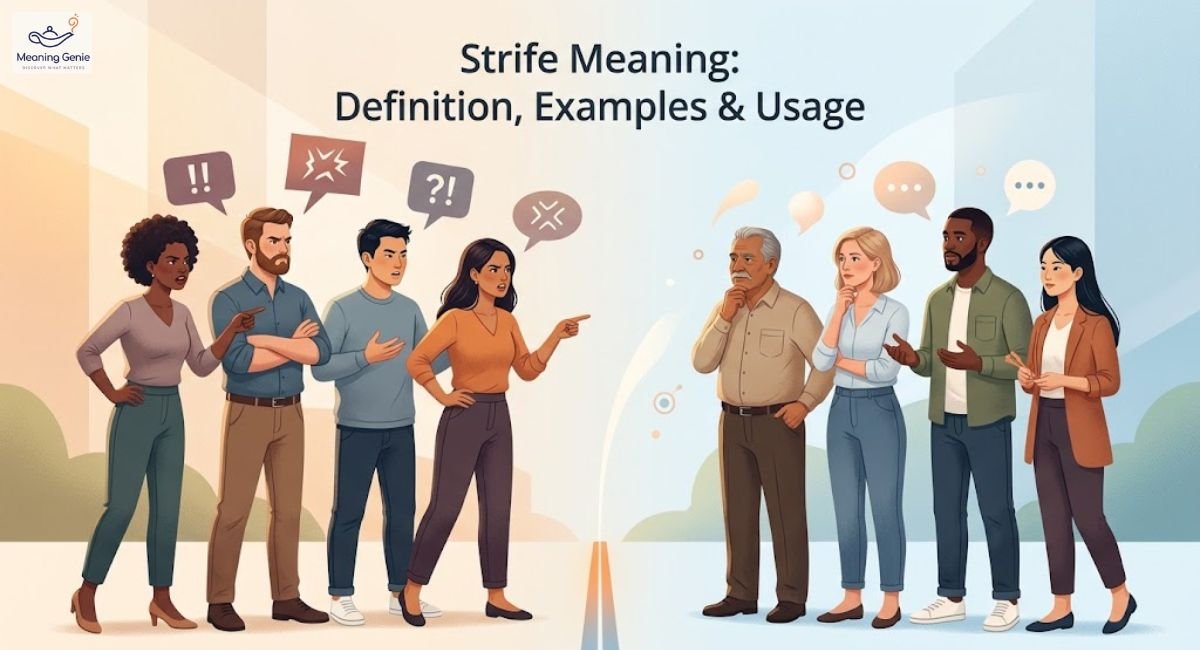
Strife means serious conflict, angry disagreement, or struggle. It often describes lasting problems between people, groups, organizations, or competing sides. Unlike modern texting terms, strife is a traditional English word with a long history.
You may encounter this word in books, news reports, workplace discussions, and everyday conversations. This guide explains the exact strife meaning, its pronunciation, grammar, origin, examples, and proper usage. By the end, you will know when this powerful word fits naturally.
Quick Answer: Strife means serious conflict, ongoing disagreement, or struggle. It usually describes deeper or longer-lasting problems rather than one small argument.
What Does Strife Mean?
The strife meaning centers on serious conflict, disagreement, or struggle. Merriam-Webster describes it as bitter and sometimes violent conflict or dissension, while Cambridge emphasizes angry or violent disagreement. The exact intensity depends on the context.
In simple terms, strife is bigger than a minor disagreement. It often suggests lasting hostility, deep tension, or a damaging dispute. Imagine a crack that keeps spreading through glass. That continuing problem often captures the feeling behind the word.
Simple Definition of Strife
The definition of strife is a state of serious conflict or bitter disagreement. It can involve individuals, families, communities, organizations, or nations. The word often suggests a problem that has developed beyond one brief argument.
Strife Meaning in Simple Words
The strife meaning in simple words is serious trouble caused by fighting or strongly disagreeing. Think of two sides pulling in opposite directions for a long time. That continuing clash and tension reflect the basic idea.
What Kind of Conflict Does Strife Describe?
Strife can describe a serious conflict, bitter disagreement, or ongoing conflict. It may involve a disagreement between people, a conflict between groups, or an internal conflict. The word usually carries more emotional weight than an ordinary difference of opinion.
How Do You Pronounce Strife?
The pronunciation of strife is /straɪf/. It rhymes with “life,” “wife,” and “knife.” Both Cambridge’s American and British pronunciation guides use the same basic pronunciation.
Say it slowly as “str-eye-f.” The spelling may initially look tricky, yet the sound is straightforward. Once you connect it with “life,” you can pronounce this English word confidently in an everyday conversation.
Strife Meaning With Examples
Learning through strife examples makes the meaning much clearer. The word can describe family problems, political divisions, workplace disputes, and larger social struggles. In every case, it usually suggests something more serious than one isolated disagreement.
For example, “The company faced months of internal strife” describes deep division. By contrast, “They argued about lunch” usually describes a small disagreement. The difference depends on intensity, duration, and the effect on those involved.

Simple Examples of Strife
Consider these sentences: “Years of civil strife damaged the country.” “The family hoped to end their family strife.” “The board struggled with organizational strife.” Each example describes serious division rather than a passing argument.
Strife in Everyday Life
You may encounter strife in families, workplaces, friendships, or communities. Workplace strife can grow when disagreements remain unresolved. Relationship strife may develop slowly through repeated problems. Small cracks can eventually become major fractures when nobody addresses them.
Strife in a Sentence
A useful strife in a sentence example is: “Political strife created uncertainty across the region.” Another is: “Years of family strife changed their relationship.” These examples show how to use strife naturally in clear and direct writing.
What Part of Speech Is Strife?
In modern English, strife is primarily a noun. It names a condition involving conflict, discord, or contention. Cambridge lists it as a noun and commonly marks the word as formal.
You can use it as the subject or object of a sentence. Common phrases include “years of strife” and “internal strife.” Understanding this grammar point helps you use the word accurately without sounding stiff or unnatural.
Is Strife a Noun?
Yes. Strife is a noun because it names a state of serious disagreement or hostility. You might say, “The region experienced strife,” or “Internal strife weakened the organization.” Both examples identify the problem itself.
Can Strife Be Used as a Verb?
In modern everyday English, you should treat strife as a noun. Historical or rare verb-related forms exist, but they are not normal modern usage. If you mean “make a strong effort,” use “strive” instead.
Common Sentence Patterns With Strife
Common patterns include “strife between groups,” “strife within an organization,” and “years of strife.” You may also see “cause strife” or “end strife.” These expressions help the word fit naturally into formal language and professional writing.
Common Types and Phrases of Strife
Different types of strife tell you where the problem occurs. The core meaning remains serious conflict, while the word before strife adds context. This makes the term useful in history, business, literature, and public discussion.
Cambridge records common combinations such as civil, domestic, and internal strife. These established phrases show how naturally the word connects with different kinds of serious division.
Family Strife
Family strife means serious or continuing disagreement within a family. It may involve money, relationships, inheritance, or old resentment. The phrase suggests deeper problems than siblings arguing briefly over a television remote.
Internal Strife
Internal strife means conflict inside a person, group, organization, or country. In a company, competing leaders may create ongoing tension. In personal writing, the phrase can also describe a difficult internal struggle.
Political Strife
Political strife describes serious political conflict between leaders, parties, or groups. It may involve power struggles and deep public divisions. The phrase frequently appears in historical analysis and news articles.
Civil Strife
Civil strife refers to serious unrest or conflict within a country or society. It often suggests widespread instability, division, or violence. The term carries considerable weight and may describe prolonged turmoil and unrest.
Social Strife
Social strife involves serious tension between groups within society. Economic pressures, cultural differences, or competing interests may contribute to this form of social conflict. Its effects can extend far beyond the people directly involved.
Religious Strife
Religious strife describes conflict connected to religious differences or disputes. Because such subjects can be sensitive, careful context matters. The word itself remains neutral even when the events being described are painful.
Is Strife an Acronym, Abbreviation, or Slang?
If you are asking is strife an acronym, the answer is no. Strife is not formed from initials, and it does not shorten a longer phrase. It is a complete dictionary word with a history reaching back centuries.
Likewise, is strife slang? Generally, no. People may use it online, but that does not turn it into internet slang. It remains a standard English word whose meaning is understood through ordinary context.
| Category | Does Strife Fit? | Explanation |
| Acronym | No | It is not formed from initials |
| Abbreviation | No | It is a complete word |
| Modern slang | Generally no | It has no special required internet meaning |
| Noun | Yes | It describes conflict or struggle |
| Formal vocabulary | Often | It commonly appears in serious contexts |
Strife Meaning in Modern Communication and Social Media
The meaning of strife remains relevant in modern communication. People use it in journalism, books, workplace discussions, and online commentary. You may see it when someone discusses politics, relationships, organizational problems, or historical events.
Social platforms do not appear to give strife a separate universal meaning. On TikTok, Instagram, Snapchat, and other platforms, context still matters most. The surrounding sentence tells you whether the speaker means personal tension, public conflict, or playful exaggeration.
How People Use Strife Today
People often choose strife when “argument” feels too small. A writer may describe personal conflict, while a manager may discuss organizational strife. The word communicates seriousness without requiring complicated or technical vocabulary.
Strife on TikTok, Instagram, Snapchat, and Other Platforms
On social media, strife may appear in storytelling, captions, commentary, or discussions about current events. Its basic meaning usually remains conflict or serious tension. The platform matters less than the context surrounding the word.
Does Strife Have a Special Internet Meaning?
No widely recognized internet definition replaces the traditional meaning. Unlike many abbreviations, strife does not require decoding. When you see it online, read the full sentence and consider whether the speaker means conflict, division, or struggle.
Tone and Context of Strife
Tone gives strife much of its strength. The word often sounds serious, thoughtful, or literary because people commonly use it for meaningful problems. You are more likely to see it in a documentary than during casual chatter about weekend plans.
However, people can use it playfully. Someone might jokingly call a disagreement about pizza toppings “household strife.” The humor comes from exaggeration. Context acts like a steering wheel and guides the emotional direction of the word.
Is Strife a Formal Word?
If you wonder is strife a formal word, the answer is generally yes. Cambridge labels it formal, which explains why it appears often in serious writing and public discussion.
Is Strife a Serious Word?
Usually, yes. Strife often suggests a serious dispute, hostility, or ongoing tension. That does not mean every use involves violence. It simply signals that the problem has more weight than a casual disagreement.
Can Strife Be Used Casually?
Yes, although it may sound dramatic in relaxed speech. Friends can use it humorously when exaggerating a harmless dispute. In ordinary situations, simpler words such as “argument” may sound more natural.
When Should You Use the Word Strife?
Use strife for lasting conflict, deep division, or repeated contention. It fits historical events, family problems, workplace divisions, and public disputes. Choose a simpler word when the disagreement was brief and relatively unimportant.
How to Use Strife Correctly
Using strife correctly is mostly about judging intensity. Choose it when a situation involves serious division, repeated disputes, or long-term problems. The word works especially well when the conflict affects several people or continues over time.
For minor disagreements, words such as “argument” or “difference of opinion” may be more accurate. Choosing the right word is like choosing the right tool. A hammer can open a walnut, but it is hardly the best choice.
Use Strife for Serious or Ongoing Conflict
Use strife when the situation involves repeated conflict, lasting tension, or a damaging bitter disagreement. “Years of political strife” sounds natural because the phrase suggests a significant and continuing problem.
Use Simpler Words for Minor Disagreements
Avoid using strife for every small argument. If two coworkers disagree once about a meeting time, “disagreement” works better. Reserve strife for problems with greater depth, duration, or emotional impact.
Choose the Right Context
Strife works well in professional communication, academic writing, history, and serious discussion. It can also appear in casual speech, especially as humor. Still, your audience and the seriousness of the situation should guide your choice.
Strife in Literature and Writing
Writers often choose strife because the word carries emotional weight. It can suggest war, family division, rivalry, or painful struggle without requiring several extra sentences. One strong word can immediately darken the mood.
In literature, strife also helps create movement. Stories thrive on obstacles and competing desires. Whether the battle occurs between nations or inside one person’s mind, conflict often keeps the narrative moving.
Why Writers Use the Word Strife
Writers use strife because it suggests turmoil, discord, and deep division. Compared with “argument,” the word often creates a broader picture. It can feel as though several unresolved problems have gathered beneath one storm cloud.
Strife as a Theme in Stories
Strife can drive stories about families, politics, war, or an emotional struggle. A character may face personal conflict between duty and desire. Meanwhile, communities may experience a damaging conflict between groups.
Why Strife Sounds More Serious Than Argument
An argument may last ten minutes and end quickly. Strife often suggests something broader or longer. It can involve repeated clash, entrenched disagreement, or competing interests that resist an easy solution.
Strife vs. Similar Words
Understanding strife vs conflict, strife vs tension, and strife vs disagreement helps you select the most accurate term. These words overlap, yet they are not identical. Each one shines a light on a different part of a difficult situation.
Merriam-Webster notes that strife can emphasize struggle for superiority, while conflict often stresses opposing forces. Discord highlights a lack of harmony, and contention often involves quarreling or controversy.

Strife vs. Conflict
Strife vs conflict involves emphasis and intensity. Conflict is a broad word for opposition. Strife often suggests a more prolonged or bitter struggle, especially when people or groups remain deeply divided.
Strife vs. Disagreement
Strife vs disagreement is often a question of scale. A disagreement may simply involve different opinions. Strife usually suggests deeper division, repeated arguments, or damaging hostility that affects relationships or larger groups.
Strife vs. Struggle
A struggle can involve difficulty without another person opposing you. Strife usually centers more clearly on conflict, competition, or contention. Climbing a mountain is a struggle, while fighting over leadership may become strife.
Strife vs. Discord
Discord emphasizes a lack of harmony. Strife often suggests active conflict or competition. Both involve division, but discord can describe disharmony before the situation becomes open confrontation or prolonged trouble.
| Word | Main Meaning | Typical Use |
| Strife | Serious, often prolonged conflict | Families, politics, groups |
| Conflict | Opposition between forces or ideas | Broad situations |
| Disagreement | Different opinions | Everyday situations |
| Tension | Strain or uneasiness | Relationships and groups |
| Discord | Lack of harmony | Groups and relationships |
| Struggle | Difficult effort or fight | Personal or external challenges |
Strife vs. Strive: What Is the Difference?
The comparison strife vs strive matters because the words look similar but have different meanings. Strife is primarily a noun connected with conflict. Strive is a verb that means making a strong or persistent effort.

For example, “The organization faced internal strife” describes division. “The organization strives to improve” describes determined effort. One word points toward conflict, while the other points toward effort and ambition.
| Word | Part of Speech | Meaning | Example |
| Strife | Noun | Serious conflict or disagreement | The group faced internal strife. |
| Strive | Verb | To try hard | They strive to improve. |
Synonyms and Antonyms of Strife
A useful strife synonym can add variety, although no synonym fits every sentence perfectly. Words such as discord, friction, and contention overlap with strife but carry slightly different shades of meaning.
A strife antonym points in the opposite direction. Words such as peace, harmony, and unity suggest cooperation and stability. Context should always decide which word fits best.
Common Synonyms of Strife
Common synonyms include conflict, discord, friction, turmoil, clash, rivalry, contention, hostility, and dispute. Each has a different nuance, so choose the one that best matches the situation.
Common Antonyms of Strife
Common opposites include peace, harmony, unity, agreement, and cooperation. These words suggest people working together rather than fighting. Many stories move from strife toward peace as part of their resolution.
Where Does the Word Strife Come From?
The origin of the word strife reaches back to the Middle Ages. Merriam-Webster traces the modern word through Middle English strif and Anglo-French forms such as estrif and estri, with deeper Germanic connections.
This long word origin helps explain why strife can sound older and more literary than casual modern expressions. The idea behind it, however, remains familiar. Human conflict has been around far longer than the internet.
Origin and Etymology of Strife
Strife entered Middle English through Anglo-French forms connected with fighting and quarrelling. Its history also links to Germanic words associated with fighting or arguing. Merriam-Webster records its first known use in the 13th century.
How Has the Meaning of Strife Changed?
The central meaning has remained fairly stable. Earlier usage connected strife with fighting and contention, while modern speakers still use it for serious conflict. Today, the settings may include workplaces, organizations, and modern public debates.
Is Strife a Negative Word?
If you ask is strife a negative word, the answer is generally yes in tone. Strife usually describes trouble, division, or difficult circumstances. You would rarely use it to describe a calm and happy situation.
However, the word itself is not bad or offensive. A story may describe years of strife before people finally achieve peace. Like a storm before clear skies, the word can describe hardship within an ultimately hopeful story.
Does Strife Always Have a Negative Meaning?
Most modern uses carry a negative feeling because they involve conflict, hostility, or turmoil. Still, the overall message can remain hopeful. People can overcome strife and rebuild unity.
Is Strife Stronger Than an Argument?
Often, yes. An argument can be brief and isolated. Strife usually suggests a broader ongoing conflict or repeated bitter disagreement. An argument may be one spark, while strife can describe the entire fire.
Can Strife Describe an Internal Struggle?
Yes. Internal strife can describe an internal struggle involving competing feelings, values, or goals. Someone may experience an emotional struggle between what they want and what they believe is right.
Is Strife Rude, Offensive, or a Bad Word?
Strife is neither automatically rude or offensive nor a taboo expression. It is an ordinary English word used to describe difficult situations. You can encounter it in books, schools, workplaces, and serious public discussions.
Still, the topic surrounding the word may be sensitive. Discussions involving war, religion, or family problems require tact. The vocabulary itself is harmless, but thoughtful communication should always consider the people involved.
Is Strife Rude?
No. Strife is not inherently rude. It describes a situation rather than insulting someone. However, describing a person’s behavior as “constant strife” may sound critical depending on your tone.
Is Strife Offensive?
No. The word itself is not offensive. It may describe sensitive events, but that does not make the term offensive. Context determines whether the overall conversation feels respectful.
Is Strife a Profanity?
No. Strife is not a profanity or swear word. It is a standard vocabulary term that can appear in serious writing and ordinary conversation without breaking rules of polite language.
Can You Use Strife at School?
Yes. Strife is generally appropriate for school. Students may encounter it in history, essays, and literature. Its serious tone makes it useful when writing about significant historical or social issues.
Can You Use Strife at Work?
Yes. Strife is generally appropriate for work when it accurately describes a serious problem. In professional communication, however, a more specific phrase may sometimes communicate the issue more clearly.
Common Mistakes When Using Strife
Most mistakes happen because writers confuse similar words or exaggerate minor problems. Strife has a particular tone, so using it carefully improves clarity. Once you understand the word’s weight, avoiding these errors becomes much easier.
Remember the main idea: strife usually involves meaningful conflict, lasting tension, or repeated disagreement. When the situation is tiny or temporary, another word may be a better fit.
Confusing Strife With Strive
This is the most common mistake. Strife means conflict, while strive means to make a strong effort. “She strives for success” is correct. “She strifes for success” is not standard modern usage.
Using Strife for a Minor Disagreement
Calling every small debate “strife” can sound overly dramatic. Save the word for deeper dispute, lasting friction, or serious division. A disagreement about movie choices rarely requires a peace treaty.
Using Strife as a Verb
In modern standard writing, treat strife as a noun. Use “strive” when you mean making an effort. This simple distinction keeps your grammar accurate and prevents unnecessary confusion.
Assuming Strife Is Modern Internet Slang
Strife did not begin as a trendy online expression. Its roots stretch back through earlier stages of the English language. Social media may spread the word, but it did not create its basic meaning.
How to Respond When Someone Uses the Word Strife
Your response should match the situation. If someone mentions serious family or workplace problems, a thoughtful answer works best. If they use the word jokingly, you can respond with the same playful energy.
The simplest rule is to understand the context first. Do not treat serious conflict like a joke. At the same time, you do not need to sound overly formal when a friend playfully describes everyday drama.
Neutral Response
You could say, “That sounds like a difficult situation.” Another natural response is, “I understand why that created tension.” These replies acknowledge the problem without making assumptions.
Supportive Response
For personal problems, try saying, “I hope things become more peaceful soon.” You could also say, “That sounds exhausting, and I hope you find a way through it.”
Serious Response
For major problems, you might say, “That sounds like a serious situation.” You could also ask, “How has the conflict affected everyone involved?” This shows genuine interest while allowing the person to explain.
Quick Summary: What Does Strife Mean?
The strife meaning is serious conflict, ongoing disagreement, or struggle. It is mainly a noun, not an acronym or modern texting abbreviation. The word often sounds formal or serious, particularly when describing lasting divisions.
You can use it for family problems, political disputes, organizational divisions, and internal struggles. The key is intensity. Strife usually suggests a deeper problem than one ordinary argument.
| Question | Quick Answer |
| What does strife mean? | Serious conflict or disagreement |
| Is it a noun? | Yes |
| Is strife slang? | Generally no |
| Is it an acronym? | No |
| Is strife negative? | Usually in tone |
| Can it describe internal problems? | Yes |
| Is it suitable for formal writing? | Yes, often |
Frequently Asked Questions
What is an example of strife?
An example of strife is ongoing conflict between family members over money, inheritance, or personal disagreements.
What does strife in the Bible mean?
In the Bible, strife generally refers to quarrels, conflict, contention, or bitter disagreement between people.
What is another word for strife?
Common alternatives include conflict, discord, hostility, tension, contention, and disagreement.
Does strife mean struggle?
Yes, strife can mean struggle, especially when it involves serious or ongoing conflict. However, struggle can also describe difficulty without conflict.
What is the root cause of strife?
Strife can arise from unresolved disagreements, competing interests, resentment, pride, misunderstandings, or disputes over power and resources.
What is the opposite of strife?
The opposite of strife is generally peace, harmony, unity, agreement, or cooperation.
Final Thoughts
Understanding strife meaning gives you a useful way to describe serious human problems. Whether you encounter family divisions, political disputes, workplace troubles, or an internal struggle, the word captures a sense of deeper and often continuing conflict.
Now you know the meaning of strife, its grammar, pronunciation, history, tone, and practical usage. Use it when the situation involves meaningful division rather than a tiny disagreement. With the right context, this centuries-old word remains clear and useful today.

Words can be confusing—but understanding them shouldn’t be. I’m Muhammad Umair, an AI-powered SEO & content writer at Meaning Genie, helping readers decode slang, abbreviations, and internet language with simple, clear explanations.