
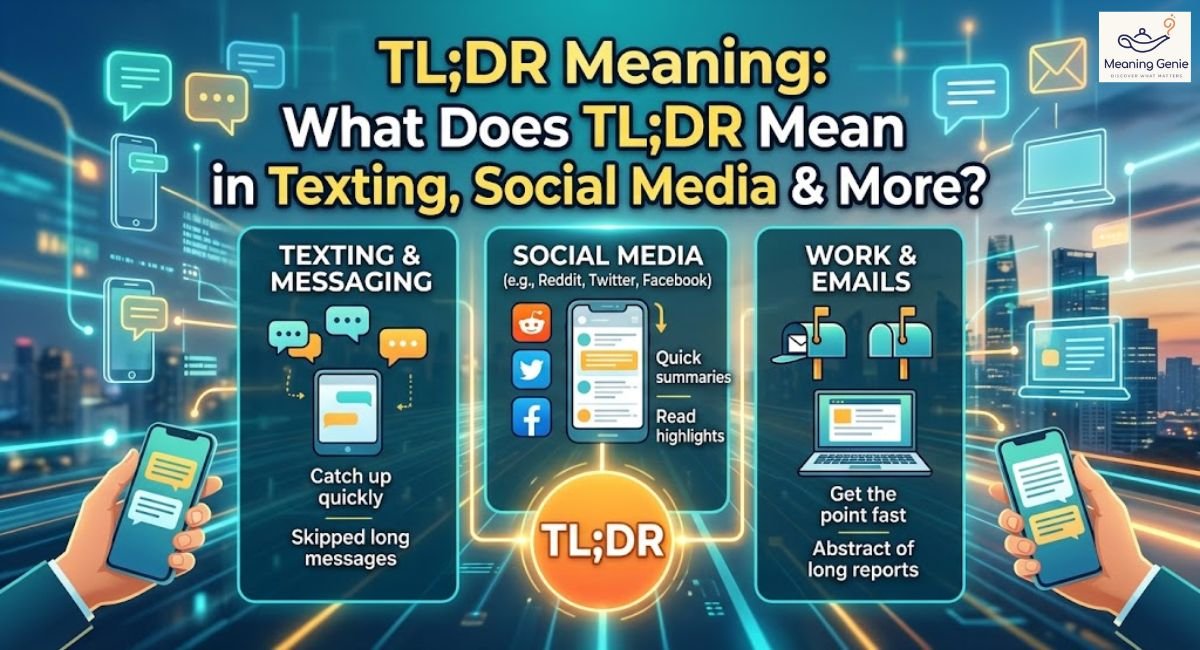
You’ve probably seen TL;DR beneath a long Reddit post, lengthy text, or social media caption and wondered what it actually means. TL;DR Meaning is simple: it stands for “Too Long; Didn’t Read.” Today, this internet abbreviation often introduces a quick summary or brief summary of lengthy content.
Instead of reading every paragraph, you can scan the key takeaway and quickly understand the main idea. However, TL;DR can also work as a humorous or sarcastic response to a long message. Its meaning depends heavily on context, tone, and the way someone uses it during online communication.
What Does TL;DR Mean?
At its core, what does TL;DR mean? It means “Too Long; Didn’t Read.” The phrase began as a blunt reaction to lengthy online writing. However, modern users often use it more helpfully. It can introduce the main idea without asking readers to wade through every detail.
Cambridge Dictionary recognizes TLDR as both an abbreviation and a noun for a short summary of written material or discussion. That dual use explains why you may see it introducing a summary or appearing alone as a comment.
TL;DR Meaning at a Glance
| Question | Answer |
| TL;DR full form | Too Long; Didn’t Read |
| TL;DR meaning in text | A short summary or reaction to lengthy content |
| TL;DR meaning in chat | “Give me the short version” or “I didn’t read it” |
| TL;DR meaning on social media | A concise takeaway from a long post, caption, or thread |
| TL;DR acronym | Technically an initialism |
| Tone | Helpful, neutral, funny, sarcastic, or dismissive depending on context |
TL;DR Stands for “Too Long; Didn’t Read”
The TL;DR full form is Too Long; Didn’t Read. Each letter represents a word from the phrase, making it an initialism rather than a spoken acronym like NASA. In everyday internet slang, however, people often casually call it an acronym.
Think of TL;DR as a signpost. It tells you, “Here is the important part.” When writers add a TL;DR section, they usually want busy readers to grasp the central message quickly.
What Does TL;DR Mean in Texting?
The TL;DR meaning in text usually depends on whether someone provides or requests a summary. If your friend sends five paragraphs, you might write “TL;DR?” to ask for the short version. You are not necessarily being rude, although the wording can sound abrupt.
In another situation, you might write TL;DR in texting before your own summary. For example, “TL;DR: The appointment moved to Friday.” Here, the abbreviation acts as a useful label rather than a criticism.
TL;DR as a Summary vs. a Response
TL;DR as a summary means a concise explanation follows. A writer might explain an entire project before writing, “TL;DR: We approved the new schedule.” This usage has become common because readers can understand the key takeaway immediately.
By contrast, TL;DR as a response can mean, “That was too long, and I did not read it.” Someone might answer a massive text with simply “TL;DR.” Between close friends, that may be funny. With strangers, it can feel dismissive.
How Is TL;DR Used in Conversation?
In everyday online communication, TL;DR works like a shortcut through a crowded highway. It helps you reach the central point without traveling through every sentence. Writers can use it to summarize information, while readers can use it to request a condensed explanation.
The placement also matters. A writer may place TL;DR before the details for immediate clarity. Alternatively, they may put it afterward as a recap. Both approaches work, although each serves a slightly different reading habit.
TL;DR at the Beginning of a Message
TL;DR at the beginning gives readers the answer before the explanation. This format works especially well for workplace updates, technical notes, and lengthy announcements. Someone who only needs the decision can stop reading after the first sentence.
For example, “TL;DR: The launch moves to Monday.” The following paragraphs can then explain why. This structure respects readers who need the essential information without eliminating useful details for people who want context.
TL;DR at the End of a Message
TL;DR at the end follows the traditional summary style. The writer first gives the complete story, then provides a condensed conclusion. Readers who finish the content receive a convenient recap. Those who only want the takeaway can scroll down.
This placement also avoids revealing the conclusion too early. Imagine reading a mystery review. A summary at the top could spoil the discussion. A recap at the bottom keeps the explanation intact.
TL;DR as a Standalone Response
A standalone TL;DR reply usually signals that someone did not read a lengthy message. It can also function as a playful nudge for brevity. Context becomes crucial here because the same two words can feel affectionate between friends and cold between strangers.
Consider two situations. Your best friend sends a giant story and receives “TL;DR 😂.” That may cause laughter. A coworker sends a serious personal explanation and receives the same reply. Suddenly, the phrase feels considerably harsher.
Why Do People Use TL;DR?
The popularity of TL;DR reflects a simple reality: people encounter enormous amounts of information every day. A lengthy text can contain useful ideas while still demanding too much time. A good summary gives readers a faster route to those ideas.
That does not mean people hate long-form writing. Instead, many readers want control over their reading pace. A quick summary lets them decide whether the complete explanation deserves their attention.
To Save Time
People use TL;DR to save time when a message contains extensive details. A manager might write a long project update followed by the most important decision. A student might summarize lecture notes before an exam.
The idea resembles a movie trailer. The trailer does not replace the movie. It gives you enough information to decide whether watching the whole thing makes sense.
To Highlight the Main Point
A well-written TL;DR highlights the main idea without drowning it in background information. This matters when a message contains statistics, explanations, examples, and side details. Readers can identify the conclusion before exploring the supporting material.
For example, a product review might contain ten paragraphs about performance. Its TL;DR could say, “Great battery life, average camera, excellent value.” That sentence captures the decision-making information.
To Make Long Content Easier to Read
A TL;DR can improve readability by creating a clear entry point into long-form content. Readers often scan headings, opening sentences, and summaries before committing to an entire article.
This technique also helps with information overload. When dozens of tabs, messages, and notifications compete for attention, a concise summary creates breathing room. It does not erase complexity. It simply organizes it.
Is TL;DR an Acronym, Abbreviation, or Slang?

Technically, TL;DR is an abbreviation and more specifically an initialism. Each letter represents the beginning of one word. Because people usually say the individual letters rather than pronouncing TLDR as one word, “initialism” provides the more precise linguistic label.
Still, everyday language rarely follows laboratory rules. People commonly call TL;DR an internet slang term or an acronym. Both descriptions communicate its cultural role, even though “initialism” is technically more exact.
TL;DR as an Internet Acronym
The phrase functions as an internet abbreviation used in digital spaces where people communicate quickly. Forums, social media, chat rooms, and online communities helped normalize these shortened expressions.
In practical terms, you do not need a linguistics degree to use it correctly. If someone writes “TL;DR: Prices increase next month,” the intended meaning is immediately clear.
Why Is It Sometimes Written as TLDR?
You may encounter TL;DR, TLDR, tl;dr, or tldr. These forms carry the same meaning. The punctuation simply changes the appearance. Many users remove punctuation because typing “tldr” feels quicker on phones and keyboards.
The shorter form also fits naturally into usernames, tags, code comments, and informal posts. Therefore, seeing TLDR instead of TL;DR should not confuse you. They are essentially the same online abbreviation.
What Is the Difference Between TL;DR and TLDR?
There is no meaningful difference in definition between TL;DR and TLDR. Both mean “Too Long; Didn’t Read.” The semicolon reflects the traditional written form, while the punctuation-free version suits fast digital communication.
| Form | Meaning | Common setting |
| TL;DR | Too Long; Didn’t Read | Standard online writing |
| TLDR | Too Long; Didn’t Read | Casual digital communication |
| tl;dr | Too Long; Didn’t Read | Informal posts and chats |
| tldr | Too Long; Didn’t Read | Fast typing and casual messages |
The phrase has become flexible enough to survive different writing styles. So, if someone asks about TLDR vs TL;DR, the simple answer is that the meaning remains unchanged. The difference lies mainly in punctuation and presentation.
What Does TL;DR Mean on Social Media?
The TL;DR meaning on social media is usually connected with summaries. People use the term when captions, threads, comments, or explanations become longer than expected. It gives followers a fast route toward the central point.
Its meaning can shift slightly between platforms because every community develops its own communication habits. Reddit may use TL;DR extensively for detailed stories. Snapchat users may encounter it less often because conversations tend to be shorter.
| Platform | Common Use | Typical Example |
| Summarizing long posts | “TL;DR: The update fixed the main issue.” | |
| TikTok | Condensing lengthy explanations | “TL;DR: Don’t buy it yet.” |
| Summarizing long captions | “TL;DR: The trip was worth it.” | |
| Snapchat | Asking for a shorter explanation | “TL;DR?” |
| Summarizing group updates | “TL;DR: Meet at 7 PM.” | |
| X | Summarizing threads | “TL;DR: Prices are going up.” |
| Discord | Condensing announcements | “TL;DR: The event starts Friday.” |
TL;DR on TikTok
TL;DR on TikTok usually appears in captions or comments attached to lengthy explanations. A creator might tell an entire story and then add, “TL;DR: I left the job and started freelancing.”
Commenters can also write “TL;DR?” when they want the creator to summarize a complicated situation. It is especially useful when a caption contains more context than someone wants to read.
TL;DR on Instagram
TL;DR on Instagram commonly appears beneath long captions. Instagram captions can become surprisingly detailed when users share travel stories, personal experiences, reviews, or announcements.
For example, a creator might write several paragraphs about a difficult career decision and finish with, “TL;DR: I accepted the new job.” The summary gives hurried readers the destination without forcing them through the entire journey.
TL;DR on Snapchat
TL;DR on Snapchat is less common than on Reddit or long-form platforms. Snapchat often centers on brief messages, images, videos, and disappearing content. Still, users can encounter TL;DR when a conversation suddenly becomes lengthy.
If someone sends several long chat messages, another person might ask, “TL;DR?” That usually means, “Can you give me the short version?” The phrase works even when the platform itself favors brevity.
TL;DR on WhatsApp
TL;DR on WhatsApp can appear in group chats, family conversations, school groups, and workplace messages. Someone might provide detailed travel instructions and then add a short summary.
For instance, “TL;DR: Meet outside the station at 8:30.” That single sentence can help people who cannot read the entire discussion immediately. It also prevents important logistics from getting buried.
TL;DR on X (Twitter)
TL;DR on X often appears when someone creates a lengthy thread or detailed explanation. Although individual posts have limits, users can connect multiple posts into a much larger discussion.
A writer may end the thread with a concise takeaway. Readers can then understand the argument without studying every post. You may also see someone request a summary when a thread becomes particularly dense.
TL;DR on Twitter
TL;DR on Twitter carries the same meaning as on X because Twitter was the platform’s former name. Older articles, screenshots, and conversations still use “Twitter,” while newer discussions commonly say “X.”
The important point remains unchanged. Whether someone writes TL;DR on X or refers to its older name, they usually mean a brief version of a longer discussion.
TL;DR on Reddit and Discord
TL;DR on Reddit has a particularly strong association with long posts, personal stories, reviews, and detailed discussions. Posters often place a short summary after a substantial explanation so readers can grasp the outcome quickly.
TL;DR on Discord serves a similar purpose in gaming communities, servers, announcements, and technical discussions. When a message becomes a wall of text, a summary acts like a small signpost in a crowded hallway.
Why Is TL;DR Commonly Used at the End of a Post?
TL;DR at the end makes sense when the writer wants readers to experience the complete explanation first. The final summary then acts like a recap. It can reinforce the conclusion and help readers remember the most important point.
There is another practical reason. Readers who do not want to read everything may scroll toward the bottom looking for an answer. A summary waiting there can provide the information they need without disrupting the full narrative.
What Does TL;DR Mean in Different Contexts?

The meaning of TL;DR stays stable, but its social flavor changes with context. A casual communication between friends gives the phrase more room for humor. A workplace message demands more awareness because brevity can easily sound abrupt.
Understanding the surrounding relationship matters just as much as understanding the abbreviation. The phrase itself is neutral. Your delivery determines whether it feels helpful, playful, impatient, or dismissive.
Casual Conversations
In casual conversations, TL;DR often works as friendly shorthand. You might ask a friend for the short version after receiving a huge story. The phrase can feel natural when both people understand each other’s humor.
For example, “TL;DR?” can replace “Okay, give me the quick version.” In informal communication, that kind of compression feels normal and efficient.
Online Discussions
Online discussions frequently involve detailed arguments, reviews, guides, and personal stories. A TL;DR gives readers a quick entry point without demanding complete attention.
This convention developed naturally within online forums and discussion boards, where long posts could become difficult to navigate. The summary became a practical tool for communities dealing with increasingly detailed conversations.
Articles and Blog Posts
In a long article, TL;DR can function like a miniature abstract. It gives readers a brief summary before or after the main content.
For example, a technology review might explain performance, design, software, and battery life across several paragraphs. The TL;DR could simply state, “Excellent performance, weak speakers, strong overall value.” That gives readers immediate direction.
Work and Professional Communication
At work, TL;DR can help people process project updates, technical documentation, and internal announcements. A manager might write a detailed explanation before presenting the decision in one sentence.
However, professional communication requires judgment. A TL;DR professional setting can be perfectly acceptable inside a relaxed team. Client-facing correspondence may benefit from more polished language.
TL;DR Tone and Emotional Meaning
The TL;DR tone changes according to context, relationship, punctuation, and wording. A summary label usually feels neutral. A one-word reply can feel sarcastic. An emoji can make the same phrase playful.
That flexibility explains why users sometimes disagree about whether TL;DR sounds rude. The letters themselves do not carry a fixed emotional charge. The surrounding situation supplies the emotional coloring.
| Tone | What It Usually Communicates |
| Neutral | Here is the main point. |
| Helpful | Here is a quick summary for busy readers. |
| Funny | That message was ridiculously long. |
| Playful | I’m joking about your long explanation. |
| Sarcastic | I wasn’t interested enough to read everything. |
| Dismissive | Your message was too long for me to bother with. |
| Professional | Here are the essential details first. |
Neutral Tone
A neutral TL;DR simply introduces information. For example, “TL;DR: The meeting starts at noon.” Nothing about that sentence suggests irritation or humor.
This style works well when clarity matters more than personality. It is especially useful in documentation, announcements, and straightforward updates.
Funny or Playful Tone
TL;DR humorous usage often appears between friends. Someone might send a dramatic seven-paragraph story before jokingly asking for the short version.
A playful exchange could look like this: “TL;DR: I made a terrible decision.” The humor comes from exaggeration and shared context rather than the abbreviation itself.
Sarcastic Tone
TL;DR sarcastic usage can gently mock someone who overexplains. Imagine a friend spending ten minutes explaining why they arrived two minutes late. “TL;DR: Traffic?” could tease them without serious hostility.
However, sarcasm becomes risky when the relationship is uncertain. What feels hilarious to one person can feel contemptuous to another.
Impatient or Dismissive Tone
A standalone TL;DR can sound impatient when someone shares something personal or important. The reader may interpret it as, “I could not be bothered to read what you wrote.”
This is where TL;DR context becomes crucial. A joke among friends can land perfectly. The same response to a heartfelt message can feel like slamming a door.
Serious Tone
Serious usage usually involves a clear summary rather than a reaction. Writers can use TL;DR to surface decisions, conclusions, or recommendations.
For example, “TL;DR: We should postpone the launch.” The phrase does not need humor. It simply directs attention toward the decision.
Is TL;DR Rude or Disrespectful?
People often ask, is TL;DR rude because the full phrase sounds blunt. The answer depends on how you use it. As a summary label, it is usually harmless. As a response to someone’s lengthy personal message, it may sound dismissive.
Similarly, is TL;DR disrespectful? Not inherently. Tone comes from context, relationship, timing, and delivery. A friendly emoji can soften it. A bare “TL;DR” after an emotional confession can do the opposite.
When TL;DR Can Sound Rude
TL;DR can sound rude when you use it to dismiss someone’s effort. Imagine a friend carefully explaining a difficult experience. Responding with “TL;DR” suggests their story did not deserve your attention.
The problem is not the abbreviation itself. The problem is the implied message. You are signaling that the length of their communication mattered more than its content.
When TL;DR Is Completely Harmless
Using TL;DR as a summary label is usually harmless. Bloggers, developers, students, and professionals can use it to present a concise conclusion.
For instance, “TL;DR: The update fixes the login issue.” Nobody is being mocked. The writer simply offers a convenient shortcut for readers who need the essential information quickly.
How Context Changes Its Tone
A single phrase can change emotional direction based on the setting. “TL;DR?” from your best friend may sound playful. The same message from a stranger may sound impatient.
Think of context as the lighting around a stage. The words stay identical, yet the atmosphere changes. Relationship, topic, timing, and punctuation all influence how your reader interprets the phrase.
How to Use TL;DR Correctly

Learning how to use TL;DR is easier than it looks. Use it when a longer explanation benefits from a clear, compact takeaway. Then make the summary genuinely useful rather than repeating vague information.
If you want to know how to use TL;DR correctly, focus on clarity. A strong summary should answer the central question quickly. It should not become another miniature essay.
Using TL;DR Before a Summary
Use TL;DR before a summary when you want readers to see the main conclusion immediately. This format works especially well for announcements and detailed explanations.
For example: “TL;DR: The event has moved to Saturday.” The sentence gives the answer first. The paragraphs afterward can explain scheduling conflicts, venue changes, or other details.
Using TL;DR After a Long Explanation
A writer can place TL;DR after a detailed explanation to provide a final recap. This approach works particularly well for stories, reviews, tutorials, and personal posts.
A good TL;DR version should compress the argument rather than merely repeat its opening sentence. It should tell readers what actually matters after all the details have been considered.
Using TL;DR in a Conversation
You can use TL;DR in a conversation when someone needs a shorter explanation. Asking “TL;DR?” is essentially asking someone to summarize lengthy content.
Still, politeness matters. If the subject is sensitive, “Could you give me the short version?” sounds warmer. Digital shorthand works best when the relationship supports it.
Can TL;DR Replace a Full Sentence?
Yes, but its role changes. A standalone TL;DR can act like a conversational reaction. In that position, it communicates the idea that the reader skipped the lengthy material.
When followed by a colon and summary, however, TL;DR functions more like a label. “TL;DR: We canceled the trip” contains a complete thought after the abbreviation. The phrase introduces the main takeaway rather than replacing it.
TL;DR Grammar, Punctuation, and Sentence Position
TL;DR behaves differently from ordinary words because it began as digital shorthand. You can treat it as a label, a noun, or an informal response depending on the sentence.
In modern usage, there is no single rigid punctuation rule. However, the conventional form remains TL;DR. Clear formatting matters more than obsessing over one tiny mark.
Is the Semicolon in TL;DR Necessary?
The semicolon in TL;DR is conventional rather than essential. TLDR without punctuation remains immediately recognizable to most internet users.
The semicolon separates “Too Long” from “Didn’t Read.” Many users retain it because it reflects the original phrase. Others remove it for speed, especially during casual texting.
Should You Capitalize TL;DR?
Uppercase TL;DR remains the clearest and most recognizable form. However, lowercase versions such as tl;dr and tldr also appear frequently online.
Capitalization usually signals style rather than meaning. Formal-looking documentation may prefer TL;DR. Casual chats may use lowercase. Neither version changes the underlying definition.
Where Should TL;DR Appear in a Sentence?
TL;DR commonly appears before a summary, after a detailed explanation, or as a standalone response. The clearest format is usually “TL;DR: [summary].”
For example, “TL;DR: The cheaper plan offers better value.” In the middle of a sentence, it can function as a noun, such as “The report includes a TL;DR.”
TL;DR Examples in Texting and Chat
Real examples make the TL;DR meaning in chat much easier to understand. The abbreviation can request a summary, provide one, or jokingly acknowledge that a message became enormous.
The examples below show how the same phrase changes according to purpose. Notice the difference between asking for information and dismissing information.
Casual Text Examples
A: “I just wrote you the longest story about my weekend.”
B: “TL;DR?”
A: “I missed my flight, found another one, and somehow made it home.”
Here, the TL;DR reaction simply requests the condensed version. It does not necessarily criticize the sender.
Social Media Examples
A creator might write, “I tested six budget laptops and compared their batteries, screens, keyboards, and performance. TL;DR: Model C gives the best value.”
This example shows TL;DR in comments and posts working as a navigation tool. Readers can understand the conclusion before deciding whether the full review deserves their attention.
Workplace Examples
A project manager might write, “We reviewed the vendor proposals and compared pricing, delivery dates, support, and security. TL;DR: Vendor B offers the strongest overall package.”
That is a practical example of TL;DR at work. The summary helps busy teammates understand the decision without ignoring the supporting evidence.
Funny TL;DR Examples
A friend might text, “I spent twenty minutes explaining why I bought another pair of sneakers. TL;DR: I have no self-control.”
That TL;DR humorous style works because the summary delivers a punchline. The abbreviation becomes part of the joke instead of simply labeling information.
How to Reply When Someone Says “TL;DR”
When someone asks for a summary, do not overthink the response. Give them the central point in one or two clear sentences. If they say only “TL;DR,” decide whether they are joking or genuinely asking for brevity.
Your answer should match the relationship. A playful friend can handle humor. A coworker may prefer direct information. A stranger usually deserves a polite, neutral response.
Funny Replies
If the conversation feels playful, you can answer with a humorous summary. For example, “TL;DR: Everything went wrong, but somehow I survived.”
Another option is, “The short version? I made questionable decisions.” Humor works best when both people already share a relaxed communication style.
Neutral Replies
Neutral responses keep things simple. You could say, “The main point is that the meeting moved to Friday.”
Another natural response is, “In short, the update fixed the main problem.” These phrases provide a quick overview without adding unnecessary personality.
Serious Replies
When someone genuinely needs information, skip the jokes. Give the core fact first and explain only what matters.
For example, “The deadline moved to Tuesday because the client requested another review.” That response gives both the decision and its most relevant reason.
When Someone Uses TL;DR as a Response
If someone replies with only “TL;DR,” do not automatically assume they are insulting you. They might be joking, asking for a summary, or admitting they skipped the message.
If the topic matters, simply ask, “Do you want the short version?” That small clarification can prevent an unnecessary misunderstanding.
TL;DR vs. Similar Internet Terms
Several digital expressions can look similar because they help people communicate efficiently. However, each one performs a different job. Understanding these differences helps you choose the right phrase instead of using every shorthand term interchangeably.
| Term | Meaning | Main purpose | Typical tone |
| TL;DR | Too Long; Didn’t Read | Summarize lengthy content | Casual |
| ELI5 | Explain Like I’m 5 | Simplify a complex idea | Friendly |
| ICYMI | In Case You Missed It | Highlight missed information | Informative |
| FYI | For Your Information | Share information | Neutral |
| Long Story Short | Brief version of a story | Condense a narrative | Conversational |
| Summary | Condensed explanation | Present key information | Neutral to formal |
When Should You Use TL;DR?

You should use TL;DR when a reader can benefit from a fast explanation of longer material. It works particularly well when the information has a clear conclusion.
Knowing when to use TL;DR also means knowing when not to use it. A summary should make reading easier. It should not make serious conversations feel rushed or trivial.
Appropriate Situations
TL;DR fits naturally in blog posts, online discussions, technical documentation, newsletters, group chats, and internal project updates. These environments often contain lengthy information that readers may want to scan.
It can also help with reviews and tutorials. A reader may want the conclusion before investing time in every detail.
When TL;DR Is Helpful
TL;DR becomes especially helpful when a message contains several layers of information. A reader can use the summary to understand the decision, result, or recommendation first.
This approach respects different reading habits. Some people want every detail. Others need the quick overview before deciding whether to continue.
Situations Where You Should Avoid It
Avoid TL;DR when the phrase could make someone feel ignored. Personal confessions, emotional messages, formal complaints, and sensitive discussions require more human attention.
You should also avoid casual shorthand when formal conventions matter. A polished document may benefit more from “Summary,” “Overview,” or “Key Takeaways.”
Is TL;DR Appropriate at Work or School?
The answer depends on the environment. TL;DR in professional writing has become increasingly familiar, especially inside technology companies and online teams. Yet familiarity does not mean it belongs everywhere.
For school, the same principle applies. TL;DR in academic writing may look too informal for an essay or research paper, even though classmates might use it freely in a study group.
Using TL;DR in Emails
TL;DR in emails can work well for internal messages with lengthy explanations. A manager might provide detailed background and then summarize the decision in one sentence.
For external clients, however, “Summary” or “Key Takeaway” usually sounds more polished. Audience matters more than the abbreviation itself.
Using TL;DR in Workplace Chats
TL;DR at work can be useful in Slack, Teams, project channels, and internal documentation. Fast-moving teams often appreciate clear summaries because employees cannot read every conversation from beginning to end.
Still, consider your workplace culture. Some teams embrace internet shorthand. Others prefer traditional business language. Follow the communication style your audience already understands.
Using TL;DR in Academic Writing
Formal academic papers usually favor terms such as “Abstract,” “Summary,” or “Conclusion.” TL;DR can appear in informal study groups, student chats, or shared notes.
The difference is register. Academic writing aims for formal precision. Group chats prioritize speed and familiarity. The same information can require different language in each setting.
When a More Formal Alternative Is Better
Choose a formal alternative when the audience expects polished professional language. “Executive Summary” works well for reports. “Overview” suits introductions. “Key Takeaways” works for presentations and business documents.
The goal remains identical: deliver the essential information efficiently. Only the label changes.
Where Did TL;DR Come From?
The history of TL;DR reaches back to early online communities. The phrase dates to at least 2002, with the earliest known use commonly linked to a Usenet post in the rec.games.video.nintendo newsgroup, according to historical references surrounding the term.
Its early flavor was more dismissive than today’s common summary label. As online writing became longer, users began putting their own summaries into posts. The expression gradually shifted from a complaint about excessive length toward a practical writing convention.
The Early Internet Meaning
Early online forums and discussion boards encouraged lengthy conversations. Users could write detailed posts about games, technology, hobbies, politics, or everyday experiences.
A reader responding with “TL;DR” could imply that the post demanded too much attention. Over time, writers began anticipating that reaction by adding their own short summaries.
How TL;DR Became Popular
The term spread beyond early forums as blogging, social media, and messaging expanded. Its compact form made it ideal for environments where people constantly encountered large amounts of text.
Today, dictionaries recognize TLDR as both an abbreviation and a noun meaning a short summary. That development reflects how deeply the term has entered ordinary digital vocabulary.
How Its Meaning Has Evolved
Originally, the phrase could sound like a blunt refusal to read. Modern writers often use it differently. They voluntarily provide a summary because they know readers may have limited time.
That shift is important. TL;DR moved from a reaction against long writing toward a tool that makes long writing easier to navigate.
Why Has TL;DR Remained Popular?
TL;DR survived because it solves a genuine communication problem. People still write detailed messages, yet readers often need answers quickly. The abbreviation bridges those two needs without forcing writers to remove useful context.
It also became part of internet culture. Once a shorthand becomes familiar across multiple communities, people no longer need to explain it. That familiarity keeps the expression useful.
The Rise of Short-Form Communication
Mobile phones changed how people consume information. Users scroll through messages, captions, articles, notifications, and conversations throughout the day.
A TL;DR fits this environment because it provides a fast destination. You can read the summary first and return to the details later.
TL;DR and Internet Culture
TL;DR reflects a central habit of internet culture: compressing complex ideas into recognizable shorthand. Like FYI, IMO, and ICYMI, it belongs to a broader vocabulary built for rapid digital exchange.
Its usefulness extends beyond jokes. Writers now use the phrase to organize information, guide readers, and improve navigation through dense material.
Why People Still Use It Today
People still use TL;DR because the underlying problem has not disappeared. If anything, digital information has multiplied. Readers need ways to separate important information from background detail.
That makes TL;DR more than old internet slang. It has become a practical communication device that helps readers control how deeply they engage with content.
TL;DR Alternatives You Can Use
Sometimes TL;DR does not match your audience. You may want something warmer, clearer, or more professional. Fortunately, English offers several TL;DR alternatives that perform almost the same job.
The best alternatives to TL;DR depend on your setting. “Long story short” feels conversational. “Executive Summary” sounds professional. “In Brief” feels compact and polished.
| Alternative | Best for | Tone | Example |
| In Short | General writing | Neutral | “In short, the plan works.” |
| Long Story Short | Conversations | Casual | “Long story short, we left early.” |
| The Bottom Line | Decisions | Direct | “The bottom line is cost.” |
| Quick Summary | Informal writing | Clear | “Quick summary: The event moved.” |
| In Brief | Formal writing | Polished | “In brief, sales improved.” |
FAQS
Does TLDR mean “too long, don’t read”?
No. TLDR usually means “Too Long; Didn’t Read.” It is used for a short summary or to say someone skipped a lengthy message.
Is it TL;DR or tldr?
Both are correct and have the same meaning. TL;DR is the traditional form, while TLDR is a simpler version commonly used online.
What’s the opposite of a TLDR?
There is no official opposite. A full version, detailed explanation, or long-form content can be considered the opposite of a TLDR.
Is it professional to say TLDR?
It can be acceptable in casual workplace chats, emails, and internal documentation. For formal reports or client communication, “Summary” or “Executive Summary” sounds more professional.
What does TLDR mean in Gen Z?
Gen Z generally uses TLDR to mean “Too Long; Didn’t Read,” especially when asking for or providing a quick summary. The tone can be casual, humorous, or slightly sarcastic.
What does TLDR mean in a relationship?
In a relationship, TLDR usually means “give me the short version” or jokingly says a message was too long. Its tone depends heavily on the couple’s communication style.
How to use TLDR correctly?
Use TL;DR before or after a long explanation to introduce its main point. For example: “TL;DR: The plans changed, so we’re meeting Friday.”
Final Thoughts on TL;DR Meaning
The simplest TL;DR meaning is “Too Long; Didn’t Read.” Yet the phrase now does more than describe someone skipping a lengthy message. It commonly introduces a concise summary, helping readers find the central point without reading every detail.
The key is context. A TL;DR heading usually feels helpful. A standalone TL;DR response may sound playful, sarcastic, or dismissive. Once you understand that difference, you can use the phrase naturally across texting, social media, forums, and workplace chats.
If you are writing for friends or online communities, TL;DR can make lengthy content easier to navigate. For formal audiences, terms such as “Summary,” “Overview,” or “Executive Summary” may fit better. In either case, the goal remains the same: communicate the main takeaway clearly and efficiently.

Words can be confusing—but understanding them shouldn’t be. I’m Muhammad Umair, an AI-powered SEO & content writer at Meaning Genie, helping readers decode slang, abbreviations, and internet language with simple, clear explanations.