Have you ever seen someone write “strunk” in a text message, comment, or meme and wondered what they meant? It looks like a spelling mistake, but it can carry a specific meaning in informal conversations. Understanding Strunk meaning slang starts with recognizing that the word has more than one possible interpretation.
The best-documented slang meaning describes being stoned and drunk at the same time. However, some online uses connect it with humorous spellings of “strong” or “drunk.” The surrounding conversation usually reveals the intended meaning. Let’s explore its definitions, examples, origins, and common uses so you can understand it correctly.
Quick Answer
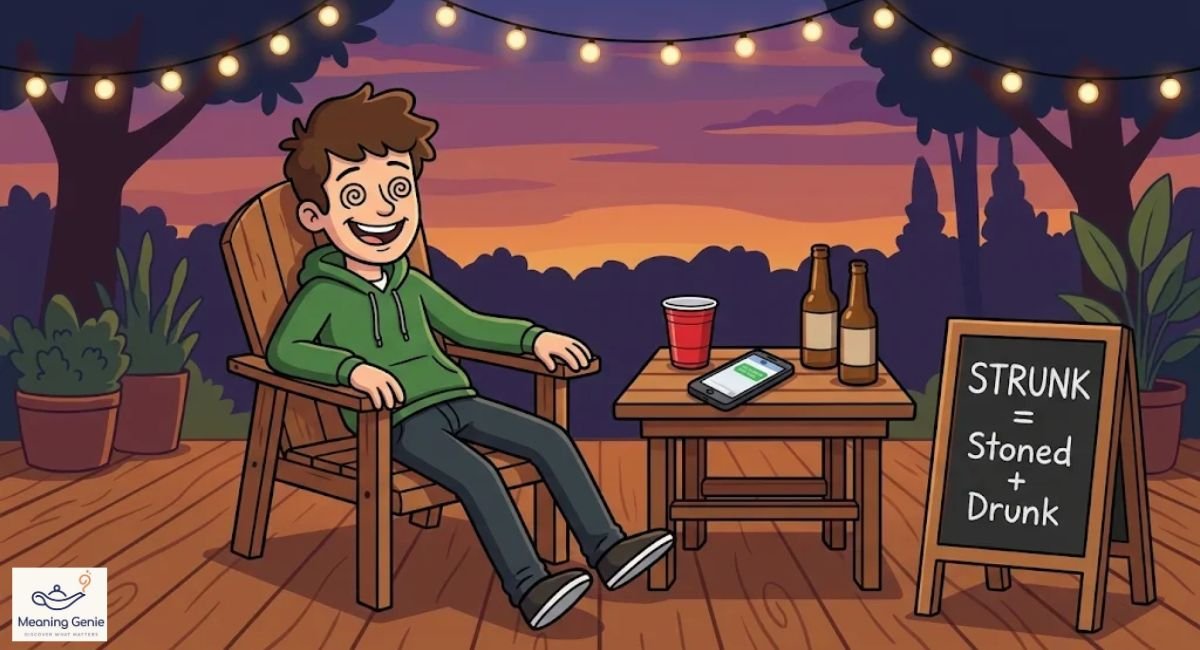
In slang, strunk traditionally means being stoned and drunk simultaneously. It combines parts of the words “stoned” and “drunk” to describe someone under the influence of both marijuana and alcohol.
Some people may also use it as a playful spelling or meme expression. However, these alternative interpretations are less consistently documented.
The Two Main Meanings of Strunk
Although the cross-faded interpretation has stronger historical support, online conversations can give the word different meanings. Here are the two interpretations worth understanding.
1) Strunk = Stoned + Drunk (Cross-Faded)
The traditional meaning of Strunk comes from combining two words:
- Stoned: Being under the influence of marijuana.
- Drunk: Being intoxicated after consuming alcohol.
Put them together, and you get Strunk. It describes someone experiencing both effects at the same time.
Older slang records contain this definition, including entries dating back to 2005. A historical American slang dictionary also records the word as a contraction of “stoned” and “drunk.”
Example:
“After the party, he said he was completely strunk.”
This means he had consumed alcohol and marijuana and was experiencing their combined effects.
The term is also associated with cross-faded, a more widely recognizable expression for being under the influence of alcohol and cannabis simultaneously.
2) Strunk = A Playful Version of Strong
Another possible interpretation connects Strunk with the word “strong.”
Internet users sometimes change ordinary spellings to make jokes, create memes, or exaggerate a particular quality. For example, “stronk” is an established humorous misspelling of “strong.”
Some online writers may extend this playful spelling style to “strunk.” However, evidence for Strunk meaning strong is considerably weaker than evidence for its traditional slang definition.
Example:
“That dog looks strunk!”
Depending on the meme or conversation, the writer might be joking that the dog looks unusually strong.
Remember that “stronk” is the better-established internet spelling for this joke. Don’t automatically assume that every use of “strunk” means strong.
How to Understand Strunk Based on Context
The easiest way to understand Strunk is to examine the words surrounding it. Since the expression has multiple reported interpretations, context helps you avoid misunderstandings.
Consider these clues:
| Context | Possible intended meaning |
| Alcohol, marijuana, or partying | Stoned and drunk |
| Talking about being high | Cross-faded |
| Gym, muscles, or physical power | Possible joke about strong |
| Funny memes or exaggerated spelling | Playful internet expression |
| Writing, grammar, or books | Possibly the surname Strunk |
For example, someone might text, “I’m still strunk from last night.” This could refer to being under the influence or, in some contexts, still feeling drunk the following morning.
However, if someone comments “That character is strunk!” beneath a humorous picture of a muscular character, the writer may be playing with the spelling of strong.
When the meaning isn’t clear, simply ask what the person intended.
What Does Strunk Mean in Texting?

In texting, Strunk is an informal expression that may describe someone’s intoxicated state. Friends might use it when discussing a party, a previous night out, or an unusual experience.
Here are some illustrative examples:
- Friend 1: “How was the party last night?”
- Friend 2: “Pretty wild. Everyone was strunk.”
Meaning: The speaker is referring to people who were both drunk and stoned.
Another example:
- Friend 1: “Why aren’t you answering?”
- Friend 2: “I’m still strunk from yesterday.”
Meaning: The person may be describing lingering intoxication or using the word jokingly.
Because Strunk isn’t universally recognized, its meaning can vary between conversations. It’s better to understand the surrounding message than rely on the word alone.
What Does Strunk Mean on Social Media?
Social media encourages people to experiment with language. Users frequently create abbreviations, playful spellings, and expressions that make their posts more entertaining.
Strunk can appear in captions, comments, memes, and casual discussions. However, there isn’t enough reliable evidence to establish a separate, standardized definition for each social media platform.
Strunk Meaning on Snapchat
On Snapchat, someone might use Strunk in a private snap or conversation about a night out.
For example:
“I’m still strunk 😂”
The person may be joking about being intoxicated or describing the effects of the previous evening.
Strunk Meaning on TikTok
TikTok videos often use humorous language, captions, and exaggerated expressions.
If Strunk appears in a video about partying, its traditional meaning may apply. If it appears in a fitness or comedy video, the creator might be playing with the spelling.
Always consider the video’s subject and caption before interpreting it.
Strunk Meaning on Instagram and Other Platforms
On Instagram, Strunk may appear in comments, stories, or captions shared between friends.
Its interpretation depends on the conversation. A post about partying may suggest the intoxication meaning, while a funny image may suggest a spelling joke.
The same principle applies to Facebook, Discord, and other online communities.
Real-Life Examples of Strunk in a Sentence
Here are some simple examples showing how people might use the expression in casual conversations.
| Example sentence | Possible meaning |
| “I was completely strunk last night.” | Stoned and drunk |
| “Are you still strunk?” | Still feeling intoxicated |
| “He said he got strunk at the party.” | Experienced combined intoxication |
| “That character looks strunk!” | Possible joke about strength |
| “Why are you acting so strunk?” | Meaning depends on context |
These examples illustrate possible usage rather than verified quotations from social media.
Is Strunk the Same as Cross-Faded?
Strunk and cross-faded can describe the same state, but they aren’t equally established expressions.
Cross-faded means experiencing the effects of alcohol and cannabis at the same time. Strunk is an informal slang expression historically used for that combination.
For example:
- “He was cross-faded after the party.”
- “He said he was strunk after the party.”
Both sentences can describe someone affected by alcohol and marijuana.
However, cross-faded is the clearer choice when communicating with people who may not recognize niche slang.
Combining alcohol and cannabis can increase impairment. Neither expression should be interpreted as suggesting that mixing these substances is safe.
Strunk vs. Stronk vs. Strong vs. Strung
These words look similar, but their meanings are different. Understanding their differences can prevent confusion when reading online conversations.
| Word | Meaning |
| Strunk | Informal slang traditionally meaning stoned and drunk |
| Stronk | Humorous internet spelling of strong |
| Strong | Having physical or mental power |
| Strung | Past tense and past participle of string; also used in expressions such as strung out |
The distinction between Strunk and Stronk is particularly important. Wiktionary identifies Stronk as a deliberate humorous misspelling of strong.
Meanwhile, Strung is a separate standard English word.
For example, “The lights were strung across the room” uses the past participle of string.
Don’t treat these four expressions as interchangeable.
Where Did the Slang Word Strunk Come From?
The exact origin of Strunk isn’t firmly established, but older slang records provide useful clues.
Some of the earliest readily available online entries date back to 2005. They describe Strunk as a combination of stoned and drunk. An American slang dictionary also records the expression with a 2002 submission date.
This supports the idea that the expression existed in informal American English before today’s social media platforms became popular.
The Possible Origin of Strunk
The strongest explanation is that speakers blended parts of two existing words:
SToned + dRUNK = STRUNK
This type of word formation is known as a portmanteau. It combines parts of different words to create a new expression.
However, the available records don’t establish who first invented Strunk or exactly where it originated.
See also: Lowkenuinely Meaning in Slang: Definition, Origin & Examples
How Internet Culture Helped Spread the Term
Internet culture makes it easier for unusual expressions to travel between communities.
People share unfamiliar words through:
- Group chats and private messages.
- Online forums and discussion boards.
- Memes and humorous captions.
- Social media comments.
- Casual conversations between friends.
Still, occasional online appearances don’t prove that a term is widely popular. Strunk remains relatively niche compared with more familiar expressions such as drunk and cross-faded.
Is There an Official History of Strunk?
No widely established origin story identifies a particular creator or platform.
Urban Dictionary contains several older user-submitted definitions, while historical slang references provide additional evidence of its use. These sources help document the expression, but they don’t establish an exact first use.
Other Meanings of Strunk You Should Know
Not every appearance of Strunk refers to slang. It can also appear as a surname, a foreign-language word, or a reference to a well-known writing guide.
Strunk as a Surname
Strunk is an existing family name, particularly associated with German-speaking regions.
FamilySearch traces the surname to a North German word associated with a stalk or stump. It may have originated as a nickname or a geographical name.
Therefore, a person named Strunk isn’t necessarily using slang.
Strunk as a German Word or Name
In German, Strunk is a noun that can refer to the hard stalk or central stem of a vegetable. It can also describe the remaining stump of a tree.
This meaning has nothing to do with being intoxicated.
Strunk as a Typo or Meme Expression
Sometimes, people simply mistype a word or intentionally change its spelling.
Depending on the sentence, Strunk could be a typing mistake, an inside joke, or a playful expression.
Look at the surrounding words before deciding what the writer intended.
William Strunk and Strunk & White
William Strunk Jr. was an American English professor known for writing The Elements of Style.
E. B. White later revised and expanded the book, which became widely known as Strunk & White. It offers guidance on grammar, composition, and clear writing.
Is Strunk a Real English Word?
Strunk is a recognizable informal slang expression, but its traditional slang meaning isn’t part of ordinary standard English vocabulary.
It appears in user-submitted slang dictionaries and historical slang references. However, that doesn’t make it a universally accepted word in formal writing.
For everyday communication, consider using clearer alternatives:
- Cross-faded: When referring to simultaneous alcohol and cannabis intoxication.
- Drunk: When referring to alcohol intoxication.
- Stoned: When referring to being under the influence of cannabis.
These expressions communicate more clearly, especially in situations where the reader may not recognize niche slang.
Is Strunk Positive, Negative, or Offensive?
Strunk isn’t inherently an insult or an offensive expression. Its tone usually depends on the speaker, audience, and situation.
When used to describe intoxication, it can sound humorous or casual. However, someone might find it inappropriate when discussing substance use seriously.
The playful spelling interpretation can also sound humorous rather than negative.
If you’re unsure how someone will interpret it, choose a clearer expression.
When Should You Avoid Using Strunk?
Although informal slang can make conversations entertaining, it isn’t suitable for every situation.

Consider avoiding it in these circumstances:
In Professional or Formal Conversations
Avoid using Strunk in workplace emails, academic assignments, business reports, or professional communication. Most readers will understand clearer standard English more easily.
When Discussing Alcohol or Drug Use
If the conversation involves someone’s safety or health, use precise language instead of relying on ambiguous slang.
When the Other Person Doesn’t Understand the Slang
Don’t assume everyone knows niche internet expressions. Using unfamiliar slang can create unnecessary confusion.
How to Respond When Someone Says Strunk
If someone uses Strunk in a message, your response should depend on what they mean.
Responding With Humor
If it’s clearly a harmless joke, you can reply casually:
- “What does that even mean?”
- “That’s a new one!”
- “You’re making up words now?”
Asking What They Mean
If the context isn’t clear, simply ask:
- “Do you mean drunk or cross-faded?”
- “Are you using that as a joke?”
- “What does Strunk mean here?”
Responding When They Mean Cross-Faded
If someone is describing intoxication, respond without encouraging risky behavior.
For example:
- “Are you somewhere safe?”
- “Please don’t drive.”
- “Do you need someone to help you get home?”
See also: PTSO Meaning in Text: What Does PTSO Mean in Slang?
Common Misunderstandings About Strunk
People sometimes confuse Strunk with other words because of its unusual spelling. Here are five mistakes worth avoiding.
Assuming Strunk Always Means Drunk
Its traditional meaning combines being stoned and drunk, rather than simply being drunk.
Assuming Strunk Always Means Strong
The strong interpretation is less established. Don’t confuse it with the better-documented internet slang term Stronk.
Confusing Strunk With Stronk
Stronk is a humorous spelling of strong. Strunk has a separate, historically documented slang meaning.
Confusing Strunk With Strung
Strung is a standard English word with its own grammatical uses. It isn’t another spelling of Strunk.
Assuming Strunk Has One Official Definition
Informal expressions can develop different meanings across communities. Context matters when interpreting them.
Final Thoughts
Strunk is an unusual slang expression with a more established meaning than its spelling might suggest. Traditionally, it describes being stoned and drunk at the same time, combining two familiar words into one informal expression.
You may also encounter playful variations, jokes, or unrelated references involving the same spelling. That’s why context is essential when interpreting it. Whether you see Strunk in a text message, social media comment, or meme, understanding the surrounding conversation will help you recognize what the writer actually means.
See also: Internet Slang and Texting Abbreviations: A Complete Guide to Online Language
FAQs
What is the meaning of Strunk?
Strunk is informal slang traditionally meaning being stoned and drunk at the same time.
What does Stronk mean in slang?
Stronk is a humorous internet spelling of “strong,” often used in memes to exaggerate someone’s strength.
Is Strunk a combination of stoned and drunk?
Yes. This is its strongest documented slang interpretation, describing simultaneous intoxication from marijuana and alcohol.
What does Strunk mean on TikTok?
It may describe combined intoxication or appear as a humorous spelling. The video’s caption and context help identify its meaning.
What is the difference between Strunk and Stronk?
Strunk traditionally means stoned and drunk, while Stronk is a humorous internet spelling of strong.
Is Strunk a bad or offensive word?
Not inherently. However, its association with intoxication makes it unsuitable for some professional or serious conversations.
What does Strunk and White mean?
Strunk and White refers to William Strunk Jr. and E. B. White, authors associated with the famous writing guide The Elements of Style.
How does Gen Z say drunk?
Gen Z commonly uses terms like “wasted,” “hammered,” “lit,” and “buzzed” to describe being drunk.

Words can be confusing—but understanding them shouldn’t be. I’m Muhammad Umair, an AI-powered SEO & content writer at Meaning Genie, helping readers decode slang, abbreviations, and internet language with simple, clear explanations.