
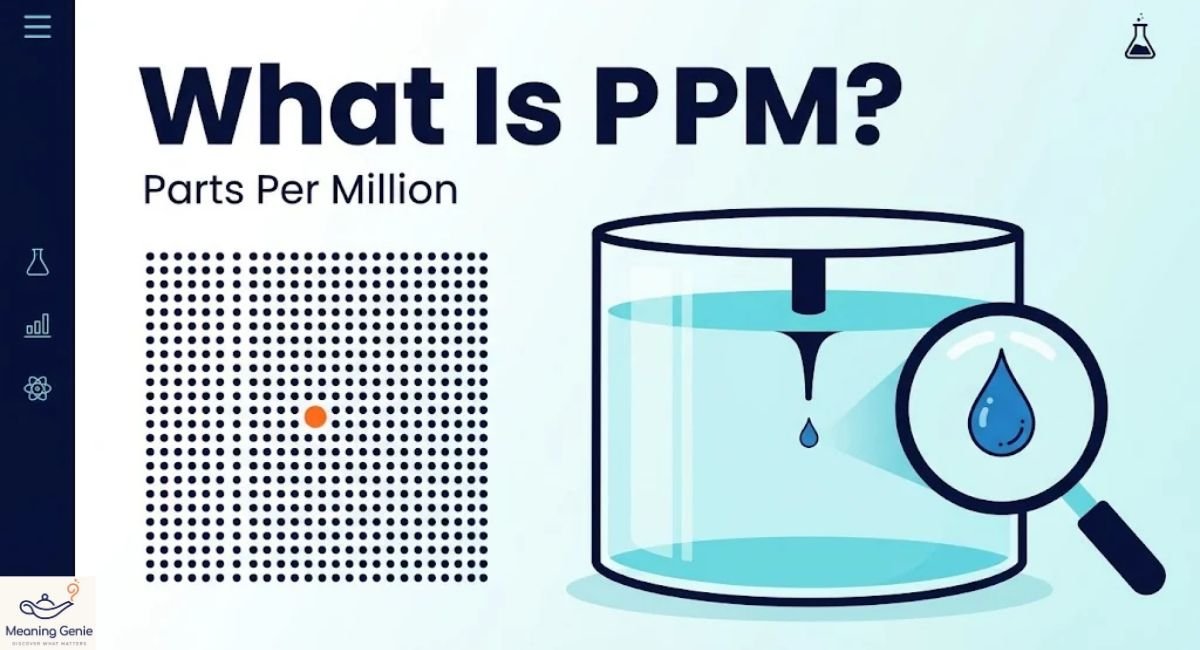
PPM stands for parts per million. It shows how many parts of a substance are present in one million parts of a mixture. One ppm equals 0.0001%, or 1 milligram per liter (mg/L) of water. Scientists, water treatment teams, and manufacturers use it to describe very small concentrations.
You will see ppm on a bottle of water, a pool test kit, an air quality report, and a fertilizer label. The number looks tiny, yet it often decides whether water is safe, a medicine is correct, or a plant gets enough nutrients. This guide explains what ppm means, how to calculate it, how to convert it, and where it is used.
What Does PPM (Parts per Million) Mean?
PPM describes concentration. It tells you how much of a substance (the solute) sits inside a larger mixture (the solution). Think of it as a percentage, but for much smaller amounts. A percentage means parts per hundred. PPM means parts per million.
Two everyday comparisons make the scale easier to picture:
- One drop of ink in about 50 liters of water is roughly 1 ppm.
- One second in about 11.5 days is 1 ppm.
Symbol and notation
The short form is ppm. Because it is a ratio, it has no dimension of its own. In practice you will meet a few related forms:
- mg/L (milligrams per liter): common for water. In dilute water solutions, 1 mg/L is about 1 ppm.
- mg/kg (milligrams per kilogram): common for soil, food, and solids. This is ppm by mass.
- ppmv: parts per million by volume, used mostly for gases such as carbon dioxide.
Note that ppm is not an official SI unit. Many labs prefer mg/L or mg/kg for that reason, but ppm remains the everyday shorthand.
The History of PPM
The idea is simple: a percent counts per hundred, so scientists needed a matching way to count per million when amounts became too small for percentages. As analytical chemistry improved through the 20th century, instruments could detect traces of contaminants, metals, and gases that earlier methods missed. PPM, along with ppb and ppt, became the standard shorthand.
The unit also became familiar through climate science. Atmospheric carbon dioxide is reported in ppm, and today’s level is above 420 ppm. Industries then adopted it for the same reason: it is short, easy to compare, and works across liquids, solids, and gases.
Why Are PPM Measurements Important?
Small amounts can matter a great deal. A few ppm of the wrong chemical can harm health, while a few ppm too little of a nutrient can stunt a crop. PPM measurements help with:
- Safety: Limits for lead, nitrate, and chlorine in drinking water are written in mg/L or ppm.
- Quality control: Food, drug, and chemical makers check purity and consistency against set limits.
- Regulatory compliance: Agencies such as the US EPA and the World Health Organization publish limits that businesses must meet or consider.
- Accurate dosing: Pool care, water treatment, and hydroponics all depend on adding the right amount of a substance to a known volume.
See also: Imploded Meaning: What Does “Imploded” Mean? (With Examples)
PPM vs. Other Units (ppb, ppt, Percentage)
PPM sits in a family of “parts per” units. Each step down is a factor of 1,000 smaller.
| Unit | Meaning | Fraction | Percentage | Equals in ppm |
| % | Parts per hundred | 1/100 | 1% | 10,000 ppm |
| ppm | Parts per million | 1/1,000,000 | 0.0001% | 1 ppm |
| ppb | Parts per billion | 1/1,000,000,000 | 0.0000001% | 0.001 ppm |
| ppt | Parts per trillion | 1/1,000,000,000,000 | 0.0000000001% | 0.000001 ppm |
A quick rule: use ppm for small amounts, ppb for trace contaminants, and ppt for ultra-trace work such as some environmental tests.
How to Calculate PPM

PPM Formula
The core formula is short:
ppm = (amount of solute ÷ amount of solution) × 1,000,000
Both amounts must use the same unit. Divide milligrams by milligrams, or milliliters by milliliters, never a mix.
A practical shortcut for water:
ppm ≈ milligrams of solute ÷ liters of water
Calculating PPM by Volume vs. Mass
PPM can describe mass or volume, so state which one you mean.
- By mass: mass of solute ÷ mass of solution × 1,000,000. Example units: mg/kg.
- By volume: volume of solute ÷ volume of solution × 1,000,000. Example units: mL/m³, often written ppmv.
For water, the two give almost the same number because 1 liter weighs about 1 kilogram. For other liquids, the density changes the result: mg/L = ppm × density (in kg/L).
Step-by-Step Worked Examples
Example 1: Salt in water
You dissolve 5 mg of salt in 2 liters of water.
- Divide the solute by the water volume: 5 mg ÷ 2 L = 2.5 mg/L
- Because the solution is mostly water, 2.5 mg/L ≈ 2.5 ppm
Example 2: Lead in soil
A lab finds 3 mg of lead in 1.5 kg of soil.
- Divide: 3 mg ÷ 1.5 kg = 2 mg/kg
- That is 2 ppm by mass.
Example 3: Dosing a tank
You want 5 ppm of chlorine in a 2,000-liter tank, using a 12% chlorine solution. A 12% solution is 120,000 ppm.
- Use the dilution formula: C₁ × V₁ = C₂ × V₂
- 120,000 × V₁ = 5 × 2,000
- V₁ = 10,000 ÷ 120,000 = 0.083 L, or about 83 mL
Always follow the product label and local safety rules when handling chemicals.
PPM Calculator
A calculator saves time when you convert often. Enter the solute amount and the total solution amount in matching units, and the tool returns the ppm value instantly.
PPM Conversions
Converting Percentage to PPM (and PPM to Percentage)
The two units differ by a factor of 10,000.
- % to ppm: multiply by 10,000
- ppm to %: divide by 10,000
Examples: 0.5% × 10,000 = 5,000 ppm. And 250 ppm ÷ 10,000 = 0.025%.
PPM to mg/L
For water and dilute water-based solutions, 1 ppm = 1 mg/L. For liquids denser or lighter than water, multiply by the density in kg/L, as shown earlier. Gas concentrations in ppmv are a different case and need temperature and pressure to convert to mg/m³.
PPM to ppb, and the Reverse
- ppm to ppb: multiply by 1,000 (2 ppm = 2,000 ppb)
- ppb to ppm: divide by 1,000 (500 ppb = 0.5 ppm)
Quick Conversion Table
| Percentage | PPM | PPB |
| 100% | 1,000,000 | 1,000,000,000 |
| 10% | 100,000 | 100,000,000 |
| 1% | 10,000 | 10,000,000 |
| 0.1% | 1,000 | 1,000,000 |
| 0.01% | 100 | 100,000 |
| 0.0001% | 1 | 1,000 |
See also: What Does Increase Mean? Definition, Examples, and Uses
How to Measure PPM
Common Instruments
The right tool depends on what you are measuring.
- TDS meter: reads total dissolved solids in water. It measures electrical conductivity and converts it to ppm.
- EC meter: measures conductivity directly, often used for nutrient solutions.
- Colorimeter: measures how strongly a treated sample absorbs light of a certain color, which relates to concentration.
- Test strips: a fast, low-cost check for chlorine, hardness, or pH.
- Spectrophotometer: a lab instrument for precise results on many substances.
Step-by-Step Measuring Process
- Rinse a clean container with the sample water.
- Collect the sample and let it settle to room temperature.
- Switch on the meter and place the probe in the sample, or follow the strip or reagent instructions.
- Wait for the reading to stabilize.
- Record the value, the temperature, and the date.
- Rinse the probe with clean or distilled water before storing it.
Maintaining Accuracy
Good numbers come from good habits:
- Calibrate regularly with a standard solution that matches your expected range.
- Check temperature. Conductivity changes as water warms, so use a meter with temperature compensation.
- Avoid contamination. Clean containers and probes matter as much as the meter.
- Watch the conversion factor. TDS meters convert conductivity to ppm using a factor, often between 0.5 and 0.7, so two meters can show different numbers for the same water.
- Replace old strips and reagents before they expire.
What Does PPM Mean in Facilities Management?
PPM has a second, unrelated meaning. In buildings and property work, it stands for planned preventive maintenance. If you landed here looking for that, this section is for you.
What Is Planned Preventive Maintenance (PPM)?
Planned preventive maintenance is a scheduled maintenance approach. Teams inspect, service, and repair equipment at set intervals so problems are fixed before they cause a breakdown. It is the opposite of reactive maintenance, where work starts only after something fails. Don’t confuse PPM with PMO, short for Project Management Office, which oversees projects rather than scheduled maintenance.
See also: PMO Meaning in Text: What Does It Stand For?
Key Components of Planned Preventive Maintenance
- Asset register: a list of every asset, with make, model, location, and serial number.
- Maintenance schedule: set intervals for each asset, based on manufacturer guidance, running hours, or regulations.
- Task lists: clear steps for inspections, cleaning, lubrication, and part replacement.
- Trained staff: technicians who know the procedures and safety rules.
- Record keeping: logs of dates, actions, and parts used.
- Review and improvement: regular checks of downtime and repair costs to adjust the plan.
The main benefits are less downtime, longer equipment life, better budget control, and easier compliance.
Industries and Applications That Use PPM

Water Treatment
Water teams track chlorine, hardness, and total dissolved solids. The US EPA sets a secondary (non-enforceable) guideline of 500 mg/L for TDS, based on taste and appearance. The WHO rates water below 300 mg/L as excellent for taste and up to 600 mg/L as good. For disinfectants, the EPA’s maximum residual level for chlorine in drinking water is 4 mg/L.
Aquaculture and Aquariums
Fish are sensitive to small changes. Keepers test ammonia, nitrite, nitrate, and salinity in ppm to keep tanks stable. Even low ammonia levels can stress or kill fish.
Pharmaceutical Industry
Drug makers measure trace impurities, residual solvents, and heavy metals in ppm. Strict limits protect patients and keep each batch consistent.
Food and Beverages
PPM appears in preservative levels (such as sulfites in wine), contaminant testing, and water quality for brewing and bottling. Regulators set maximum levels for many additives and residues.
Environmental Monitoring and Air Quality
Gas sensors report carbon dioxide, carbon monoxide, and other pollutants in ppm. Indoor CO₂ is a popular proxy for ventilation: higher readings often mean stale air. Outdoors, the global CO₂ reading is a key climate indicator.
Automotive Industry
Emission tests measure exhaust gases in ppm. Technicians also check contaminants in engine oil and coolant to catch wear early.
Agriculture and Hydroponics
Growers mix nutrient solutions by target ppm and check them with EC or TDS meters. Seedlings usually need a weaker solution than mature plants, so growers adjust the ppm as the crop develops.
Common Mistakes When Working With PPM
- Confusing ppm with percentage. 1% is 10,000 ppm, not 1 ppm. This is the most frequent error.
- Mixing mass and volume. Say whether your ppm is by mass (mg/kg) or by volume (ppmv). They are not interchangeable for most substances.
- Mixing units in the formula. Convert the solute and solution to the same unit first.
- Ignoring temperature. Conductivity-based readings drift with temperature.
- Trusting TDS meters blindly. They estimate dissolved solids from conductivity and cannot tell which substances are present.
- Skipping calibration. An uncalibrated meter can be consistently wrong.
Conclusion
PPM is a simple way to express very small concentrations: parts of a substance per one million parts of a mixture. Once you know the formula, the percentage conversion (multiply by 10,000), and the mg/L rule for water, most everyday calculations become quick. Try the PPM calculator above on your own numbers, and check our related guides on TDS meters and ppm to ppb conversion to go deeper.
FAQs
What does PPM mean in slang?
There is no widely agreed slang meaning. Most of the time it just means “parts per million,” and on sugar-dating sites it is reported to mean “Pay Per Meet.”
What does PPM stand for on dating sites?
It is reported to stand for “Pay Per Meet,” meaning payment for a meeting. Platforms such as SeekingArrangement ban it, though I only found this on low-quality pages, so treat it as unconfirmed.
What does PPM mean in the workplace?
In facilities and maintenance teams, it means Planned Preventive Maintenance, which is scheduled servicing to prevent breakdowns. In project teams, it can also mean Project Portfolio Management.
What does 1 PPM equal?
One ppm is 1 part in 1,000,000, or 0.0001%. In water, it equals 1 mg/L (or 1 mg/kg by mass), and 1,000 ppb.
How can I calculate ppm?
Use ppm = (amount of solute ÷ amount of solution) × 1,000,000, with both amounts in the same unit. For water, divide milligrams of solute by liters of water.
Is 1 ppm equal to 1 ml?
No, ppm is a ratio, not a volume. By volume, 1 ppm is 1 mL in 1,000 liters (1 m³).
How do I convert ppm to ounces?
You need the total amount of liquid first. In water, 1 ppm is about 0.0000353 oz per liter, or about 0.000134 oz per US gallon.
How to make a 1 ppm solution?
Dissolve 1 mg of the substance in 1 liter of water. For easier measuring, make a 1,000 ppm stock (1 g in 1 L), then dilute 1 mL of it into 1 L of water.
How much is 50 ppm?
It is 50 mg per liter of water, which equals 0.005% or 50,000 ppb.

Words can be confusing—but understanding them shouldn’t be. I’m Muhammad Umair, an AI-powered SEO & content writer at Meaning Genie, helping readers decode slang, abbreviations, and internet language with simple, clear explanations.