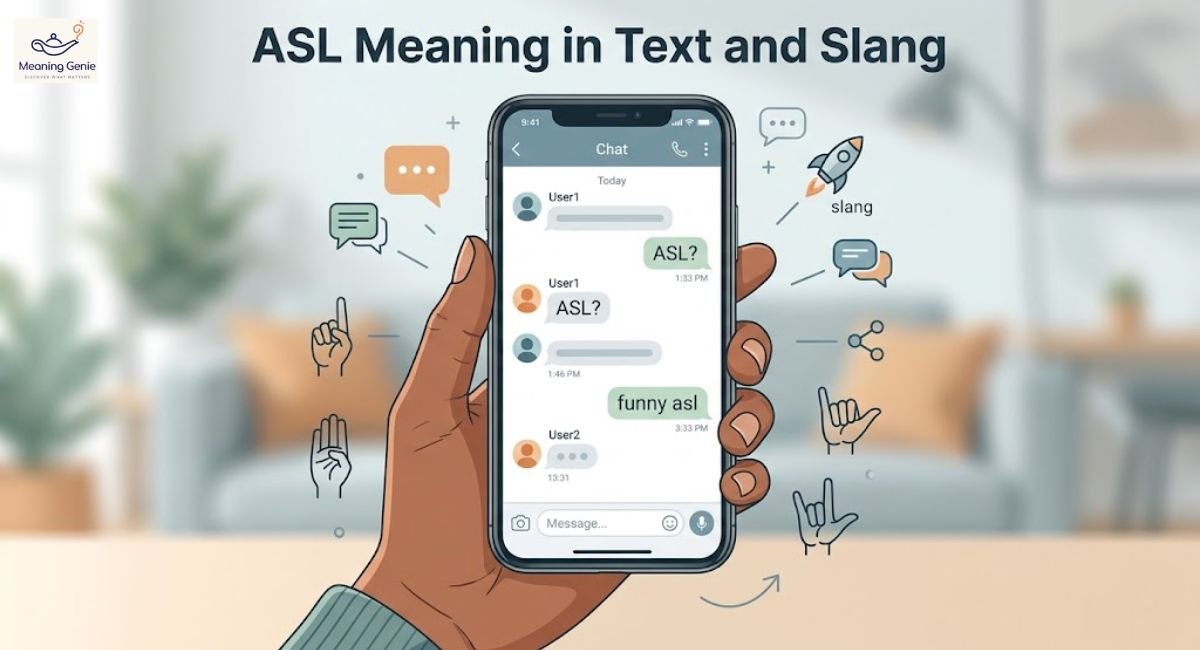
Seeing ASL in a text can leave you scratching your head for a second. Does it mean “age, sex, location?” Is someone saying “as hell”? Or are they talking about American Sign Language?
The answer depends heavily on the conversation around it. The same three letters can carry completely different meanings in online conversations, text messages, social media, and everyday communication.
In this guide, you’ll learn the most common meanings, how people use ASL today, and how to figure out the intended meaning without guessing.
What Does ASL Mean in Text?
In text messages, ASL can traditionally mean “age, sex, location?” This abbreviation became popular during the early days of online chat, chat rooms, and instant messaging, when people wanted to ask basic personal details quickly.
Today, however, lowercase asl is also widely used as a slang abbreviation for “as hell.” You’ll usually see it after an adjective, such as “funny asl,” “tired asl,” or “cute asl.” The context is the real giveaway.
ASL Meaning: Age, Sex, Location?
When someone writes “ASL?”, they may be asking for your age, sex, and location. It was a common question in early internet culture, especially when strangers met in online communities or chat rooms.
For example, someone might have written, “Hey, ASL?” to quickly learn basic information about another person. Today, this usage feels somewhat old-fashioned, although you may still encounter it in certain online forums, dating spaces, or nostalgic references to early internet culture.
ASL Meaning as “As Hell”
Modern slang uses asl differently. When it appears after an adjective or description, it commonly means “as hell,” adding strong emphasis to the word before it.
For example, “That movie was funny asl” means the movie was extremely funny. Likewise, “I’m tired asl” means the person is very tired. This texting abbreviation is informal and belongs mainly to casual texting, social media, and other relaxed conversations.
ASL Meaning at a Glance
The easiest way to understand ASL is to look at how it appears in a sentence. Punctuation, word placement, and the topic often reveal the intended meaning more clearly than capitalization.
| ASL Form | Meaning | Typical Context |
| ASL? | Age, Sex, Location? | Early internet chats |
| asl | As hell | Modern internet slang |
| ASL | American Sign Language | Language and accessibility |
| funny asl | Extremely funny | Casual texting |
| tired asl | Extremely tired | Casual texting |
| cute asl | Extremely cute | Social media or messages |
| fine asl | Very attractive, excellent, or very good | Informal slang |
Capitalization can offer a clue, but it should not be treated as a hard rule. People often type quickly and ignore capitalization altogether.
What Does ASL Mean in Slang?
In modern internet slang, “asl” commonly means “as hell.” It works as an intensifier, making the adjective before it stronger.
You might see it in social media posts, comments, private messages, and gaming communities. The expression is casual and sometimes mildly vulgar because “hell” is being used for emphasis. Still, the tone usually depends on the surrounding conversation.

How “As Hell” Is Used
The slang version usually follows an adjective, emotion, or description. Think of it as adding “extremely” or “very” to what came before it.
Someone might write, “That game is hard asl,” meaning the game is extremely difficult. Another person could say, “I’m hungry asl,” meaning they are extremely hungry. The abbreviation saves space while giving the sentence a stronger emotional punch.
Common ASL Slang Examples
Modern ASL slang appears in many combinations. The following examples show how the meaning changes depending on the word before it.
| Expression | Meaning |
| funny asl | Extremely funny |
| tired asl | Extremely tired |
| hungry asl | Extremely hungry |
| busy asl | Extremely busy |
| cold asl | Extremely cold |
| cute asl | Extremely cute |
| loud asl | Extremely loud |
| bored asl | Extremely bored |
| exhausted asl | Extremely exhausted |
| fine asl | Very attractive, excellent, or very good |
Notice that “fine asl” needs extra context. Depending on the conversation, it can describe someone as very attractive or something as exceptionally good.
What Does ASL? Mean in Chat?
When you see “ASL?” by itself, especially as a direct question, the traditional meaning is usually “age, sex, location?”
This meaning comes from older chat abbreviation culture, where people often exchanged short questions with strangers. Someone asking “ASL?” was generally trying to learn basic information about the person they were chatting with.
Example Conversation
Person A: Hey, where are you from?
Person B: California. You?
Person A: Texas. ASL?
Person B: 24, male, Texas.
In this example, ASL clearly means “age, sex, location?” because it appears as a standalone question asking for personal details.
Where Did ASL Come From?
The history of ASL is interesting because its different meanings developed in different communication environments. “ASL?” became associated with early internet chat, while “asl” later became a shorthand form of “as hell.”
At the same time, American Sign Language has a completely separate history. It is not an internet abbreviation and should not be confused with the slang uses of ASL.
Early Internet Chat Culture
During the early internet era, people used abbreviations heavily because typing was slower and online conversations were often fast-paced.
Terms such as ASL helped users exchange basic information quickly. This was particularly common in chat rooms and early messaging services. The abbreviation became closely connected with meeting strangers online.
How the Meaning Changed Over Time
Internet language rarely stays still. As texting and social media evolved, users created shorter ways to express emotions, reactions, and emphasis.
The slang use of asl meaning “as hell” became more visible in modern online communication. Instead of asking a question, users began attaching “asl” to words such as “funny,” “tired,” “cute,” or “mad.”
That shift explains why two people can see the same abbreviation and understand completely different things.
How Is ASL Used in Real Conversations?
The meaning becomes much easier to identify when you look at real examples. Different platforms also encourage slightly different styles of communication.

Text Message Example
Alex: How was the party?
Sam: It was loud asl 😂
Alex: I can imagine.
Here, “asl” clearly means “as hell” because it intensifies the adjective “loud.”
Texting slang often appears around everyday topics, including food, drinks, moods, and social situations. If you’ve also seen people use the word “coffee” in unusual ways online, you may want to explore our guide to [Coffee Slang Meaning: What Does “Coffee” Mean in Text and Slang?].
Snapchat Example
Friend: You look cute asl in that picture.
You: Haha thanks!
In this ASL meaning Snapchat example, the abbreviation is being used as slang. The person is saying you look extremely cute.
Instagram Example
Comment: This outfit is fire asl 🔥
The ASL meaning Instagram usage here is again “as hell.” The commenter is strongly emphasizing the adjective or description.
TikTok Example
Comment: Bro is tired asl 😭
The ASL meaning TikTok is easy to identify because “asl” follows the adjective “tired.” It means extremely tired.
Gaming or Discord Example
Player 1: That boss is hard asl.
Player 2: Fr, we need another player.
In ASL meaning Discord or gaming conversations, the slang form can appear naturally in quick reactions. It simply strengthens the adjective.
What Does ASL Mean on Snapchat?
On Snapchat, asl is more likely to appear as casual internet slang when it follows an adjective.
For example, “That filter is funny asl” means the filter is extremely funny. However, you should not assume every occurrence has this meaning. A standalone “ASL?” could still refer to the older “age, sex, location?” question.
The conversation provides the strongest clue.
What Does ASL Mean on TikTok?
On TikTok, “asl” commonly appears in comments and captions as an intensifier. You may see expressions such as “funny asl,” “cute asl,” or “tired asl.”
The social media slang style on TikTok tends to favor short, expressive phrases. Because of that, abbreviations can spread quickly across different online communities and age groups.
What Does ASL Mean on Instagram?
Instagram users may use “asl” in comments, captions, stories, and direct messages. The modern slang meaning is particularly easy to spot when it follows an adjective.
For example, “You’re funny asl” means “You’re extremely funny.” Meanwhile, a message simply saying “ASL?” could have the older meaning. The platform itself does not determine the definition.
What Does ASL Mean in Gaming and Discord?
In gaming and Discord conversations, slang abbreviations are common because people communicate quickly while playing or chatting.
A player might write, “This level is hard asl,” or “I’m tired asl.” In both examples, ASL means “as hell.” However, ASL in online chat can still mean “age, sex, location?” if someone is specifically asking about personal information.
Does ASL Mean the Same Thing on Every Platform?
No. There is no universal ASL meaning that works in every conversation.
The same abbreviation can mean something completely different depending on where it appears. ASL meaning online may refer to “as hell,” while a language-related discussion almost certainly points toward American Sign Language.
| Context | Most Likely Meaning |
| “ASL?” from a stranger | Age, Sex, Location? |
| “Funny asl” | Funny as hell |
| “Tired asl” | Tired as hell |
| Deaf culture discussion | American Sign Language |
| Accessibility discussion | American Sign Language |
| Professional document | Could have another specialized meaning |
The key lesson is simple: context beats capitalization.
How Can You Tell Which ASL Meaning Is Correct?
You do not need to guess blindly. Look at how the abbreviation functions in the sentence.
Look at the Sentence
If ASL follows an adjective, it probably means “as hell.” Phrases such as “cute asl,” “mad asl,” and “busy asl” usually use the slang meaning.
If ASL appears alone as a question, the older “age, sex, location?” meaning becomes more likely.
Check for a Question Mark
Punctuation can provide a useful clue. “ASL?” traditionally functions as a question asking for personal details.
By contrast, “funny asl” or “tired asl” is a statement rather than a question. Still, punctuation is only one clue, not an absolute rule.
Consider the Topic
The surrounding topic can settle the matter quickly. If people are discussing sign languages, Deaf culture, interpreters, or accessibility, ASL almost certainly refers to American Sign Language.
If friends are discussing a movie, outfit, game, or mood, “as hell” may be the intended meaning.
If you often come across unfamiliar abbreviations online, context is your best clue. Our Internet Slang and Texting Abbreviations guide explains how online language works, how meanings change across platforms, and how to understand confusing terms in text and social media.
Other Meanings of ASL You Should Know
Although internet slang gets most of the attention, ASL has an important non-slang meaning.
The most significant alternative is American Sign Language, a natural language used primarily in the United States and parts of Canada. It has its own vocabulary, grammar, syntax, and cultural context.

American Sign Language
American Sign Language is not simply English translated into hand movements. It is a complete visual language with its own linguistic structure.
Many Deaf and hard-of-hearing people use ASL as part of everyday communication. It also plays an important role in education, accessibility, interpreting, and Deaf culture.
This meaning is entirely separate from the internet slang abbreviation.
Other Possible Professional Meanings
ASL can also appear as an abbreviation in specialized fields, organizations, names, and technical terminology. These meanings are much less predictable because they depend on the industry or subject.
That is why you should always check the surrounding context before assigning one fixed definition to an abbreviation.
ASL vs. American Sign Language: What Is the Difference?
The difference is mainly contextual.
When someone writes “ASL?” in an old-fashioned chat setting, they may mean “age, sex, location?” When someone writes “funny asl,” they probably mean “funny as hell.” When someone discusses interpreters, Deaf education, or sign language, ASL means American Sign Language.
American Sign Language is a genuine language, not merely texting slang. Treating the two meanings as interchangeable can create unnecessary confusion.
Why Did “ASL?” Become So Popular?
The original “ASL?” became popular because early internet communication rewarded brevity. Users wanted to ask basic questions without typing an entire sentence.
Short abbreviations became part of early internet culture, especially in chat rooms and instant messaging. The phrase was quick, recognizable, and easy to type.
Modern platforms changed the landscape, but the abbreviation survived in a different form. Internet language often recycles old terms while giving them fresh meanings.
Is ASL Still Used Today?
Yes, but its different meanings have very different levels of visibility.
The “age, sex, location?” usage is much less dominant than it was during the early days of online chat. You may still encounter it in older references, certain communities, or conversations involving strangers.
The slang “as hell” usage remains common in informal digital communication. Meanwhile, American Sign Language continues to be widely used as a natural language and remains completely separate from internet slang.
Who Uses ASL Slang Today?
There is no single age group that exclusively owns this slang. You may encounter it among younger internet users, social media users, gamers, and people who regularly communicate through informal messaging.
Usage varies by community, platform, and personal style. Some people use abbreviations constantly, while others prefer complete words.
That distinction matters because calling ASL exclusively “Gen Z slang” would oversimplify how internet language actually spreads.
Common ASL Variations You May See
The abbreviation can appear in several forms. Capitalization often changes because people type casually, so the letters themselves are not enough to determine the meaning.
| Variation | Common Interpretation |
| ASL | Depends on context |
| asl | Often “as hell” |
| ASL? | Often “age, sex, location?” |
| funny asl | Extremely funny |
| tired asl | Extremely tired |
| fine asl | Very attractive, excellent, or very good |
| cute asl | Extremely cute |
| mad asl | Extremely angry |
| loud asl | Extremely loud |
Expressions such as funny asl, tired asl, and cute asl are generally straightforward because “asl” acts as an intensifier.
How Do You Respond When Someone Says ASL?
Your response should depend on what the person means. There is no need to make the conversation awkward if the context already makes the meaning clear.

If They Mean “As Hell”
You can simply respond naturally to the statement. If someone says, “That movie was funny asl,” you could say, “Seriously 😂” or “Right? I couldn’t stop laughing.”
If They Ask “ASL?”
If someone sends “ASL?” and appears to be asking for personal information, you can answer only what you are comfortable sharing.
For example, you might say, “I’m 25 and from Texas,” or avoid giving personal details altogether. You never have to share private information simply because someone asks.
Funny Responses
If the conversation is clearly playful, you can respond with humor. A message such as “ASL?” could receive a light response like, “Classified information 😂.”
Respectful Responses
If you are unsure what they mean, the safest response is to ask, “Which ASL do you mean?” A short clarification can prevent an entire conversation from going sideways.
Is ASL Safe to Use?
The slang itself is generally harmless in casual conversation, but context matters.
The older “age, sex, location?” meaning deserves more caution because it can involve sharing personal information with strangers. You should think carefully before giving your age, exact location, or other identifying details to someone online.
Professional Conversations
Avoid using internet slang such as “funny asl” in formal emails, job applications, business documents, or professional communication.
Informal abbreviations can make your message sound overly casual or unclear. In professional settings, write the full phrase instead.
Serious or Sensitive Conversations
Slang may also be inappropriate during serious discussions. If someone is talking about grief, conflict, health, work problems, or another sensitive subject, clear language usually works better.
Tone matters. The same abbreviation that sounds funny in a group chat can feel dismissive somewhere else.
When Context Could Cause Confusion
If the abbreviation has multiple plausible meanings, avoid assuming. Ask for clarification when necessary.
This is especially useful when talking with people from different online communities, cultures, or generations. Internet slang does not always travel with the same meaning.
Common Misunderstandings About ASL
Because ASL has several meanings, confusion is completely understandable. The trick is recognizing what role the abbreviation plays in the sentence.
Confusing “As Hell” With “Age, Sex, Location”
“Funny asl” and “tired asl” are not asking for personal information. In these expressions, “asl” means “as hell.”
By contrast, “ASL?” as a standalone question may refer to the older phrase “age, sex, location?”
Confusing Slang With American Sign Language
American Sign Language has nothing to do with the slang expression “as hell.” It is a natural visual language with its own grammar and syntax.
The subject usually makes the distinction obvious. A conversation about Deaf culture points toward American Sign Language, while a casual reaction such as “That was crazy asl” points toward slang.
Assuming ASL Always Has One Meaning
This is probably the biggest mistake to avoid.
Abbreviations behave like chameleons. Their meaning changes with the sentence, audience, platform, and topic. ASL is a perfect example.
Similar Texting Slang You Should Know
If you’re learning internet slang, you may also come across abbreviations that look surprisingly similar to ASL. One common example is ASF, which is another informal intensifier used in texting and social media.
If you’re wondering whether ASF has the same meaning as ASL, our guide to [ASF Meaning: What Does ASF Mean in Text, Slang, and Social Media?] explains the difference, common examples, and how people use it online.
FAQS
What is ASL for texting?
In texting, ASL can mean “age, sex, location?” Traditionally, it was used to ask someone for basic personal details.
What does “I’m bored asl” mean?
“I’m bored asl” means “I’m extremely bored” or “I’m bored as hell.” Here, “asl” is slang for “as hell.”
What does ASL mean for Gen Z?
In modern internet slang, asl commonly means “as hell” and is used to emphasize an adjective, such as “tired asl” or “funny asl.”
What does “pretty asl” mean?
“Pretty asl” means “very pretty” or “pretty as hell.” It is usually a casual compliment about someone’s appearance.
What does ASL mean on TikTok?
On TikTok, asl commonly means “as hell” when it follows an adjective. For example, “funny asl” means “extremely funny.”
What is ASL on the internet?
On the internet, ASL has multiple meanings, including “as hell,” “age, sex, location?” and American Sign Language. The surrounding context tells you which meaning is intended.
Final Thoughts
The ASL meaning in text depends on context more than anything else. In older internet conversations, “ASL?” traditionally meant “age, sex, location?” In modern slang, “asl” often means “as hell,” especially after an adjective.
ASL can also mean American Sign Language, which is a completely separate and important language.
So, the next time you see ASL, do not automatically assume you know what it means. Look at the sentence, punctuation, topic, and conversation first. Those clues usually reveal the intended meaning in seconds.

Words can be confusing—but understanding them shouldn’t be. I’m Muhammad Umair, an AI-powered SEO & content writer at Meaning Genie, helping readers decode slang, abbreviations, and internet language with simple, clear explanations.
1 thought on “ASL Meaning in Text and Slang: What Does ASL Mean?”