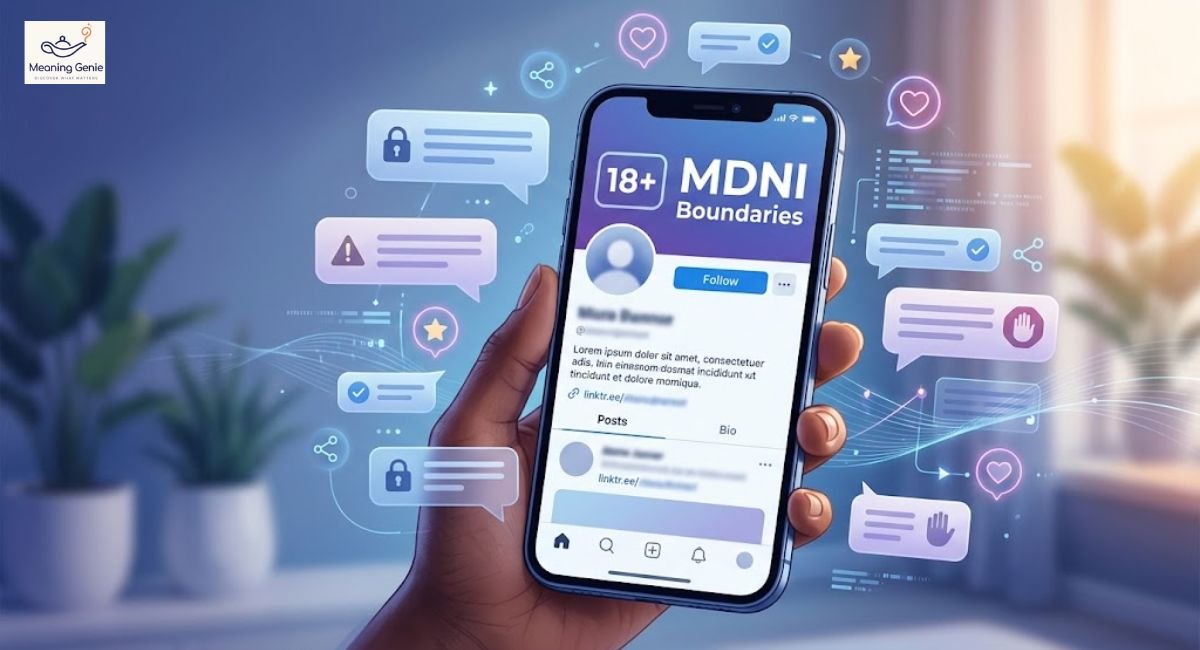
If you have seen MDNI meaning in a TikTok bio, Instagram caption, Discord profile, or comment, you may have wondered what those four letters mean. The answer is simple: MDNI stands for “Minors Do Not Interact.”
People use this MDNI acronym to communicate an age-based boundary around an account, post, community, or conversation. You may also see it beside terms such as 18+, NSFW, or DNI. Understanding the phrase helps you recognize online boundaries and respond appropriately.
What Does MDNI Mean?
The basic MDNI definition is “Minors Do Not Interact.” In simple terms, it tells people under 18 not to engage with a particular account, post, conversation, or community. It works as an age warning rather than an automatic technical restriction.
For example, a profile might say “18+ account. MDNI.” That statement communicates an audience restriction and asks minors not to interact. However, the acronym itself does not verify someone’s age or automatically block an account.
| Term | Meaning | Main Purpose |
| MDNI | Minors Do Not Interact | Sets an age-based interaction boundary |
| 18+ | Adults only | Indicates an adult audience |
| NSFW | Not Safe For Work | Warns about potentially unsuitable content |
| DNI | Do Not Interact | Sets a broader interaction boundary |
The MDNI acronym meaning becomes clearer when you break down each word. “Minors” identifies the audience, while “do not interact” describes the requested action. So, the minors do not interact meaning is simply a request for younger users to avoid engagement.
What Does MDNI Mean on Social Media?
The MDNI meaning on social media generally stays the same across different platforms. You can find it in profiles, captions, comments, community descriptions, and direct messages. The surrounding words usually tell you how broadly the boundary applies.
For example, a creator might place MDNI in a permanent bio. Another person might use it only on a particular post containing mature content. In both cases, the phrase communicates an age-related interaction boundary.

MDNI Meaning on TikTok
The MDNI on TikTok label can appear in a creator’s bio, caption, comment, or profile description. Because TikTok content can reach large audiences quickly, some creators use clear age-related language before people interact.
If you see “18+ | MDNI,” treat it as an audience request. The creator is communicating that their space is intended for adults. You should also check any community guidelines or additional notices on the profile.
MDNI Meaning on Instagram
The MDNI on Instagram label often appears in bios, captions, creator profiles, or posts involving mature subjects. Users may combine it with “18+,” “adults only,” or “NSFW” to make their intended audience clearer.
For example, “Artist | 18+ | MDNI” tells visitors that the creator has established a specific boundary. The surrounding profile can provide more context about the account and its adult-oriented content.
MDNI Meaning on Snapchat
The MDNI on Snapchat label may appear in profiles, messages, or community-related conversations. Its purpose remains straightforward: communicate that minors should not participate in the relevant interaction or space.
Although Snapchat conversations often feel casual, MDNI can carry a serious boundary. Respecting that boundary supports digital safety and helps reduce inappropriate interactions.
MDNI Meaning on Other Social Platforms
You may also encounter MDNI on Twitter, MDNI on Tumblr, MDNI on Discord, or MDNI on Reddit. The placement can change, but the core meaning usually remains “Minors Do Not Interact.”
Fandom pages, creator accounts, private accounts, and online communities may use the acronym differently. Always read the surrounding profile, post, or rules before deciding exactly what the notice covers.
What Does MDNI Mean in Texting and Messaging?
The MDNI meaning in texting is generally identical to its social media meaning. Someone may use it in a direct message, group chat, community conversation, or profile note to tell minors not to interact.
For example, someone might write, “This chat is adults only. MDNI.” The wording is brief, but the intention is clear. The person is establishing an online safety boundary before the conversation continues.
You may also see a message such as, “Please read my bio before DMing me. MDNI.” Here, the acronym reinforces an existing boundary rather than introducing a new one.
Why Do People Use MDNI?
People use MDNI because online spaces can contain users of many different ages. A visible boundary provides a quick way to communicate who should participate. It can be especially useful around mature discussions or age-restricted content.
However, MDNI is not the same as a technical safety feature. It usually represents boundary setting by an individual or community. Actual platform age restrictions depend on the service’s own policies, controls, and moderation systems.
Setting Age-Based Boundaries
An age-based boundary tells users that age matters before they interact. An adult creator may use MDNI because their account contains mature discussions, adult subjects, or other content intended for adults.
This also supports personal boundaries. Instead of explaining the same expectation to every visitor, a creator can display one clear statement. That makes their expectations easier to understand.
Managing Online Interactions
MDNI can help content creators communicate who they expect to interact with their accounts. A visible notice may discourage unwanted messages, comments, follows, or participation from younger users.
The practice also relates to digital accountability. Clear communication gives other users a better chance to understand expectations before interacting. It cannot control every person’s behavior, but it can reduce avoidable confusion.
Protecting Younger Users From Adult Content
MDNI frequently appears around adult-oriented content, which explains its association with mature online spaces. The notice can tell younger users to avoid material or discussions intended for adults.
Still, the label alone does not guarantee protection. A written notice cannot replace age verification, moderation, privacy controls, or platform safety features. User safety often depends on several safeguards working together.
Controlling Who Engages With Their Content
For some creators, MDNI communicates who they do not want interacting with their work. That interaction can include comments, messages, follows, reposts, or community participation.
An audience restriction may therefore concern more than simply viewing content. A creator might allow adults to view a post while asking minors not to participate. The exact boundary depends on the wording and context.
MDNI and NSFW Content: What’s the Connection?
MDNI and NSFW often appear together because adult-oriented spaces may need both audience and content warnings. MDNI focuses on who should interact. NSFW describes content that may be unsuitable for work or certain public settings.
For example, “NSFW — 18+ — MDNI” combines several signals. The MDNI content warning focuses on age and interaction, while NSFW tells readers something about the nature of the material.

What Does MDNI + NSFW Mean?
MDNI and NSFW together usually indicate an adult-oriented space containing potentially mature material. You might see this combination on a creator profile, fandom page, community description, or individual post.
The distinction remains important. MDNI adult content wording addresses minors and interaction, while NSFW describes potentially unsuitable material. One term does not replace the other.
Is MDNI the Same as NSFW?
No. MDNI and NSFW serve different purposes. MDNI communicates an age-related interaction boundary. NSFW generally warns that content may be unsuitable for a workplace or public setting.
| Acronym | Primary Focus | Typical Message |
| MDNI | Age and interaction | Minors should not interact |
| NSFW | Content suitability | Content may be unsuitable for work |
Therefore, MDNI mature content does not automatically mean every MDNI account contains sexual material. The acronym establishes an age boundary. The surrounding content explains why that boundary exists.
Why Are MDNI and DNI Sometimes Used Together?
MDNI and DNI can appear together because they establish related but different boundaries. MDNI specifically concerns minors, while DNI can communicate a broader request against interaction.
For example, “18+ MDNI. DNI if you cannot respect boundaries” contains two messages. The first concerns age. The second establishes a broader expectation about respectful behavior and digital consent.
What Does MDNI Mean in Different Online Communities?
The MDNI in online communities context can vary because different groups develop their own customs. You may encounter it in fandoms, art spaces, roleplay groups, adult communities, or personal profiles.
Rather than guessing, check the surrounding rules. Online communities may provide additional information about age requirements, privacy, conduct, moderation, and acceptable interaction.
MDNI in Fandom Communities
MDNI in fandom communities often appears around mature fanfiction, fan art, discussions, or roleplay. Some creators use it when their work explores mature themes that they do not want minors engaging with.
Fandom spaces may also use terms such as 18+, NSFW, or fandom content. If a community has specific rules, those rules provide important context for understanding the boundary.
MDNI in Art and Creative Spaces
Artists may use MDNI when their work includes adult subjects, disturbing imagery, strong themes, or other material intended for older audiences. The notice gives visitors context before they explore the creator’s work.
For creators, this can form part of their broader creator boundaries. It does not replace platform policies. Instead, it communicates the creator’s expectations in familiar internet language.
MDNI in Roleplay Communities
Roleplay communities may use MDNI when fictional scenarios involve mature themes or adult-only interactions. These communities can have detailed rules because participants may interact closely over long periods.
In such spaces, online community rules matter greatly. MDNI might establish the minimum audience age, while separate rules cover conduct, privacy, consent, and acceptable roleplay.
MDNI in Dating or Adult Communities
Adult dating and discussion spaces may use MDNI to communicate their intended audience. These environments can involve relationships, sexuality, or other mature subjects where age boundaries become especially important.
Users should still follow the platform’s own age requirements. A profile saying adults only does not override a service’s eligibility rules, safety policies, or moderation systems.
If you come across other adult-related slang online, you may also want to understand the snowball kiss meaning and how the term is used in conversations.
MDNI in Personal Profiles and Bios
People often place MDNI directly in social media bios because the bio provides a visible location for ongoing boundaries. Someone might write “18+ | MDNI” or “Adults Only | MDNI.”
This makes MDNI in a bio particularly easy to understand. The profile owner may be establishing a general boundary for their online space rather than warning about one specific post.
MDNI Examples in Real Online Conversations
Examples make unfamiliar internet language much easier to understand. MDNI can appear in many situations, but its core message remains consistent.
The examples below show how people may use the acronym naturally in profiles, posts, communities, and conversations.

MDNI in a Profile Bio
A creator might write, “18+ profile. MDNI.” This is a straightforward MDNI example because the profile clearly establishes an adult audience and interaction boundary.
Another bio might say, “Adult creator | NSFW | MDNI.” The extra terms give visitors additional context about the profile’s intended audience and content.
MDNI in a Social Media Post
A user might caption a mature post with “Adult discussion ahead. MDNI.” The notice gives readers useful information before they continue interacting.
Here, MDNI can work alongside a content warning. The warning describes the subject, while MDNI communicates the intended age boundary.
MDNI in a Direct Message
Imagine someone receives an unwanted message and responds, “Please check my profile. It says MDNI.” The response reinforces an existing boundary.
The wording may sound brief or firm. However, the message is clear: the sender does not want minors participating in that interaction.
MDNI in a Community Introduction
A Discord community might state, “18+ server. MDNI.” This tells visitors that the community has an adult audience requirement.
The notice becomes more useful when combined with community moderation. Moderators can use separate procedures for reports, rule violations, privacy concerns, or unwanted interactions.
MDNI With a Content Warning
A post might say, “Mature discussion. Content warning: violence. MDNI.” This shows why different notices can work together.
The content warning tells readers what they may encounter. MDNI establishes an age-based boundary. Together, they communicate more information than either label alone.
MDNI in an Artist or Creator Profile
An artist might write, “Adult art account. 18+ content. MDNI.” This tells visitors that the creator’s work is intended for adults.
This is common in some MDNI adult-only spaces, especially where mature creative work forms a central part of the account. The creator must still follow the relevant platform’s rules.
MDNI in a Comment or Reply
Someone might reply, “MDNI. Please respect the account rules.” Here, the acronym functions as a direct reminder rather than a permanent profile notice.
This shows how MDNI usage can change in tone. It may sound neutral in a bio but become firmer when someone ignores an already stated boundary.
What Does MDNI Mean When Someone Has It in Their Bio?
When someone puts MDNI in their bio, they usually establish an ongoing age-related interaction boundary. The MDNI meaning in bio can therefore apply to the account more broadly rather than one individual post.
You may see phrases such as “18+ | MDNI,” “NSFW | MDNI,” or “Adults Only | MDNI.” These MDNI variations provide additional context, but they generally communicate the same basic request.
The important point is that a bio notice expresses the account holder’s expectation. It does not automatically verify someone’s age, create a technical block, or replace platform rules.
How to Respond When You See “MDNI”
The safest approach is straightforward: read the notice, understand its context, and respect the stated boundary. You do not need to decode every piece of internet culture before making a sensible decision.
Respecting boundaries matters more than finding a workaround. If an account clearly says minors should not interact, treating that request seriously supports healthier online spaces.

If You Are Under 18
If you are under 18 and encounter MDNI, do not interact with the account or community when the notice applies to you. You should also follow the platform’s own age requirements and safety rules.
This is not about deciding whether you personally feel mature enough. The creator or community has communicated a specific boundary. Respecting it supports internet safety.
If You Are an Adult
If you are an adult, MDNI does not automatically mean every type of interaction is welcome. Read the profile, community rules, and additional notices before commenting or messaging.
Good digital responsibility means recognizing age boundaries as well as personal boundaries. If a creator lists specific interaction rules, follow the complete message rather than focusing only on MDNI.
If You Are Unsure What the Person Means
If MDNI appears without enough context, check the surrounding bio, caption, content warning, or community description. Look for terms such as 18+, NSFW, adults only, or additional interaction rules.
That approach is better than guessing. User honesty also matters because an acronym cannot independently determine someone’s age. When uncertainty remains, avoiding the interaction is often the simplest choice.
MDNI vs DNI vs NSFW: What’s the Difference?
Understanding MDNI vs DNI vs NSFW becomes easier when you focus on what each acronym communicates. MDNI concerns minors, DNI concerns interaction more broadly, and NSFW concerns potentially unsuitable content.
These terms can appear together, which sometimes causes confusion. A profile might say “18+ NSFW MDNI,” while another might simply say “DNI.” Reading the complete wording gives you a clearer picture of the account’s expectations.
| Acronym | Full Form | What It Communicates |
| MDNI | Minors Do Not Interact | Minors should not interact |
| DNI | Do Not Interact | A broader request not to interact |
| NSFW | Not Safe For Work | Content may be unsuitable for work |
| 18+ | Adults Only | Intended for people 18 and older |
In simple terms, MDNI 18+ meaning relates closely to an adult audience boundary. NSFW does not necessarily specify an age, while DNI can apply to many forms of unwanted interaction.
Common Misunderstandings About MDNI
Because MDNI is short, readers sometimes assume it means more than it actually does. These misunderstandings can create confusion around age, content, and online interaction.
The best approach is to separate the acronym’s basic meaning from its surrounding context. Common MDNI misunderstandings often disappear once you read the complete profile or community rules.
Does MDNI Mean the Content Is Always Sexual?
No. MDNI does not specifically mean sexual content. It establishes an age-based interaction boundary, although people often use it around adult or mature material.
A creator could use MDNI for discussions involving violence, disturbing subjects, strong language, or other age-restricted content. The surrounding context explains the reason for the notice.
Does MDNI Automatically Verify Someone’s Age?
No. MDNI is generally a stated boundary rather than an age-verification mechanism. Anyone can write the acronym in a profile without the platform confirming every visitor’s age.
Actual platform age restrictions vary by service. Therefore, seeing MDNI does not necessarily mean the platform has already checked everyone’s age.
Does MDNI Mean Everyone Under 18 Is Blocked?
Not necessarily. MDNI communicates a request or restriction, but the acronym itself does not automatically block accounts, comments, messages, or profile views.
That distinction is important when considering MDNI age restriction. A social boundary and a technical restriction are different things. Platforms may provide their own controls while users communicate expectations separately.
Is MDNI a Legal Requirement?
MDNI is an internet acronym, not a universal legal requirement. Seeing the phrase does not automatically mean that an account has satisfied every legal obligation related to age or content.
Legal requirements can vary by location, platform, content, and circumstances. Therefore, it is better to view MDNI as a communication signal rather than legal advice.
Is MDNI the Same as NSFW?
No. MDNI concerns minors and interaction. NSFW generally warns that content may be unsuitable for work or certain public environments.
This explains why MDNI and NSFW frequently appear together. One describes an audience boundary, while the other provides information about the content itself.
When Should You Use MDNI?
MDNI makes sense when you need a short way to communicate an age-related interaction boundary. It can work for mature creator accounts, fandom spaces, adult communities, and profiles involving age-sensitive subjects.
However, clarity should come first. If your audience may not understand MDNI internet slang, plain language such as “18+ only” can sometimes communicate the same idea more effectively.

When MDNI Makes Sense
MDNI works best when an online space has a genuine age-related interaction boundary. For example, an adult creator may place it beside 18+ information on a profile.
It can also support ethical boundaries before people participate. The acronym becomes more useful when surrounding profile information explains the intended audience and relevant rules.
When You Should Use a Clearer Age Restriction
Sometimes “18+ only” or “Adults only” is easier to understand than MDNI. This matters when your audience includes people unfamiliar with online abbreviations.
A clear statement can reduce ambiguity around an age-restricted account. If the age requirement matters, plain language may be the better choice. MDNI can still appear alongside it as shorthand.
Why Context Matters
Context shapes how people interpret internet language. A profile containing MDNI, NSFW, and detailed community rules communicates more information than MDNI alone.
That is why MDNI cultural differences can appear across online communities. Different groups develop their own shorthand and expectations. Reading the complete message helps you avoid assigning a meaning the creator never intended.
Is MDNI Still Common in 2026?
MDNI remains recognizable in many modern online spaces where users establish age-based audience boundaries. You may encounter it around mature creator accounts, fandoms, roleplay groups, and adult-oriented discussions.
The wider world of MDNI internet acronym usage continues to evolve as platforms and communities change. Even so, short boundary terms remain useful because they communicate expectations quickly.
Frequently Asked Questions
What does “MDNI” mean?
MDNI stands for “Minors Do Not Interact.” It is an online boundary asking people under 18 not to engage with an account, post, or community.
What does “MDNI” mean on Twitter?
On Twitter (X), MDNI means “Minors Do Not Interact.” Users commonly place it in bios, posts, or profiles to indicate an adult-only interaction boundary.
What does “mdni” mean?
“MDNI” means “Minors Do Not Interact.” It is internet slang used to tell minors not to interact with certain adult-oriented accounts or content.
What is MDNI in slang?
In internet slang, MDNI means “Minors Do Not Interact.” It is mainly used as an age-based boundary in online communities and social media.
What does MDNI mean on Tumblr?
On Tumblr, MDNI means “Minors Do Not Interact.” You may see it on blogs, profiles, or posts that are intended for adults or contain mature themes.
Final Takeaway: What MDNI Means Online
The simplest MDNI meaning is “Minors Do Not Interact.” It communicates an age-based boundary and commonly appears in profiles, posts, messages, fandoms, and adult-oriented online communities.
Remember the key distinction: MDNI is a stated interaction boundary, while NSFW describes potentially unsuitable content. DNI creates a broader interaction restriction. None of these terms should automatically be treated as age-verification technology.
When you encounter MDNI, read the surrounding context and respect the stated request. In today’s fast-moving online spaces, clear communication and responsible behavior can make digital communities safer and easier to navigate.

Words can be confusing—but understanding them shouldn’t be. I’m Muhammad Umair, an AI-powered SEO & content writer at Meaning Genie, helping readers decode slang, abbreviations, and internet language with simple, clear explanations.