
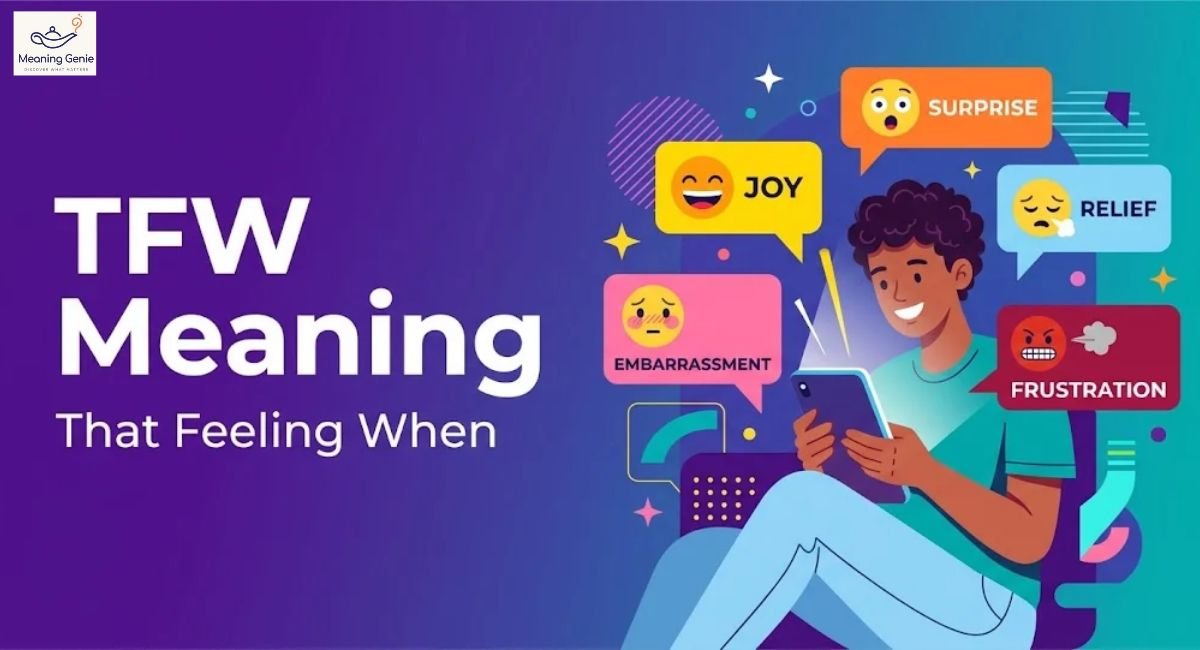
Have you ever seen someone write “TFW” in a text message, meme, or social media caption? TFW means “That Feeling When” or “That Feel When.” People use it to introduce a feeling connected to a particular situation, often one that is funny, awkward, exciting, or relatable.
You will often see this Internet abbreviation before a short description of an experience. For example, “TFW you finally finish your work” expresses the relief of completing a task. Once you understand the phrase, you can recognize it in memes, comments, and everyday online conversations.
This guide explains the TFW meaning in text, its internet origins, how people use it across social platforms, and how it differs from similar abbreviations.
Quick Answer: What Does TFW Mean?
TFW stands for “That Feeling When” or “That Feel When.” It is an informal expression used to describe an emotion or reaction connected to a particular moment.
| Term | Meaning | Common use |
| TFW | That Feeling When / That Feel When | Describing a relatable feeling or situation |
| MFW | My Face When | Describing your reaction to something |
| MRW | My Reaction When | Showing how you react to an event |
| TFW no GF | That Feeling When No Girlfriend | An early internet meme about loneliness |
Example: “TFW you find money in an old jacket.”
Here, the writer is expressing the happiness and surprise of finding unexpected money. The phrase does not need a picture or GIF to make sense.
What Does TFW Mean?
TFW Meaning in Simple Words
The TFW slang meaning is simple: it describes how you feel when something happens. Think of it as a short introduction to an emotion or experience. You can use it for happy moments, embarrassing situations, frustrating events, or anything that makes you think, “I know that feeling!”
For example, imagine waiting all week for Friday. When the weekend finally arrives, you might post, “TFW it’s finally Friday.” Anyone who enjoys finishing a busy workweek can understand the feeling. This makes TFW useful for Expressing emotions through short, casual messages.
What Does TFW Stand For?
The most common TFW full form is “That Feeling When.” You may also see “That Feel When,” which is an informal variation widely associated with internet meme culture. Some dictionaries also recognize “That Face When” as an expansion connected to reaction images.
These versions are closely related, but “That Feeling When” is a clear choice when explaining the modern expression. The phrase introduces a situation and the emotion connected to it. In other words, TFW is less about describing an actual face and more about communicating a Specific feeling or Emotional reaction.
Is TFW Positive or Negative?
TFW can express positive, negative, or mixed emotions. The abbreviation itself does not carry a happy or sad meaning. The words that follow it provide the context.
You can use it to describe Happiness, Sadness, Excitement, Frustration, Embarrassment, Confusion, Relief, or Surprise. It can even communicate Disbelief when something seems too strange to be true. The main purpose is to highlight an emotion connected to a situation.
Where Did TFW Come From? Origin and History
TFW developed through early internet culture, especially imageboard communities such as 4chan. Its history is connected to older expressions like “My Face When” (MFW), which people used to introduce a reaction to a particular situation. These phrases often appeared alongside funny or emotional images.
Over time, TFW became associated with “That Feel When” and the internet’s growing use of the word “feels” to describe emotions. The expression gradually moved beyond reaction pictures and became a standalone phrase in posts, captions, and comments. You can read more about this development in Know Your Meme’s explanation of TFW.
The Early Use of TFW on Internet Forums

One well-known early example was “TFW no GF,” meaning “That Feeling When No Girlfriend.” It appeared in online discussions about loneliness and the experience of not having a girlfriend. Know Your Meme records an archived 4chan post containing the phrase “that feel when no gf” from September 23, 2010.
The phrase later became closely associated with the “That Feel Guy” image and other reaction memes. Although its early use often involved sadness, the expression eventually expanded to cover many kinds of emotions. You can explore the documented history in the TFW No GF meme entry.
How TFW Became Popular in Meme Culture
As online communities shared more reaction images, TFW became a convenient way to introduce a situation. A caption could describe an awkward moment, while the image showed the emotion behind it. This combination made the expression easy to understand and share.
Today, TFW is recognizable as TFW internet slang, even though its use can vary between communities. Some people write it before a complete sentence, while others use it as a short caption. Its connection to Meme culture remains strong, but you do not need to create a traditional meme to use it.
How Is TFW Used in Texting and Online Conversations?
TFW usually appears at the beginning of a sentence or caption. It introduces a situation that causes a particular feeling. People often use it in Casual communication because it conveys an emotion without requiring a long explanation.
For example, “TFW your phone battery reaches 1% when you’re away from home” describes a familiar moment of panic. The reader understands the situation and the emotion almost immediately. This is why TFW works well in Informal texting, comments, and other Digital conversations.
TFW in Everyday Text Messages
In private messages, friends may use TFW to share something funny, frustrating, or exciting that happened during their day. It can make a simple update sound more expressive. The phrase also helps the sender show that a situation has a particular emotional effect.
For example, someone might text, “TFW you get home and realize tomorrow is a holiday.” The message communicates relief and excitement without needing a long explanation. This kind of Relatable experience makes TFW useful in everyday chats and Group chats.
TFW in Different Emotional Situations
TFW is flexible because it can introduce almost any feeling. You might use it after a small achievement, an unexpected problem, or a moment that makes you laugh. It can also describe an experience that is difficult to explain in ordinary words.
The expression works best when the situation is clear. A reader should understand what happened and why it creates an emotional response. Whether the moment involves Funny situations or difficult Emotional experiences, the context gives TFW its meaning.
TFW Meaning on Social Media Platforms
The TFW meaning on social media generally stays the same across platforms: “That Feeling When” or “That Feel When.” You may see it in captions, comments, posts, memes, or video descriptions. The format changes, but the basic purpose remains the same.
On Instagram, someone might use TFW with a photo or Reel caption. On TikTok, it may introduce a relatable video scenario. On Facebook, it can appear in posts shared with friends. On Reddit and Discord, users may include it in discussions, community jokes, or reaction messages. It can also appear on X (Twitter) and Threads. These are examples of possible usage, not separate platform-specific definitions.
Does TFW Mean Something Different on Instagram or TikTok?
No. TFW does not normally have a different meaning on Instagram or TikTok. It still introduces a feeling connected to a situation. The difference is usually how people present that feeling.
An Instagram user might write TFW in a photo caption, while a TikTok creator might place it above a short video. The same expression can also appear in comments or descriptions. If you understand the context, you can usually understand the message without knowing anything special about the platform.
See also: WTW Meaning in Text: What Does WTW Mean on Snapchat, TikTok & Social Media?
TFW Meaning in Memes
The TFW meaning in memes is closely connected to describing a recognizable feeling through a short caption. A meme might show someone celebrating, panicking, looking confused, or reacting dramatically. The TFW caption explains the situation that supposedly caused that reaction.
For example, a picture of someone smiling could appear with the caption, “TFW your favorite food is on the menu.” The image communicates happiness, while the caption explains why. This combination creates Relatable memes that people can quickly understand and share.
What Does a TFW Meme Usually Look Like?

A typical TFW meme combines a short situation with an image, GIF, or reaction picture. The caption often begins with “TFW” and describes something familiar or amusing. The image then adds another layer of meaning by showing the person’s supposed reaction.
However, there is no fixed design. Some memes use photographs, cartoons, or reaction faces, while others contain only text. The important part is the connection between the situation and the feeling. A good Meme caption makes that connection easy to recognize.
Does TFW Always Need a Picture or GIF?
No. TFW can work perfectly well without an image, GIF, or video. People regularly use it in ordinary text messages and written posts. The phrase itself gives readers enough information when the situation is described clearly.
Images can make a message funnier or more expressive, but they are optional. For example, “TFW you remember you have no meetings tomorrow” communicates relief even without a picture. The words alone can create a Relatable moment.
TFW Examples in Text Messages and Sentences
The easiest way to understand TFW is to see it in everyday situations. The following TFW examples show how people can use the expression to describe different emotions. Each sentence introduces a moment and the feeling connected to it.
| Emotion or situation | TFW example | What it expresses |
| Happiness | TFW you get an unexpected day off. | Joy and excitement |
| Relief | TFW you finish your assignment before the deadline. | Relief after completing a task |
| Embarrassment | TFW you wave at someone who wasn’t waving at you. | Awkwardness |
| Frustration | TFW the Wi-Fi stops working during your favorite show. | Annoyance |
| Excitement | TFW your favorite singer announces a new album. | Happiness and anticipation |
| Confusion | TFW someone explains something and you understand even less. | Confusion |
| Surprise | TFW you find money in an old pair of jeans. | Unexpected happiness |
| Disbelief | TFW your friend says they’ve never watched your favorite movie. | Shock or disbelief |
See the picture below which is showing chat screenshot of how TFW used in text messages to describe relief, frustration and surprise.

TFW Examples in Casual Conversations
You can also use TFW in short exchanges with friends. Imagine your friend has been waiting for a food delivery. When it finally arrives, they might message, “TFW the food finally gets here.” The phrase adds emotion to an otherwise ordinary update.
Another example is, “TFW you open your laptop and it updates for 30 minutes.” This describes a familiar frustration that many people can recognize. These examples show how TFW turns Everyday situations into short, expressive messages.
How to Use TFW Correctly
Using TFW is easy. Place it before a situation that creates a recognizable feeling, then explain what happened. You do not need to follow strict grammar rules because it belongs to Informal language. Still, your message should be clear enough for the reader to understand the situation.
You can write TFW in uppercase or lowercase. Both “TFW” and “tfw” are commonly understandable in casual online writing. Choose whichever style feels natural, and avoid adding the abbreviation where it does not help the sentence.
When Should You Use TFW?
Use TFW when you want to describe a feeling, share a relatable moment, or make a casual message more expressive. It works particularly well when your audience understands internet slang and the situation is easy to recognize.
For example, you could write, “TFW you wake up five minutes before your alarm.” This gives readers an immediate picture of the moment. It is suitable for friendly messages, memes, and Online discussions, but it may not fit every situation.
When Should You Avoid Using TFW?
TFW is best suited to casual communication. Avoid using it in formal reports, official letters, or serious workplace messages where clear and professional wording matters more. Some readers may not recognize the abbreviation, especially if they do not spend much time in online communities.
In Professional communication, it is usually better to describe the situation directly. The same applies to Business emails, academic writing, and formal documents. You can still discuss TFW in those settings when the abbreviation itself is the subject.
TFW vs. MFW, MRW, and Other Similar Slang
TFW is related to several other internet expressions, but they do not all mean exactly the same thing. Some introduce a feeling, while others focus on a person’s face or reaction.

Understanding these differences can help you interpret Popular internet slang and other Internet abbreviations more accurately.
| Abbreviation | Full form | Main purpose |
| TFW | That Feeling When / That Feel When | Introduces a feeling connected to a situation |
| MFW | My Face When | Describes or introduces your facial reaction |
| MRW | My Reaction When | Introduces your reaction to something |
| IYKYK | If You Know, You Know | Refers to an inside joke or shared knowledge |
| POV | Point of View | Presents a situation from a particular perspective |
See also: What Does OTW Mean in Text? Meaning, Full Form, Examples & Uses
TFW vs. MFW
TFW means “That Feeling When,” while MFW means “My Face When.” TFW focuses on the emotion connected to a situation. MFW focuses more directly on the expression or reaction someone might show.
For example, “TFW you get good news” describes the feeling of receiving good news. “MFW I get good news” emphasizes the person’s facial reaction. The two expressions can appear in similar memes, but their wording gives them slightly different purposes.
TFW vs. MRW
MRW stands for “My Reaction When.” It introduces how someone reacts to a particular event, message, or situation. TFW is more focused on the feeling associated with that moment, while MRW often emphasizes the response itself.
For example, “TFW your vacation finally begins” highlights the feeling of excitement. “MRW my vacation finally begins” suggests the person’s reaction, which might be shown through a GIF or image. Both are informal expressions used in online conversations.
TFW vs. IYKYK and POV
IYKYK means “If You Know, You Know.” People use it when a joke, experience, or reference makes sense mainly to those who understand the context. POV means “Point of View” and introduces a situation from a particular perspective.
TFW is different because it introduces a feeling connected to an event. These expressions may appear together in Digital communication slang, but they serve different purposes. Knowing the difference makes online messages easier to understand.
How to Respond When Someone Sends You TFW
Your response depends on what the sender is describing. If the situation is funny, you can laugh or share a similar experience. If it expresses frustration or sadness, a sympathetic response may be more appropriate.
For example, if a friend writes, “TFW you miss the bus by two seconds,” you could reply, “That is the worst feeling!” If they write, “TFW you finally get paid,” you might respond, “Enjoy it while it lasts!” You do not need a special reply for TFW. Respond to the situation and emotion behind the message.
Does TFW Have Other Meanings?
Although TFW is widely recognized as internet slang, its meaning can change in a different context. In casual texting and online posts, it usually means “That Feeling When” or “That Feel When.” However, Canadian employment and immigration materials also use TFW as an abbreviation for “Temporary Foreign Worker.”
| Context | TFW meaning |
| Texting and social media | That Feeling When / That Feel When |
| Internet memes | That Feeling When / That Feel When |
| Canadian employment and immigration | Temporary Foreign Worker |
The Canadian meaning refers to a foreign national who is authorized to work in Canada under the relevant temporary worker arrangements. It is not the usual meaning in everyday texting. You can see the abbreviation in Canadian government material, including this Government of Canada document.
How Can You Tell Which TFW Meaning Someone Intends?
Look at the subject of the conversation. If someone writes, “TFW you finally get home,” they almost certainly mean “That Feeling When.” If a Canadian government document discusses work permits or foreign workers, TFW likely means “Temporary Foreign Worker.”
The surrounding words usually make the intended meaning clear. This is true of many Online slang terms and abbreviations because people often use the same letters in different fields. Context is the best way to avoid misunderstanding.
Common Misunderstandings About TFW
One common misunderstanding is that TFW always expresses sadness. That idea comes partly from early expressions such as “TFW no GF,” but modern usage covers many emotions. Another mistake is assuming that TFW must appear with a meme or reaction image. It can also stand alone in a text message.
People sometimes confuse TFW with MFW because both have roots in reaction-image culture. They are related, but their wording emphasizes different things. Remember that TFW introduces a feeling, while MFW refers to someone’s face or expression. Once you understand that distinction, the abbreviation becomes much easier to use.
Final Thoughts on TFW Meaning
The TFW meaning in text is “That Feeling When” or “That Feel When.” It is a simple internet expression that helps people describe emotions connected to everyday situations. You can use it for happiness, frustration, embarrassment, excitement, or almost any other recognizable feeling.
You will most often encounter TFW in casual messages, memes, captions, and online discussions. Remember that it does not require a picture, and its meaning usually stays the same across social media platforms. Once you understand the context, recognizing and using TFW becomes easy.
See also: Internet Slang and Texting Abbreviations: A Complete Guide to Online Language
FAQS
What does TFW mean in slang?
TFW means “That Feeling When” or “That Feel When.” People use it online to describe an emotion or relatable experience.
What does “TFW” mean in Gen Z slang?
In Gen Z slang, TFW means “That Feeling When.” It introduces a funny, awkward, exciting, or relatable situation.
What does TFW mean on my cell phone?
If TFW appears in your phone’s status bar, it usually stands for TracFone Wireless. It indicates a connection associated with TracFone or one of its service brands, rather than internet slang.
What is the difference between MFW and TFW?
MFW means “My Face When,” while TFW means “That Feeling When.” MFW emphasizes a facial reaction, whereas TFW describes the feeling connected to a situation.
What carrier does TFW use?
TFW refers to TracFone Wireless, a mobile virtual network operator (MVNO). It now operates under Verizon, which provides its main network infrastructure.
Is TFW part of Verizon?
Yes. Verizon acquired TracFone Wireless in 2021. TracFone operates as part of Verizon’s wireless business and offers service through brands such as Straight Talk and Total Wireless.
What is the meaning of TFW in work?
In Canadian employment contexts, TFW commonly stands for “Temporary Foreign Worker.” In casual workplace messages, however, it may still mean “That Feeling When,” depending on the context.

Words can be confusing—but understanding them shouldn’t be. I’m Muhammad Umair, an AI-powered SEO & content writer at Meaning Genie, helping readers decode slang, abbreviations, and internet language with simple, clear explanations.