
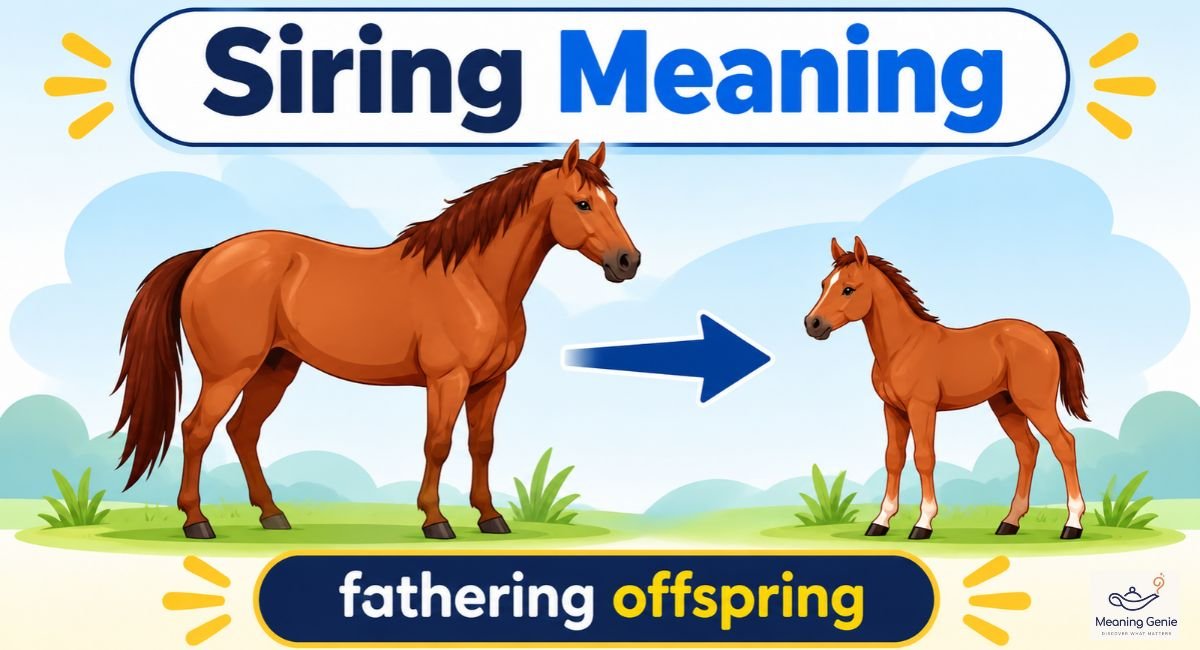
Siring means fathering or producing offspring as a male biological parent. The word comes from the verb “sire,” which refers to becoming the father of a child or animal. For example, when a stallion fathers a foal, people say he has sired that foal.
In everyday English, people mostly use siring when discussing animals, genetics, breeding, and family lines. It can also describe a man fathering children, although that usage sounds more formal or old-fashioned. Understanding the word becomes easier when you look at its grammar, examples, and different contexts.
What Does Siring Mean?
Siring means fathering offspring. In simple words, when a male animal becomes the biological father of young animals, he is said to be siring them.
The word comes from the verb “sire,” which specifically focuses on the male parent’s biological role. For example, when a stallion fathers a foal, you can say that the stallion is siring a foal.
Here is the basic meaning:
- Sire: To father offspring; also a male biological parent.
- Siring: The act of fathering offspring.
- Sired: Fathered offspring.
- Sire (noun): The male parent of an animal.
For example:
- The stallion is siring several foals.
- The bull is known for siring healthy calves.
- The dog has sired three litters.
- The male lion has sired several cubs.
The word focuses on biological fatherhood rather than raising or caring for offspring. Its exact meaning depends on the sentence and the situation.

What Is the Simple Definition of Siring?
The simplest definition of siring is fathering offspring.
When a male animal produces young through reproduction, he is siring those offspring. The word can also describe a man becoming the biological father of a child, although people rarely use it that way in casual conversations.
For example:
“The champion horse is siring a new generation of racehorses.”
This means the horse is fathering offspring that may become part of future racing generations.
Remember this simple connection:
Siring = Being the biological father of offspring.
What Part of Speech Is Siring?
Siring is the present participle and gerund form of the verb “sire.” It can describe an ongoing action or function as a noun-like word within a sentence.
The verb has several forms:
| Verb form | Word | Example |
| Base form | Sire | The stallion may sire another foal. |
| Third-person singular | Sires | The bull sires healthy calves. |
| Present participle | Siring | The horse is siring several foals. |
| Past tense | Sired | The dog sired five puppies. |
| Past participle | Sired | The stallion has sired many foals. |
Here are three sentences showing the difference:
- “The horse sires many foals.” This describes a general fact or regular activity.
- “The horse is siring many foals.” This describes an ongoing activity.
- “The horse sired many foals.” This describes an action that happened in the past.
Siring can also work as a gerund:
“Siring offspring requires careful breeding decisions.” Here, the word describes the activity itself rather than simply showing an ongoing action.
See also: What Does Increase Mean? Definition, Examples, and Uses
How Do You Use Siring in a Sentence?
Siring is generally used when discussing a male animal’s offspring or biological fatherhood. It often appears in breeding records, veterinary discussions, genetics articles, and descriptions of family lines.
Common expressions include:
- Siring offspring
- Siring foals
- Siring puppies
- Siring calves
- Siring cubs
- Siring a new generation
- Siring healthy offspring
Here are some examples:
| Sentence | Meaning |
| The stallion is siring several foals this season. | The horse is fathering several young horses. |
| The bull became famous for siring healthy calves. | The bull fathered healthy calves. |
| The breeder selected the dog for siring healthy puppies. | The male dog was chosen to father puppies. |
| The male lion was responsible for siring several cubs. | The lion was the biological father of several cubs. |
| The king was believed to have sired several children. | The king was believed to be their biological father. |
The final example is grammatically correct, but it sounds more formal than ordinary conversation. Most people would simply say that the king fathered several children.
Is Siring the Same as Fathering?
Siring and fathering have similar meanings because both can describe becoming the biological father of offspring. However, they differ in their usual contexts and tone.
Siring is strongly associated with animal breeding, genetics, and biological parentage. Fathering is more common when discussing humans and can sometimes refer to a broader parenting role.
Compare these examples:
- “The stallion is siring several foals.”
- “The man is fathering two children.”
Both sentences communicate biological fatherhood. However, the first sounds natural in animal-breeding language, while the second is less common than saying “The man is the father of two children.”
| Siring | Fathering |
| Common in animal breeding and genetics | Common in everyday English |
| Focuses on biological fatherhood | Can refer to biological fatherhood or a parenting role |
| Often sounds technical or formal | Usually sounds more conversational |
| Example: The bull is siring calves. | Example: He fathered two children. |
One important distinction is that siring does not mean raising children. A man can raise a child without being the biological father. Siring specifically concerns biological parentage.
What Is the Difference Between Siring and Breeding?
Siring and breeding are related to reproduction, but they do not mean exactly the same thing.
Siring refers specifically to the male parent’s role in producing offspring. Breeding is a broader term that can describe reproduction, planned mating, or the process of producing animals with particular characteristics.
For example, a farmer may breed cattle to develop a healthier herd. The bull sires the calves, while the cow is their female biological parent.
The difference is simple:
- Breeding: The broader reproductive process or planned mating.
- Siring: The male’s role as the biological father.
Consider these examples:
“The farm is breeding cattle.”
This describes the overall breeding activity.
“The bull is siring healthy calves.”
This identifies the male animal as the calves’ biological father.
The distinction matters in livestock management, horse racing, dog breeding, and genetics, where identifying both parents is important.

Is Siring Used for Humans?
Yes, siring can describe a man fathering a child. However, this usage is less common than “fathering” or “having children.”
When writers use siring for humans, they usually emphasize biological reproduction rather than everyday family life. The word may sound formal, historical, literary, or humorous depending on the context.
For example:
“The king was said to have sired several children.”
This means the king was believed to be their biological father.
In ordinary conversation, people would more naturally say:
“The king had several children.”
Cambridge Dictionary identifies this human use as old-fashioned or humorous. You can check its definition of siring for more information.
Also, remember that biological fatherhood and legal parenthood are different concepts. Siring a child does not automatically establish legal parental rights, custody, or responsibilities.
Why Is Siring Common in Animal Breeding?
Animal breeding often involves studying the characteristics passed from parents to offspring. Breeders need precise terms to identify the male and female parents of each animal.
This is where the word siring becomes useful. It clearly identifies the male animal’s reproductive role without requiring a longer explanation.
For example:
“This stallion has sired more than 100 foals.”
The sentence tells readers that the stallion is the biological father of those foals.
Breeders may examine a male animal’s offspring when evaluating inherited characteristics such as:
- Size and physical development
- Speed and athletic ability
- Strength and appearance
- Health-related traits
- Temperament and behavior
However, an offspring’s characteristics do not come from the sire alone. Both biological parents contribute genetic material, and other biological and environmental factors can influence development.
What Does Siring Mean in Horse Breeding?
In horse breeding, siring means that a male horse, called a stallion, has fathered one or more foals.
The word is especially common in horse pedigrees, racing records, and breeding discussions. Breeders often examine a stallion’s offspring to understand his breeding history and evaluate potential bloodlines.
For example:
“The champion stallion is siring several promising foals this year.”
This means the stallion is the biological father of those foals.
Horse breeding also uses three important terms:
- Sire: The male biological parent of a horse.
- Dam: The female biological parent.
- Foal: A young horse.
Here is a simple example of how these terms work:
| Pedigree role | Horse’s name | Relationship |
| Sire | Thunder | Biological father |
| Dam | Bella | Biological mother |
| Offspring | Star | Foal |
In this illustrative example, Thunder sired Star, while Bella is Star’s dam.
A stallion’s siring record can help breeders understand his reproductive history. However, a horse’s performance depends on much more than its sire. Its dam, genetics, training, health, and environment also play important roles.
What Does Siring Mean in Dog Breeding?
In dog breeding, siring means that a male dog has fathered puppies.
The male parent is called the sire, while the female parent is called the dam. Breeders use these terms when recording litters, documenting pedigrees, and tracking a dog’s breeding history.
For example:
“The champion Golden Retriever has sired several litters.”
This means the dog is the biological father of puppies from several litters.
You may also see sentences such as:
- The dog sired eight puppies.
- The breeder recorded the male responsible for siring the litter.
- The champion has sired dogs with strong working abilities.
These expressions are common in breeding-related discussions. In everyday conversation, however, people usually say that the dog fathered the puppies.
What Does Siring Mean in Genetics?
In genetics, siring describes the male parent’s role in producing offspring. A biological father contributes genetic material to his children or animal offspring.
Researchers and breeders sometimes need to identify the biological father of an animal. DNA parentage testing can help establish whether a particular male is the sire.
For example:
“The male horse was confirmed as the sire through DNA testing.”
This means genetic evidence supported the horse’s identification as the biological father.
The University of California, Davis Veterinary Genetics Laboratory explains how parentage testing compares DNA profiles to evaluate biological relationships. Its parentage testing service provides further information.
DNA testing can be particularly useful when breeders need to:
- Confirm an animal’s biological parentage.
- Maintain accurate pedigree records.
- Investigate uncertain breeding histories.
- Support breeding and genetic research.
One important point: siring identifies a biological relationship. It does not mean that the offspring will automatically inherit every physical or behavioral characteristic of the sire.
What Is the Origin and History of the Word Siring?
The word siring comes from the verb “sire,” which has a long history in the English language.
Historically, the word “sire” was used as a respectful way to address a father, lord, or king. It was also associated with male parenthood. Over time, the word became particularly familiar in animal breeding, where it identifies a male animal that fathers offspring.
The verb developed the meaning of fathering or producing offspring as a male parent. Adding “-ing” creates the form “siring.”
The basic relationship is:
Sire → Siring
The word “sire” also has historical roots in Middle English and Old French. Its older forms are connected to the Latin word senior, meaning an older person or elder.
Many animal-related words have interesting histories, and you can see another example in the origin of the word skink.
How Do You Pronounce Siring?
Siring is pronounced SYE-ring and has two syllables.
The first part sounds like the word “sire,” while the second part sounds like the ending in “running” or “reading.”
Here is an easy breakdown:
| Part | Pronunciation |
| First syllable | SYE |
| Second syllable | ring |
| Full pronunciation | SYE-ring |
The American pronunciation of “sire” is /saɪr/. Adding the “-ing” ending gives you “siring.”
If you already know how to pronounce “sire,” saying “siring” should feel straightforward.
Is Siring a Correct Spelling?
Yes, siring is the correct spelling. It is formed by adding “-ing” to the verb “sire” while dropping its final silent “e.”
A common spelling mistake is writing “sireing.” However, that form is incorrect in standard English.
The correct spelling is:
Sire + ing = Siring
The same spelling pattern appears in several other English words:
- Make → Making
- Write → Writing
- Drive → Driving
- Ride → Riding
- Sire → Siring
This is a common English spelling rule. When many verbs ending in a silent “e” take the “-ing” suffix, the final “e” disappears.
Siring vs. Sireing: Which Is Correct?
“Siring” is correct, while “sireing” is incorrect.
The confusion happens because the base word is “sire.” Someone might think the final “e” should remain when adding “-ing.” However, standard English spelling removes the silent “e” in this word.
Compare the following examples:
| Correct spelling | Incorrect spelling |
| The stallion is siring a foal. | The stallion is sireing a foal. |
| The bull is siring calves. | The bull is sireing calves. |
| The dog is siring puppies. | The dog is sireing puppies. |
Remember the rule: drop the final silent “e” before adding “-ing.”
Siring vs. Sired: What Is the Difference?
Siring and sired come from the same verb, but they describe different grammatical forms.
Siring is the present participle or gerund, while sired is the past-tense and past-participle form.
Compare these sentences:
“The stallion is siring several foals.”
“The stallion sired several foals.”
The first sentence describes an ongoing action. The second describes an action that happened in the past.
Here is another comparison:
| Siring | Sired |
| The dog is siring puppies this year. | The dog sired puppies last year. |
| The bull is siring calves. | The bull sired several calves. |
| The stallion is siring foals. | The stallion sired three foals. |
Both words refer to fathering offspring. The main difference is their grammatical role and the time of the action.
Siring vs. Sire: What Is the Difference?
The word “sire” can function as both a noun and a verb. As a noun, it identifies a male biological parent. As a verb, it means to father offspring.
“Siring” is the “-ing” form of that verb.
For example:
- “The horse’s sire was a famous champion.” Here, sire is a noun meaning male parent.
- “The horse sired several foals.” Here, sired is the past-tense verb.
- “The horse is siring several foals.” Here, siring describes an ongoing action.
The relationship is easy to remember:
| Word | Meaning |
| Sire | Male parent or to father |
| Sired | Fathered |
| Siring | Fathering |
These words are closely connected, but you should use each one according to the sentence’s grammar.
What Are Some Synonyms for Siring?
The closest everyday synonym for siring is fathering. However, other words can express similar ideas depending on the context.
Here are some related words and expressions:
| Synonym | Meaning |
| Fathering | Becoming the biological father of offspring |
| Begetting | Producing or fathering offspring; often literary or old-fashioned |
| Procreating | Reproducing or producing offspring |
| Producing offspring | A general description of reproduction |
| Reproducing | Creating offspring; a broader biological term |
These words are not always interchangeable.
For example, “fathering” is a close alternative when discussing male biological parenthood. “Reproducing” is broader and does not specifically identify the male parent.
When discussing animal pedigrees, siring is often the more precise word.

Can Siring Be Used in Formal Writing?
Yes. Siring is commonly used in formal and technical writing about animal breeding, genetics, agriculture, veterinary science, and biological parentage.
For example:
“The stallion is known for siring offspring with strong racing potential.”
“The breeding records identify the bull as the sire of several calves.”
“DNA testing helped confirm the male responsible for siring the offspring.”
The word can also appear in historical and literary writing about human parentage.
However, formal language is not always the clearest choice. If you are writing for general readers, “fathering” or “becoming the biological father of” may be easier to understand.
Choose the word that communicates your meaning most clearly.
Common Mistakes With Siring
People sometimes confuse siring with other words because they are closely related to reproduction and parenthood. Understanding the differences can help you use the word correctly.
Writing “Sireing” Instead of “Siring”
This is a common spelling mistake. The final silent “e” disappears before adding “-ing.”
Incorrect: The horse is sireing a foal.
Correct: The horse is siring a foal.
Using Siring to Mean Raising Children
Siring describes biological fatherhood. It does not mean taking care of or raising a child.
For example, “He is raising his children” describes parenting and daily care. “He sired three children” describes biological fatherhood.
These meanings are different.
Treating Siring and Breeding as Identical
Siring specifically identifies the male parent’s role. Breeding describes the broader reproductive process.
“The farm is breeding cattle” refers to the overall activity.
“The bull is siring calves” identifies the male biological parent.
Assuming Siring Applies to Every Parent
Siring specifically refers to the male parent’s role. It should not be used as a general replacement for giving birth or producing offspring regardless of sex.
Using the correct term makes your writing more accurate.
See also: Strife Meaning: Definition, Examples, Origin, and How to Use It
What Are Some Real-World Examples of Siring?
The word appears in different situations, especially when discussing animals, reproduction, and biological family relationships.
Here are some examples:
- “The stallion is siring his first group of foals.” This means the horse is fathering its first group of young horses.
- “The bull has sired hundreds of calves.” This means the bull has fathered hundreds of calves.
- “The dog sired a litter of puppies.” This identifies the dog as the puppies’ biological father.
- “Scientists used DNA testing to identify the sire.” This means they used genetic evidence to identify the biological father.
- “The famous racehorse was responsible for siring many successful offspring.” This means the horse fathered many offspring that achieved success.
- “The breeder carefully recorded which male was siring each litter.” This means the breeder tracked the biological fathers of different litters.
- “The historical account claimed that the king had sired several children.” This means the account described the king as their biological father.
These examples show how the word works in animal breeding, genetics, history, and discussions about biological parentage.
Does Siring Have a Negative Meaning?
No. Siring is generally a neutral word. It describes the biological act of fathering offspring and does not automatically express praise, criticism, or insult.
The surrounding sentence determines the tone.
For example:
“The stallion has sired many healthy foals.”
This is a neutral or positive statement about the horse’s breeding history.
“The research examined the number of offspring sired by each male.”
This is a neutral scientific statement.
The word itself does not carry a negative or insulting meaning. However, a sentence can discuss siring in a negative context depending on the subject.
Is Siring Common in American English?
Yes. Siring is understood and used in American English, particularly in writing about animal breeding, genetics, horse racing, and biological parentage.
However, it is not especially common in everyday conversations. Most Americans would use “fathered” or “had children” when talking about human parenthood.
For animals, words such as “sire,” “sired,” and “siring” are natural in many breeding-related contexts.
For example:
“The champion horse sired 20 foals.”
This sentence sounds natural in horse-breeding language.
Is Siring Used Differently in British English?
The basic meaning of siring is the same in British and American English.
British writers also use “sire,” “sired,” and “siring” when discussing horses, livestock, pedigrees, and biological parentage.
There is no major difference in the spelling or central meaning between the two varieties of English.
The main difference is how frequently people use the word in particular contexts. In both countries, it is more familiar in animal-breeding language than in casual conversations.
Why Do Writers Use Siring Instead of Fathering?
Writers often choose siring because it is concise and precise, especially when discussing male animals and their offspring.
Compare these sentences:
“The stallion fathered 50 foals.”
“The stallion sired 50 foals.”
Both sentences communicate the same basic idea. However, “sired” is a familiar technical term in horse breeding and pedigree records.
The word also keeps attention on biological parentage. A writer discussing genetics may prefer it because it identifies the male parent without suggesting anything about parenting behavior or daily care.
In short, siring is useful when biological fatherhood is the main point of the discussion.
How Can You Remember the Meaning of Siring?
A simple way to remember siring is to connect it with the word “sire.”
A sire is a male biological parent. Therefore, siring means acting as the biological father of offspring.
Remember these three related forms:
- Sire = Father
- Sired = Fathered
- Siring = Fathering
You can also remember the spelling through a simple rule:
“Drop the silent e before adding -ing.”
So:
Sire + ing = Siring
Not “Sireing.”
This small connection makes both the meaning and spelling easier to remember.
Quick Examples to Understand Siring
Here are some short examples with simple explanations to help you understand the word quickly.
| Example | Simple meaning |
| The bull is siring calves. | The bull is fathering calves. |
| The stallion sired the foal. | The stallion was the foal’s biological father. |
| The dog has sired several litters. | The dog has fathered puppies in several litters. |
| The DNA test confirmed the horse as the sire. | The test helped identify the horse as the biological father. |
| The breeder is tracking which dogs are siring puppies. | The breeder is recording which male dogs are fathering puppies. |
These examples cover the most common ways you may encounter siring in everyday reading and technical discussions.
Conclusion
Siring means fathering offspring as a male biological parent. It is especially common in animal breeding, horse racing, genetics, agriculture, and pedigree discussions. Although the word can describe human fatherhood, it usually sounds more formal or old-fashioned in that context.
Remember the simple relationship: sire means a male parent or to father, sired means fathered, and siring means fathering. Once you understand this connection, you can recognize the word and use it correctly in different situations.
FAQS
What does siring mean in simple words?
Siring means fathering offspring. It usually describes a male animal becoming the biological father of young animals, but it can also refer to human fatherhood.
What does it mean when a person is siring?
When a man is described as siring, it means he is fathering a child biologically. This usage can sound formal, old-fashioned, or humorous.
Is siring the same as fathering?
They are closely related when discussing biological parenthood. However, siring is more common in animal breeding and technical discussions, while fathering is more familiar in everyday English.
What is the difference between a sire and a dam?
A sire is the male biological parent of an animal, while a dam is the female biological parent. For example, a stallion is the sire of a foal, and the mare is its dam.
Is siring a proper word?
Yes. Siring is a recognized English word and the correct present participle and gerund form of the verb “sire.”
What is the past tense of siring?
The past tense of the verb “sire” is “sired.” For example, “The stallion sired three foals last year.”
Is siring or sireing correct?
Siring is correct. Sireing is incorrect because the final silent “e” is removed before adding “-ing.”
What is another word for siring?
Fathering is the closest everyday synonym. Depending on the context, begetting or producing offspring may also express a similar idea.
Is siring used only for animals?
No. It can also describe a man fathering a child. However, this use is less common than using the word “fathering.”
Does siring have a negative meaning?
No. Siring is generally a neutral term that describes biological fatherhood. The context determines whether a sentence has a positive, negative, or neutral tone.
What is the opposite of siring?
There is no exact opposite of siring. In animal breeding, the female parent is called the dam, but this identifies a different reproductive role rather than a direct antonym.

Words can be confusing—but understanding them shouldn’t be. I’m Muhammad Umair, an AI-powered SEO & content writer at Meaning Genie, helping readers decode slang, abbreviations, and internet language with simple, clear explanations.