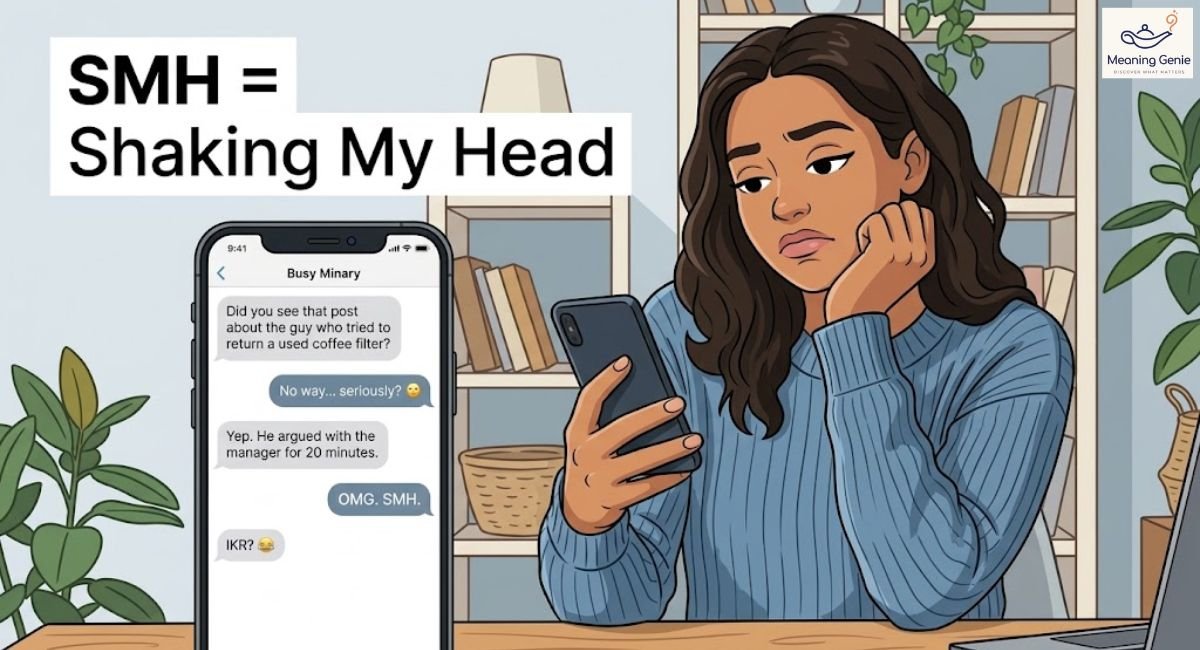
Your friend answers your weekend plans with one word: “smh.” Did you do something wrong? Probably not. The SMH meaning in text is simple. It stands for “shaking my head” and shows disbelief, disappointment, or mild frustration. Below you will find how to read the tone, example chats, and ready-to-copy replies for every situation.
What Does SMH Mean in Text?
SMH stands for “shaking my head.” People type it in text messages, comments, and chats to show disbelief, disappointment, or mild frustration. It works like the head shake you would give in person. Example: “He texted me at 3 a.m. to ask about homework. smh.”
Dictionary.com describes SMH as an internet slang initialism that signals disappointment, disapproval, frustration, or impatience. You can read the full entry at Dictionary.com. The idea is easy to grasp. You cannot show a head shake through a screen, so three letters do the job for you. That is why the SMH full form stays the same on every app.
Spelling matters a little. The correct order is S-M-H. QuillBot points out that “SHM” is a common mistake, and you can see its explanation in the QuillBot SMH guide. You can also place SMH at the end of a sentence or let it stand alone. Both are normal.
| Quick Fact | Detail |
| Full form | Shaking my head |
| Type | Internet slang initialism |
| Main feelings | Disbelief, disappointment, mild frustration |
| Formality | Informal |
| Earliest record found | Urban Dictionary entry, February 2004 |
What Does SMH Mean From a Girl or Guy?
The SMH meaning from a girl and the SMH meaning from a guy are identical. Gender does not change the letters or the definition. What changes the feeling is the sender’s history with you, the punctuation, and any emoji nearby. Think of it like a shrug. A shrug from your best friend means something different from a shrug from your boss.
Here is how that plays out. A crush who sends “smh 😂” is probably teasing you. A partner who sends a bare “smh.” after an argument likely feels hurt or tired. A guy friend who writes “smh bro” after you lose a game is just joking around. When you cannot tell, ask a calm question like “Does that bother you?” That beats guessing every time.
| Message | Sender | Likely Feeling |
| “smh 😂 you’re so dramatic” | Crush | Flirty teasing |
| “smh.” | Partner after a fight | Hurt or frustration |
| “smh bro, third time this week” | Friend | Friendly disapproval |
The Tone Behind SMH
SMH is really a tone word. The meaning stays put but the mood moves around. Lowercase “smh” feels relaxed. Capital “SMH” sounds louder and firmer. Add a period or dots and it can sound tired or cold. In short, small marks do the work that your face and voice would do in person.

Emojis steer the message too. A laughing face softens it into a joke. The eye-roll face makes it sarcastic. A crying face usually signals dramatic frustration played for laughs. Meanwhile, no emoji at all can read as flat. Before you decide someone is upset, look at the whole message.
| Version | Tone Level | What It Feels Like |
| smh | Mild | Casual shrug |
| smh 😂 | Mild | Teasing |
| SMH | Medium | Firm disapproval |
| smh. | Medium | Cold or tired |
| smh 🙄 | Strong | Eye roll |
A flat “wtv” can carry the same eye-roll energy. See what WTV means in text.
Disappointment
Your friend cancels dinner for the third time and you reply “smh.” You are not angry. You are let down. This quiet use is common after broken plans or small betrayals. A kind reply such as “Yeah, I owe you one” usually calms things.
Disbelief
This is the classic use. Someone says a squirrel stole their homework and you type “smh” in amazement. You feel surprise mixed with a smirk. In this mood the sender is reacting to something unbelievable rather than attacking a person.
Sarcasm or mild annoyance
A dry “smh” can act like an eye roll. Your brother promises to start his diet tomorrow, again, and you answer “smh.” Watch for a period or a 🙄. Those clues show the joke has a little irritation hiding inside it.
Playful use among friends
Friends often toss it around like confetti. Someone posts a terrible pun in the group chat and three people reply “smh 😂.” Nobody gets hurt. In close circles it works as a friendly nudge, so you can relax.
How to Reply When Someone Says SMH
Before you answer, read the mood. Did they add a laughing emoji or a cold period? That quick scan saves awkward moments. Knowing how to reply to SMH starts with the SMH meaning in text and ends with the context around it. You can match their playful energy or calm things down if they sound upset.

Most replies fall into three styles. Casual replies keep things easy. Funny replies lighten the mood. Formal replies protect your professional image. Pick the one that suits the person, then hit send. Do not overthink it, because nobody expects a speech.
Casual replies
Casual replies work best with friends and family. Try “Yeah, that was a bad call,” “Fair, I messed up,” or “Okay, what’s wrong?” Each one admits the feeling without starting a fight. Short and honest wins here.
Funny or playful replies
Humor melts tension when the mood is light. Try “Shake it off, buddy 😂,” “My head is shaking right back,” or send a facepalm GIF. However, skip the joke if the sender sounds truly upset. Timing matters more than the punchline.
Formal or professional replies
A boss, client, or teacher needs a calmer tone. Write “Understood. I will fix it today,” or “Thanks for the feedback. Let me clarify.” These replies show respect and move the conversation forward. Avoid slang in return, because plain words protect trust.
SMH Examples in Everyday Chats
Seeing SMH in action makes the tone easier to read. Notice the punctuation, the emoji, and who is talking. A friend’s “smh” feels light. A manager’s “smh” can feel heavy. Speed matters as well, since a quick reply often signals humor while a slow one can signal real frustration.

Each short chat below shows a different mood. Read them as a decoder guide. Then compare them with the messages on your own phone.
Friends and group chats
Mia: I wore two different shoes to class.
Jay: smh 😂 how did you not notice?
Sam: Pizza for breakfast again?
Leo: smh. Respect, though.
School or work
Coworker: The meeting moved to 8 a.m. again.
You: smh. Setting three alarms now.
Classmate: I started the essay at 11:58 last night.
You: smh, you live dangerously.
Dating
Her: He left me on read for two days.
You: smh, you deserve better.
News and social media
Post: A man tried to return a used car after one year.
Comment: SMH. People never cease to amaze me.
Gaming
Teammate: I walked off the map by mistake.
You: smh 😭 third time tonight.
Is SMH Rude? When to Use It (and When Not To)
SMH is not rude by default. It is informal language, so the target decides how it lands. Saying “smh at this traffic” is harmless. Saying “smh at you” can sting. QuillBot notes that SMH fits best when you talk about situations rather than people, since aiming it at a person can feel like gossip. That is a handy rule to remember.
Quick note for parents and English learners: SMH is not an insult on its own. It is shorthand for a head shake. Look at the words around it to see who or what the sender means. Bark, a parental-monitoring company, says kids often use SMH to express displeasure.
As a simple rule, the closer you are to someone, the safer SMH becomes. That also answers the common question of whether SMH is formal or informal. It is informal, and it belongs in casual spaces.
Safe contexts
Friends, group chats, memes, and public comments about silly news are safe ground. Complaining about a bad movie or a strange headline works fine. In these casual spaces, everyone understands the shrug. Keep it short and avoid pointing it at one person.
Avoid it in work emails, condolences, or serious topics
Skip SMH in work emails, sympathy messages, and heavy conversations. A grieving friend does not need your head shake. A client might read it as mocking. Say what you mean instead, such as “I’m concerned about this” or “I’m so sorry.” Clear kindness beats slang every time.
SMH on TikTok, Snapchat, and Other Apps
The SMH meaning does not change by app. It means “shaking my head” on WhatsApp, Instagram, TikTok, Snapchat, X, and Facebook. You never need a separate decoder for each platform. What shifts is the setting. Public comments tend to feel more performative because strangers are watching. Private chats tend to feel looser. These are general patterns rather than strict rules.
On WhatsApp, SMH usually appears in private chats and family or friend groups. It tends to feel personal and direct. A short “smh” after a silly story is normal and friendly.
On Instagram, people often drop SMH in comments under posts or in replies to stories. The audience is wider, so the tone can sound more like a public reaction than a private joke.
TikTok
On TikTok, SMH shows up in comment sections under funny, shocking, or cringe videos. It usually works as a quick reaction to what the creator did. Commenters often pair it with emojis.
Snapchat
On Snapchat, SMH fits the quick, casual style of chats and replies. Users often add 😂 or 🙄 to make the mood clear. Since messages are fast and informal, the tone usually stays light.
X and Facebook
On X and Facebook, SMH often appears under news posts and public arguments. Dictionary.com says the slang had spread on Twitter by 2007, so the link to those platforms goes back a long way.
SMH vs. SMDH and Similar Slang
SMDH means “shaking my damn head.” It is simply a stronger version. Use SMH for mild moments and SMDH when you feel truly fed up. Know Your Meme records an Urban Dictionary entry for SMDH from June 2007. See its SMH page for details. You will also see “SMH my head.” That phrase repeats itself because the H already means head, although most people still understand it.
Next comes the facepalm. A facepalm is the image or emoji of a hand covering the face. SMH is the typed version of a head shake. Both react to something foolish, so they often travel together. Wikipedia’s facepalm page notes that the gesture is used online to show emotions that are hard to express through text alone.
| Term | Meaning | Tone | Best Use |
| SMH | Shaking my head | Mild | Everyday disbelief |
| SMDH | Shaking my damn head | Strong | Real frustration |
| SMHS | Shaking my head sadly | Mild and sad | Disappointment |
| SMFH | A profane, harsher form | Very strong | Avoid in public |
| Facepalm | Hand on face | Playful | Silly mistakes |
| FML | A profane phrase about a bad day | Strong | Venting to close friends |
| BRUH | Casual disbelief | Mild | Friends and gaming |
| IDK | I don’t know | Neutral | Uncertainty |
| TBH | To be honest | Neutral | Sharing an opinion |
Not every reaction is a head shake. You can also see WTH meaning which shows surprise or confusion rather than a head shake, so it works differently from SMH.
Other Meanings of SMH
Sometimes the same letters mean something else. Dictionary.com lists “so much hate” and “scratching my head” as less common meanings. The first expresses disdain. The second shows puzzlement. If a message feels odd, read the sentence around the letters before you decide.
SMH is also the common shorthand for the Sydney Morning Herald, an Australian newspaper whose website is smh.com.au. If you see SMH next to a headline or a news link, think journalism rather than head shakes. In everyday US texting, though, “shaking my head” wins almost every time.
Where SMH Came From
Nobody knows who first typed it. Dictionary.com says SMH was first entered on Urban Dictionary in 2004 and had spread on Twitter by 2007. Know Your Meme dates that Urban Dictionary entry to February 14, 2004. Those are the earliest dated records available, but they show when people wrote it down rather than who invented it.
The slang kept growing from there. Dictionary.com adds that the term may have started among Black internet users, since early notable uses appear in those speech communities. How-To Geek says it reached peak popularity in the early 2010s through sites like Facebook and Tumblr. Some sites claim much older or vaguer dates. Treat those with caution unless they cite a record.
Is SMH Still Popular?
Google Trends shows that US searches for “smh” climbed fast around 2010 and peaked in late 2011 or early 2012. Interest has stayed lower since then. It rose again in 2026 before easing, so the slang is clearly still on people’s radar. Below is Google Trends chart of US search interest in smh from 2004 to present, peaking around 2011 to 2012 and staying lower since. Accessed October 3, 2026.

A lower line does not mean people stopped using SMH. Most readers now know the slang, so fewer need to look it up. Still, the chart shows its biggest buzz is behind it. Trends scores interest from 0 to 100 against the term’s own peak, so it shows direction rather than real search counts.
Conclusion
Now you know the SMH meaning in text. It stands for “shaking my head” and shows disbelief, disappointment, or mild frustration. Tone and context do the rest. Check the punctuation and emoji before you react, and you will avoid most misunderstandings. SMH means the same thing on every app, but the mood shifts with the sender, the audience, and the little clues around it.
Keep a few simple habits in mind. Save SMH for casual chats and skip it in work emails or sympathy messages. Aim it at situations rather than people. Pick a reply that fits the mood, whether that means a quick joke, an honest apology, or a polite professional answer. These small choices keep your messages friendly and clear.
FAQS
Is SMH disrespectful?
Not by default. It’s casual slang, but it can feel disrespectful when you aim it at a person or send it in a serious moment.
How to reply to SMH?
Read the tone first. Then match it with a casual “Yeah, my bad,” a joke like “Shake it off 😂,” or a formal “Thanks for the feedback.”
What does SHM mean in a text message?
Most of the time it’s a typo for SMH, “shaking my head.” The correct order is S-M-H.
What does SMH stand for?
SMH stands for “shaking my head.” People use it to show disbelief, disappointment, or mild frustration.
When a girl says “smh”?
It means the same as from anyone: she’s surprised, disappointed, or reacting to something silly. Check her punctuation and emoji, since “smh 😂” is playful and a bare “smh.” can sound cold.
What is the difference between SMH and facepalm?
SMH is typed slang for a head shake. A facepalm is an emoji, image, or GIF of a hand on the face. Both react to something foolish.
Can SMH be used in formal writing?
No. It’s informal slang, so use plain words like “I disagree” or “I’m surprised” in emails, reports, and school papers.

Words can be confusing—but understanding them shouldn’t be. I’m Muhammad Umair, an AI-powered SEO & content writer at Meaning Genie, helping readers decode slang, abbreviations, and internet language with simple, clear explanations.
2 thoughts on “What Does SMH Mean in Text? Meaning, Examples & How to Reply”