
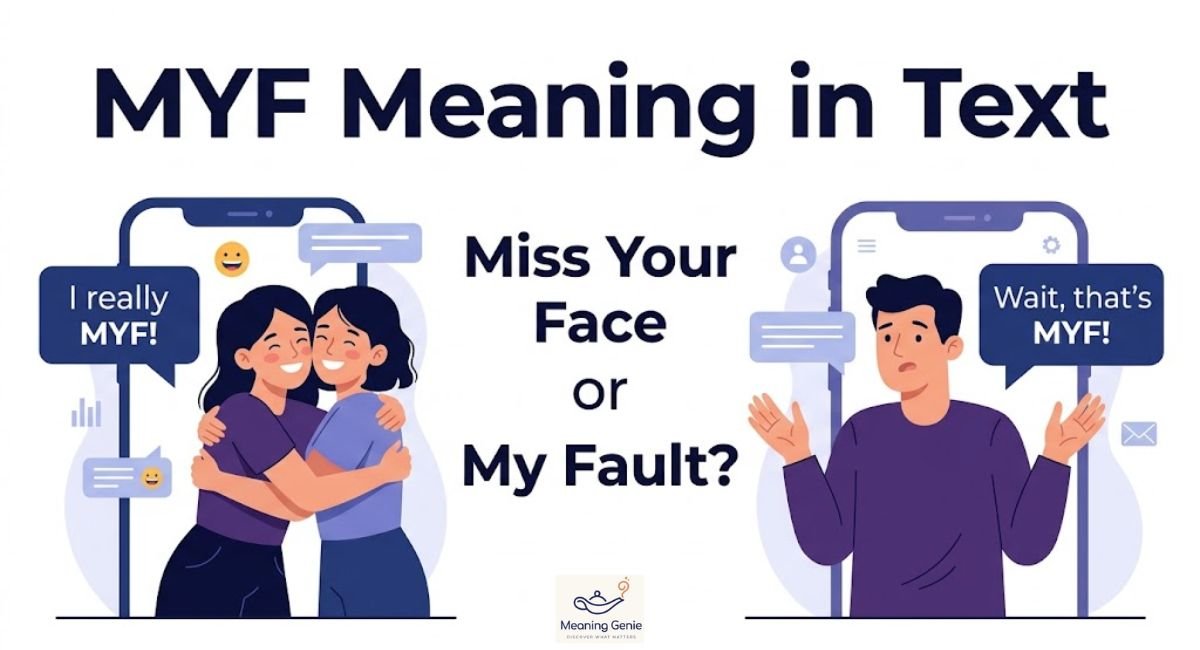
MYF most often means “Miss Your Face,” a casual way to say you miss someone. It can also mean “My Fault” when someone admits a mistake. Check the conversation: missing someone points to Miss Your Face, while an error points to My Fault.
Quick Answer
| MYF Meaning | What It Means | Typical Context | Tone |
| Miss Your Face | I miss seeing you | Friends, partners, dating | Warm, playful |
| My Fault | I made the mistake | Errors, apologies | Casual, apologetic |
| Mind Your Feelings | Be careful with emotions | Rare, advice-style messages | Cautionary |

Three letters are not enough to decide. The sentence before it, the relationship, and the topic usually settle the question in seconds.
What Does MYF Mean in Text?
What Does “Miss Your Face” Mean?
“Miss Your Face” means you miss someone’s company. Nobody means it literally. “Your face” stands in for the whole person: their expressions, their presence, the way they’re usually around.
A friend who moved away might text, “MYF! We need a reunion soon.” That is affection and nostalgia, not romance.
Why People Say “Face” Instead of “You”
“I miss you” is direct and can feel heavy. “I miss your face” adds a playful image that keeps the message light while still being personal. That small change is the whole appeal of the phrase.
Is MYF the Same as “I Miss You”?
Close, but not identical. When MYF means Miss Your Face, the feeling is similar, yet it sounds more casual and teasing. “I miss you” is clearer and works better when the emotion is serious. The separate abbreviation for “I miss you” is IMY.
Origin of MYF in Texting
There is no verified inventor or documented first use of MYF, and I could not find an authoritative source tracing it. It appears to be informal shorthand that people shortened from everyday phrases while typing quickly, which is also why its meaning varies between conversations.
How Is MYF Used in Text Messages?
MYF Between Close Friends
Friends use it after time apart, such as after a move, a holiday, or a busy few months. “MYF! When are you back?” is warm without being sentimental. It does not imply romance.
You may also see BSF, a common abbreviation for “Best Friend.”
MYF Between Romantic Partners
Partners use it as a softer way to say they’re longing for each other, often with a heart emoji. The affection comes from the existing relationship, not from the abbreviation itself.
MYF After Time Apart or When Reconnecting
Absence and reunion are the most natural settings for it. “Welcome home! MYF.” acknowledges that someone was missed without a long emotional message.
MYF in Flirty or Dating Conversations
If the conversation already includes teasing, compliments, or talk of the next date, MYF can read as flirty. One abbreviation alone proves very little, so look at the pattern around it.
Common Texting Patterns
- “MYF” or “MYF ❤️” on its own, usually Miss Your Face in an affectionate chat
- “MYF already” after seeing someone, usually Miss Your Face
- “MYF, I forgot…” followed by an error, usually My Fault
Example Conversations

These are illustrative examples, not screenshots. They show how the same letters change meaning.
| Message | Likely Meaning | Why |
| “Haven’t seen you in months. MYF!” | Miss Your Face | The topic is separation |
| “Found our old photos. MYF. We need another trip.” | Miss Your Face | Nostalgia and plans to meet |
| “Wish you were here. MYF.” | Miss Your Face | Longing |
| “I forgot the tickets. MYF.” | My Fault | The sender admits a mistake |
| “You sent the wrong address.” “MYF, I copied the old one.” | My Fault | Responsibility for an error |
In this table example, Jordan answers Maya’s “I found our old vacation pictures” with “MYF,” which signals nostalgia. If Maya instead says “You sent me the wrong address” and Jordan answers “MYF, I copied the old one,” Jordan is taking responsibility. Same letters, opposite meanings, and the only difference is the topic.
How to Tell What MYF Means in a Message

Look at the Words Around MYF
“MYF, I forgot your birthday” points to My Fault. “MYF, we need to hang out” points to Miss Your Face. Read the full thought rather than the abbreviation alone.
Consider Who Sent the Message
A close friend after a long gap probably means Miss Your Face. A coworker after a mistake probably means My Fault. The sender’s relationship to you narrows the options quickly.
Check the Tone
Warm emojis, memories, and reunion plans favor Miss Your Face. Apologies, corrections, and explanations favor My Fault.
Think About What Happened Before
If you just said, “You missed the meeting,” a reply of “MYF” is almost certainly an apology. If you just shared an old photo, it’s almost certainly affection.
A Simple Rule
Match the abbreviation to the topic: missing someone means Miss Your Face, a mistake means My Fault. If neither fits, ask.
Is MYF Flirty or Romantic?
It can be, but it isn’t inherently romantic. Affection exists between friends, family, and partners, so one affectionate phrase rarely proves attraction.
Signs MYF May Be Flirty
- It comes with compliments, heart emojis, or teasing
- It’s followed by questions like “When am I seeing you again?”
- The conversation is already romantic or late-night
Signs MYF Is Just Friendly
- It follows a long gap between meetups
- It comes with jokes, memories, or group-hangout plans
- The two of you are already close friends
MYF on Dating Apps
Early in dating, MYF after a first date can signal interest or excitement. It is not a declaration of commitment. Watch for repeated, consistent signals instead.
You may also see Coffee Slang Meaning because Coffee works well in dating because it feels low-pressure.
Why You Shouldn’t Overinterpret MYF
Treating one abbreviation as a secret confession is the most common mistake. If you want to know how someone feels, look at their behavior over time, or ask.
MYF on Social Media
The meaning follows the same rules everywhere: topic and relationship decide it, not the app. What changes is the kind of context available.
| Platform | Where You’ll See It | Context Clue to Use |
| DMs, Story replies, comments | The photo or Story it responds to | |
| Snapchat | Chat messages under snaps | The snap itself and the last message |
| TikTok | Comments and DMs | The video and the comment thread |
| Private and group chats | Who it’s sent to and the previous message | |
| Discord | DMs, servers, game chat | Personal DM vs. in-game mistake |
Two patterns are worth noting. In a game chat on Discord, MYF after a failed play most plausibly means My Fault. A selfie on Snapchat followed by “MYF 😭” most plausibly means Miss Your Face. These are common-sense readings, not rules.
Other Meanings of MYF
My Fault
A compact way to take responsibility, similar to “my bad” or “that was on me.” Example: “MYF, I sent the wrong link.” Wikipedia’s MYF disambiguation page also lists ‘my fault’ as an internet slang meaning
Mind Your Feelings
Some sources list MYF as “Mind Your Feelings” (and sometimes “Mind Your Friend” or “Manage Your Feelings”), used as a reminder to be careful with emotions, for example “Before you reply, MYF.” I could not find strong evidence that this is as common in everyday texting as Miss Your Face or My Fault, so treat it as a less established, context-specific meaning. If the message is clearly advising someone to be sensitive, this reading fits better than the others.
Other Context-Specific Meanings
Private groups and online communities invent their own abbreviations. If none of the above fits, the sender may be using an in-group meaning. Ask rather than guess. Outside texting, MYF is the IATA airport code for Montgomery Field, a public airport in San Diego.
MYF vs. Similar Expressions
| Expression | Meaning | Tone |
| MYF | Miss Your Face | Warm, casual |
| IMY | I miss you | Direct, affectionate |
| Miss you | Shortened “I miss you” | Casual |
| Thinking of you | Remembering someone | Warm |
| My Fault / My bad | Accepting blame | Casual apology |
When clarity matters, the full phrase leaves less room for misreading. When a conversation becomes more personal, abbreviations such as TTM (“Talk To Me”) can also signal that someone wants to continue the conversation or open up.
How to Reply to MYF
If They Mean “Miss Your Face”
Return the feeling or suggest meeting: “MYF too!”, “Same here, let’s hang out soon,” or “I miss seeing you too.”
If They Mean “My Fault”
For small errors, “No worries” or “All good” is enough. For serious issues, a short abbreviation isn’t enough, so talk it through properly.
If You’re Not Sure
Just ask: “Do you mean ‘Miss Your Face’ or ‘My Fault’? 😄” A quick question beats a confident reply to the wrong meaning.
When to Use MYF (and When Not To)
Good situations: personal texts, close friends, casual DMs, dating chats, and relaxed group chats, especially after a reunion or time apart.
When “I miss you” works better: serious relationship conversations, or any time the exact feeling matters and a playful tone might undersell it.
When to avoid it: with people who may not know the slang, in sensitive apologies, and in anything formal or consequential.
The main trade-off: MYF is quick and playful, but it has more than one meaning and not everyone knows it.
Is MYF Appropriate in Professional Messages?
No. At work the recipient may not know which meaning you intend, and “My Fault” is too casual for real accountability.
Better alternatives:
- For an apology: “That was my mistake” or “I apologize for the error.”
- For warmth: “It was great to see you” or “I’m looking forward to catching up.”
Common Misconceptions About MYF
- “MYF always means Miss Your Face.” It’s the most common personal meaning, not the only one.
- “MYF means romance.” Friends use affectionate shorthand too.
- “The platform decides the meaning.” The conversation decides it, not the app.
- “Capital letters change the meaning.” They don’t. Topic and tone do.
- “Every expansion online is equally valid.” Some are well supported and some are niche. Weigh them by how well they fit the conversation.
Final Thoughts
MYF most often means “Miss Your Face,” with “My Fault” as the main alternative and “Mind Your Feelings” as a rarer, less established option. The reliable method is the same every time: read the whole conversation, match the abbreviation to the topic, and ask when you’re unsure.
MYF is informal shorthand with no official definition, so it works best between friends and partners who share the same texting habits. When clarity matters, such as in a serious apology or a work message, write out “I miss you” or “that was my mistake” instead.
FAQS
What does MYF mean in text?
MYF usually means “Miss Your Face” in friendly or affectionate texts. It can also mean “My Fault” when someone admits a mistake. The surrounding conversation tells you which one it is.
Does MYF mean “I miss you”?
It expresses a similar feeling, but it’s more casual and playful. “I miss you” is the clearer and more serious phrase.
Is MYF a flirty text?
It can be, if you’re dating or the conversation is already romantic. On its own it doesn’t prove attraction, since friends use it too.
Can MYF mean “My Fault”?
Yes. It usually appears when someone acknowledges a small error, a forgotten task, or a wrong message.
What does MYF mean on Snapchat or Instagram?
The same two meanings apply. Photos, captions, and previous messages show which one is intended.
How should I reply to MYF?
Decide whether it means Miss Your Face or My Fault, then return the affection or acknowledge the apology. If you can’t tell, ask.
Is MYF okay to use at work?
Usually not. It’s ambiguous and informal, so use clear wording like “That was my mistake.”
Does MYF mean “Mind Your Feelings”?
Some sources list it, but it appears less established than Miss Your Face or My Fault. It only fits if the message is clearly advising someone to be careful with emotions.

Words can be confusing—but understanding them shouldn’t be. I’m Muhammad Umair, an AI-powered SEO & content writer at Meaning Genie, helping readers decode slang, abbreviations, and internet language with simple, clear explanations.