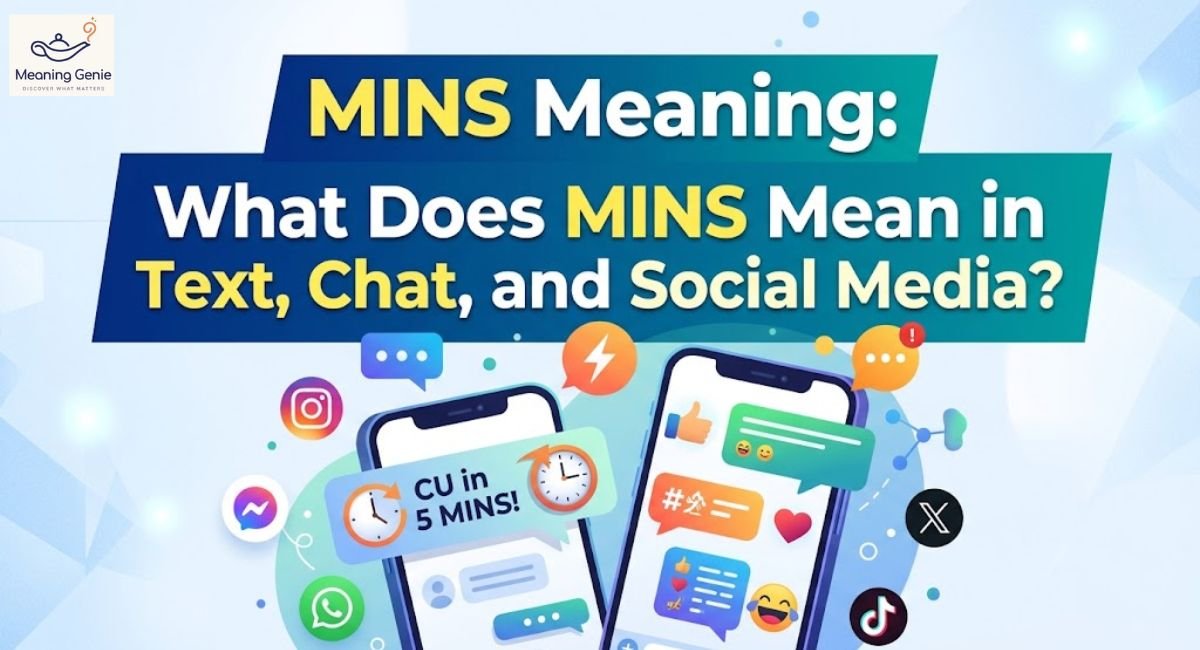
If someone texts “I’ll be there in 10 mins,” there is usually no hidden message. MINS meaning is most commonly minutes, especially in texting, chat, and everyday social media conversations. It is a practical abbreviation that saves typing while keeping the message easy to understand.
Still, context can occasionally change the interpretation. In a workplace conversation, “mins” may refer to meeting minutes, meaning the written record of a meeting. So, if you have been wondering what does MINS mean, the short answer is “minutes,” but there is a little more worth knowing.
What Does MINS Mean?
The most common meaning of MINS is minutes. People use this shortened form when talking about time, waiting, appointments, arrival, calls, deadlines, or plans. For example, “Give me 5 mins” simply means “Give me five minutes.”
In everyday conversation, the abbreviation feels natural because digital communication favors speed. You might see “I’ll call in 10 mins” or “Be there in 20 mins.” The surrounding words usually make the intended definition obvious.
MINS Meaning in Text and Chat
The MINS meaning in text is normally “minutes.” In a quick chat, someone might write “Need 5 mins” instead of typing the complete phrase. This is common shorthand, not a secret code.
For example, “I’m 10 mins away” means the person expects to arrive in about ten minutes. The same MINS meaning in texting applies across ordinary messages, group chats, and direct messages.
Is MINS an Acronym, Abbreviation, or Slang?
MINS is primarily an abbreviation, rather than an acronym or genuine slang term. An acronym usually forms a word from initial letters. Slang typically introduces a distinctive informal meaning.
“Mins” does neither. It simply shortens “minutes.” That is why searching for the MINS slang meaning can be misleading. The term usually retains its literal meaning.
The Most Common Meaning of MINS
The dominant meaning is minutes, especially when a number appears before it. “5 mins,” “10 mins,” and “30 mins” all describe periods of time.
This usage appears in countless situations. Someone may discuss an appointment, a workout, a phone call, a game, or an arrival time. The subject changes, but the basic meaning stays the same.
Why Context Matters When Reading MINS
Context becomes important when the abbreviation appears without a number. “Send me the mins” could mean “send me the meeting minutes,” especially in a workplace conversation.
However, “I’ll be there in 10 mins” clearly refers to time. Think of context as the key that unlocks an abbreviation. You rarely need to guess when you read the surrounding message.
What Does MINS Stand For?
So, what does MINS stand for in an ordinary message? It stands for minutes. That is the interpretation you should consider first when the conversation involves duration, schedules, waiting, or arrival.
The MINS full form can occasionally differ in specialized settings. Still, you should not jump toward obscure acronyms when the everyday meaning fits perfectly. Google also emphasizes clear, useful answers that satisfy the reader rather than content created merely to capture search variations.
MINS as an Abbreviation for Minutes
As an abbreviation for minutes, “mins” is especially common in informal digital writing. “I need 10 mins” and “Back in a few mins” are easy for most readers to understand.
There is a useful style distinction, though. Cambridge lists “min.” as a written minutes abbreviation, while “mins” is widely used in casual digital communication.
MINS as Meeting Minutes
In professional settings, “mins” can sometimes mean meeting minutes. These are the written records of what happened during a meeting, including decisions, actions, and important discussion points.
For example, “Can you send the mins from yesterday?” may refer to the meeting record. Merriam-Webster recognizes “minutes” as a record of proceedings at a meeting.
Other Possible Meanings of MINS
MINS can represent specialized names or acronyms in certain industries, organizations, or technical fields. Those meanings are real, but they are not the usual interpretation in everyday American messages.
When someone writes “Give me 10 mins,” the ordinary meaning is overwhelmingly likely. Specialized definitions only become useful when the surrounding subject clearly points toward one.
MINS Meaning in Different Contexts

The MINS meaning usually remains unchanged across different settings. Whether you see it in a text, schedule, group chat, or social platform, it generally refers to minutes.
The main exception is professional terminology such as meeting minutes. Therefore, understanding the topic around the abbreviation is more useful than memorizing a long list of obscure definitions.
MINS in Text Messages
In text messages, “mins” commonly appears in short timing updates. Someone might write, “I’ll be home in 15 mins,” or “Give me 5 mins.”
This is ordinary casual communication. The shortened form makes the message quicker to type without sacrificing clarity.
MINS in Work and Professional Communication
In professional communication, “mins” can appear in quick internal messages. A coworker might write, “The call starts in 10 mins.”
For formal reports, client documents, or official records, spelling out “minutes” usually looks more polished. The more formal the audience, the more valuable clarity becomes.
MINS in School or Academic Contexts
Students often use “mins” in group chats. “Class starts in 5 mins” is a perfectly understandable informal message.
However, school assignments and academic papers usually require more formal language. In those situations, “minutes” is a safer choice than casual shorthand.
MINS in Schedules and Time References
Schedules are a natural place for “mins.” You may see it beside appointment times, travel estimates, event countdowns, or cooking durations.
A phrase such as “The bus arrives in 8 mins” provides a quick time reference. The number makes the meaning immediately clear.
MINS in Online Conversations
In online communication, “mins” appears in gaming chats, group messages, livestream discussions, and DMs. The abbreviation works because people often communicate quickly while multitasking.
For example, “I’ll join in 10 mins” simply tells other players when someone expects to arrive. There is no special internet definition hiding behind it.
MINS Meaning on Social Media

The MINS meaning on social media generally stays the same across major platforms. TikTok, Instagram, Snapchat, WhatsApp, and X do not normally give “mins” a unique slang definition.
That distinction matters because social platforms constantly produce new slang. Not every shortened word becomes slang. In this case, “mins” remains a practical abbreviation for minutes.
MINS on TikTok
The MINS meaning on TikTok usually relates to duration. A creator might say, “I made this video in 20 mins,” or “The live starts in 5 mins.”
TikTok does not generally transform “mins” into a special platform-specific expression. The surrounding context still determines the meaning.
MINS on Instagram
The MINS meaning on Instagram is usually connected to time. You might see “Back in 10 mins” in a DM or “Edited this in 30 mins” in a conversation.
The same abbreviation can appear in captions, comments, and private messaging. Its meaning generally remains unchanged.
MINS on Snapchat
The MINS meaning on Snapchat is typically “minutes.” Snapchat users may write it while arranging plans, discussing arrival times, or asking someone to wait.
For example, “Give me 5 mins” simply means “Give me five minutes.” There is normally no hidden Snapchat-specific meaning.
MINS on WhatsApp
The MINS meaning on WhatsApp also refers to minutes in most conversations. Users commonly employ it while discussing calls, travel, appointments, or plans.
A message such as “Call me in 10 mins” is straightforward. WhatsApp may be used for professional or personal communication, so the surrounding conversation still matters.
MINS on X
The MINS meaning on X generally relates to timing. You may see it in posts about sports, livestreams, events, announcements, or countdowns.
For example, “The game starts in 15 mins” clearly refers to fifteen minutes. The platform does not normally change the abbreviation’s basic usage.
How MINS Is Used in a Sentence
Understanding the sentence patterns makes this abbreviation easy to recognize. “Mins” often follows a number, but it can also appear with phrases such as “a few” or “several.”
Because digital conversation often relies on shared information, a complete sentence is not always necessary. “Five mins” can answer a question perfectly well.
MINS Meaning “Minutes” in a Sentence
The abbreviation commonly appears after a number. “I need 20 mins” means the speaker needs twenty minutes.
It can also describe elapsed time. “I posted it 10 mins ago” means ten minutes have passed. The exact interpretation comes from the words around it.
MINS in Questions
People can ask, “How many mins?” when they want to know the remaining duration. Another example is “How many mins until you arrive?”
Such questions are common in texting because the context is already understood. There is little need to repeat the complete word.
MINS in Short Replies
“Five mins” can work as a complete reply to “How long?” The reader understands that the speaker means five minutes.
This is a normal feature of digital grammar. People often omit predictable words when the meaning remains clear.
MINS in Time-Related Messages
You will often find “mins” in messages about waiting time, deadlines, travel, appointments, and calls.
“I’m 10 mins away” describes an estimated arrival time. “Wait 5 mins” describes a requested delay. Both uses are easy to understand.
MINS Tone and Meaning in Conversation
The abbreviation itself has a neutral tone. However, the surrounding conversation can make it sound casual, urgent, playful, serious, or even sarcastic.
Compare “Give me 5 mins” with “You have 5 mins.” The first sounds like a casual request. The second can sound like a deadline. The words around “mins” create the emotional difference.
Casual or Friendly Tone
Friends often use “mins” because it sounds relaxed. “I’ll be there in 10 mins” fits naturally into a casual exchange.
The abbreviation works particularly well when the people involved already understand the situation. There is no need for elaborate wording.
Professional Tone
“Meet me in 10 mins” can work perfectly well in an internal workplace chat. Quick messages often use informal language without causing confusion.
However, formal communication calls for greater precision. A client email or official document may look better with “minutes” written in full.
Urgent Tone
A message such as “The deadline is in 5 mins” creates urgency because the available time is short.
Still, the abbreviation itself does not create that urgency. The deadline does. In important situations, prioritize clear instructions over excessive brevity.
Playful or Humorous Tone
Friends can joke about someone’s definition of “five mins.” A late friend might promise five minutes and arrive half an hour later.
You could jokingly say, “Your five mins are looking suspiciously long.” The humor comes from the situation, not from a new meaning of the abbreviation.
Confusing or Ambiguous Usage
“Send me the mins” can create uncertainty because it may refer to minutes or meeting minutes.
If the conversation involves a recent meeting, the second meaning becomes likely. If people are discussing timing, the first meaning makes more sense.
How to Reply When Someone Says MINS
There is no special response to “mins” because it is not a standalone slang expression. Your reply should address the actual message.
If someone gives you an arrival estimate, acknowledge it. If they ask for time, answer directly. Good messaging keeps the exchange simple.
Casual Reply
If a friend says, “I’ll be there in 10 mins,” you could reply, “Sounds good” or “See you soon.”
A relaxed response fits casual communication. There is no reason to make a simple exchange sound formal.
Funny Reply
For a playful response, you might say, “Actual five mins or your famous five mins?”
That works when you already have a joking relationship. Humor adds personality without changing the basic meaning.
Serious Reply
When timing matters, keep your response direct. “Okay, I’ll wait here” works well after someone gives you an arrival estimate.
Clear replies become especially important when appointments, deadlines, or travel plans are involved.
Neutral Reply
Simple responses such as “Okay,” “Got it,” or “Sure” work in most ordinary situations.
These replies acknowledge the message without adding unnecessary detail. They fit naturally into quick text messages.
Professional Reply
In a workplace chat, “Sounds good. Thank you” is a polite response.
For client-facing professional communication, you may prefer complete wording. “That works. I’ll expect it in 10 minutes” sounds more polished.
MINS vs MIN vs MINUTES

The MINS vs MIN question is mainly about style and usage. All three forms point toward the same unit of time, but they do not always fit the same writing situation.
Cambridge identifies “min.” as a written abbreviation for minute. In casual digital writing, however, “mins” is widely recognizable.
MINS vs MIN
“Min” is commonly used as a compact abbreviation, while “mins” is especially familiar in informal digital writing.
For example, “5 min” may appear in a compact schedule, while “See you in 5 mins” sounds natural in a text. The choice depends on the style of the communication.
MINS vs MINUTES
“Minutes” is the complete word. “Mins” is the shortened form commonly used in casual writing.
When clarity and professionalism matter, the full word is usually the safest option. When speed matters in a friendly chat, “mins” is perfectly understandable.
When Should You Use Each Form?
| Form | Best use | Example |
| mins | Casual digital communication | “Back in 10 mins.” |
| min | Compact notation | “10 min.” |
| minutes | Formal or general writing | “Back in 10 minutes.” |
There is no need to force one form into every situation. Good writing adapts to the audience, purpose, and level of formality.
Which Form Is More Common in Texting?
“mins” feels natural in texting because it is quick to type and easy to recognize. “Give me 10 mins” communicates the same idea as “Give me 10 minutes” with less effort.
Still, common texting usage does not make it the best choice for every document. Formal writing follows different conventions.
Is MINS Grammatically Correct?
In casual digital writing, “mins” is widely understood and commonly used. In formal writing, however, established abbreviation conventions may favor “min.” or the complete word “minutes.”
That difference reflects the gap between informal communication and formal prose. A text message has different expectations from an academic paper or business report.
Is “MINS” a Standard Abbreviation?
“Mins” is a widely recognized informal abbreviation for minutes. Cambridge formally lists “min.” as the written abbreviation.
So, “mins” is common and understandable, while “min.” may be preferable when following formal abbreviation conventions.
Singular vs Plural Usage
In everyday texting, “1 min” usually means one minute, while “5 mins” means five minutes.
The “s” helps casual writers make the plural obvious. Formal style systems can use different conventions, so follow the style guide required by your school or workplace.
MINS in Formal Writing
For academic papers, reports, official notices, and polished business documents, “minutes” is usually the clearest choice.
Writing the complete word avoids ambiguity and gives the document a more professional appearance. When the communication is important or permanent, clarity should win.
MINS in Informal Writing and Texting
In casual writing and texting, “mins” works naturally. Friends, coworkers, and classmates commonly understand it without hesitation.
A message such as “I’ll finish in 20 mins” is short, readable, and practical. That is exactly what informal digital language aims to achieve.
MINS Examples in Real Conversations
Real examples reveal how naturally the abbreviation fits everyday communication. Most cases clearly refer to minutes, while workplace language can create a second interpretation.
The key is not memorizing examples. Instead, notice how the surrounding words establish the intended meaning.
Example Between Friends
Alex: “Where are you?”
Jordan: “Leaving now.”
Alex: “How long?”
Jordan: “About 15 mins.”
Here, “mins” clearly refers to minutes because the friends are discussing arrival.
Example in a Work Chat
Mia: “When does the call start?”
Chris: “In 10 mins.”
Here, the abbreviation describes time. If Chris instead said, “Please review the meeting mins,” the meaning would change to meeting minutes.
Example About Travel or Appointments
Sam: “How far away are you?”
Taylor: “About 20 mins.”
This indicates an estimated arrival time. It does not guarantee an exact arrival because traffic and other delays can change the estimate.
Example on Social Media
User 1: “When does the livestream start?”
User 2: “In 15 mins.”
This demonstrates that MINS meaning on social media generally remains the same as in ordinary texting.
Example Showing Meeting Minutes
Manager: “Did you finish the meeting mins?”
Assistant: “Yes. I’ll send them now.”
Here, “mins” means meeting minutes. The word “meeting” provides the clue that changes the interpretation.
Who Uses MINS?

Unlike trendy internet expressions, “mins” is not strongly connected to one generation. It is a practical abbreviation that people across age groups can understand.
You may encounter it among Gen Z users, millennials, older adults, students, and professionals. Its usefulness explains its longevity better than any particular internet trend.
Gen Z and Younger Users
Younger users often favor concise digital language, so “mins” appears frequently in their messages.
However, it is not specifically a Gen Z expression. Calling it Gen Z slang would overstate its cultural significance.
Millennials
Millennials commonly use “mins” in texts, DMs, group chats, and workplace messaging.
Its popularity among this group reflects ordinary digital communication rather than a special generational meaning.
Older Adults
Older adults can also understand and use the abbreviation. Its resemblance to “minutes” makes it relatively intuitive.
Unlike more obscure internet slang, you do not need extensive knowledge of online culture to understand it.
Students
Students may use “mins” while coordinating classes, study sessions, projects, sports, or social plans.
In formal school assignments, however, they should follow the required academic style instead of copying casual texting habits.
Professionals
Professionals often use “mins” in quick internal messages about meetings, calls, deadlines, and schedules.
For formal documents, client communication, and official records, “minutes” generally provides a more polished presentation.
Is MINS Slang or Just an Abbreviation?
The most accurate description is simple: “mins” is an abbreviation that is commonly used in informal digital communication. Some websites may group it with texting terms, but that does not make it genuine slang.
The difference is important. True slang often introduces a meaning that differs from ordinary language. “Mins” does not. It simply shortens “minutes.”
Why People Sometimes Mistake MINS for Slang
Internet users encounter new expressions constantly. As a result, unfamiliar short forms can look like secret slang.
“Mins” may seem mysterious at first, but expanding it to “minutes” immediately explains the term. No special internet dictionary is normally required.
MINS in Internet Language
Digital communication rewards brevity. People often type on phones while moving, working, traveling, or multitasking.
That environment naturally encourages shorthand. “Mins” removes several characters while preserving the original idea. Its staying power comes from usefulness rather than trendiness.
MINS Compared With True Texting Slang
A genuine texting slang term often requires interpretation. “Mins” does not. Once you know the word “minutes,” the abbreviation is almost self-explanatory.
That makes it closer to ordinary abbreviated language than expressions that carry hidden cultural meanings.
Is MINS Offensive or Inappropriate?
“Mins” is generally neutral and harmless. It does not contain profanity or an inherently offensive expression.
The real issue is formality. A casual text and a formal report serve different purposes. Choosing the right wording shows that you understand your audience.
Does MINS Contain Profanity?
No. The ordinary term contains no profanity or offensive language.
If someone uses “mins” sarcastically, the surrounding message creates that tone. The abbreviation itself remains neutral.
Is MINS Safe to Use With Friends?
Yes. “Mins” is completely ordinary in friendly conversations.
“Give me 5 mins” or “Call me in 10 mins” carries no inappropriate meaning. It simply communicates time.
Is MINS Appropriate at School?
It is generally fine in casual student messages and group chats.
For essays, assignments, and formal academic work, writing “minutes” is usually the better choice. Follow your instructor’s preferred style when one exists.
Is MINS Appropriate at Work?
It can work well in informal internal workplace chats.
For official emails, reports, client documents, and formal records, “minutes” is more polished. The communication’s purpose should determine the choice.
When Should You Write “Minutes” Instead?
Choose “minutes” when your audience expects formal, precise, or permanent writing. Academic papers, official notices, business reports, and client-facing documents are good examples.
When there is little cost to being clearer, the full word is usually worth using. A few extra letters can make your writing look more deliberate.
Common Misunderstandings About MINS
Most confusion comes from assuming that every internet abbreviation has a secret definition. “Mins” is much simpler.
In ordinary conversations, the surrounding words usually provide enough information. Only specialized or professional contexts require you to consider another meaning.
Does MINS Always Mean Minutes?
Not always. “Meeting minutes” is the main alternative you are likely to encounter in everyday professional communication.
Specialized industries may also use MINS as an acronym. However, ordinary messages should be interpreted using the most natural meaning first.
Can MINS Mean Meeting Minutes?
Yes. In a workplace context, “mins” can refer to the written record of a meeting.
For example, “Please send the mins” may mean “Please send the meeting minutes.” The preceding conversation normally makes this clear.
Is MINS a Gen Z Word?
No. Gen Z may use it frequently, but “mins” is not uniquely associated with that generation.
It is better described as practical digital shorthand. People across generations can use it without participating in internet slang culture.
Is MINS the Same as MIN?
They can communicate the same basic unit of time. “Min” is a widely established abbreviation, while “mins” is particularly common in informal digital writing.
The preferred form depends on the writing style. Formal contexts may favor “min.” or “minutes.”
Does MINS Have a Secret Slang Meaning?
Usually, no. If the message involves time, “mins” almost certainly means minutes.
Only consider another definition when the surrounding subject clearly supports it. Do not replace a simple explanation with an obscure one without evidence.
MINS Meaning Compared With Similar Abbreviations
A quick comparison helps place “mins” among other common time-related expressions. These forms can overlap in casual digital communication, but their preferred settings differ.
| Term | Meaning | Common setting | Style |
| mins | Minutes | Texts and casual chats | Informal |
| min | Minute/minutes | Compact notation | Neutral |
| minutes | Complete word | Formal and general writing | Standard |
| secs | Seconds | Casual messages | Informal |
| hrs | Hours | Casual schedules | Informal |
| ETA | Estimated Time of Arrival | Travel and planning | Common abbreviation |
| ASAP | As Soon As Possible | Requests and deadlines | Common abbreviation |
The key distinction is simple. “Mins” shortens a familiar word, while terms such as ETA or ASAP communicate broader concepts. Using the right form depends on your audience and purpose.
FAQS
What does “mins” mean?
“Mins” is a common abbreviation for minutes, especially in texting and casual chat.
Example: “I’ll be there in 10 mins” means “I’ll be there in 10 minutes.”
What does “min” mean in slang?
“Min” usually means minute when used in texting or casual communication.
It is generally an abbreviation, not a separate slang term.
What does “a minute” mean in slang?
In casual speech, “a minute” can mean a short or unspecified amount of time, not necessarily exactly 60 seconds.
For example, “Wait a minute” can simply mean “Wait a little while.”
Does minute have two meanings?
Yes. Minute can mean a unit of time, while minute (pronounced “my-NOOT”) can mean extremely small or detailed.
The pronunciation and context distinguish the two meanings.
What does “minute man” mean in Urban Dictionary?
“Minute Man” can have different user-submitted meanings on Urban Dictionary, often involving slang or sexual references.
Its exact meaning depends on the specific entry and context.
What is another meaning of minute?
Besides a unit of time, minute can mean “very small” or “tiny,” pronounced “my-NOOT.”
Example: “The scientist noticed a minute difference between the samples.”
Final Takeaway: What Does MINS Really Mean?
So, MINS meaning is usually straightforward: it means minutes. You will commonly see it in texts, chats, schedules, DMs, and social platforms when someone discusses duration, waiting, arrival, or plans.
The main alternative is meeting minutes, especially in workplace conversations. In casual communication, “mins” is convenient and widely understood. In formal writing, “minutes” is usually the cleaner choice. When you see “mins,” check the context first. In most everyday cases, the answer is simply “minutes.”

Words can be confusing—but understanding them shouldn’t be. I’m Muhammad Umair, an AI-powered SEO & content writer at Meaning Genie, helping readers decode slang, abbreviations, and internet language with simple, clear explanations.