
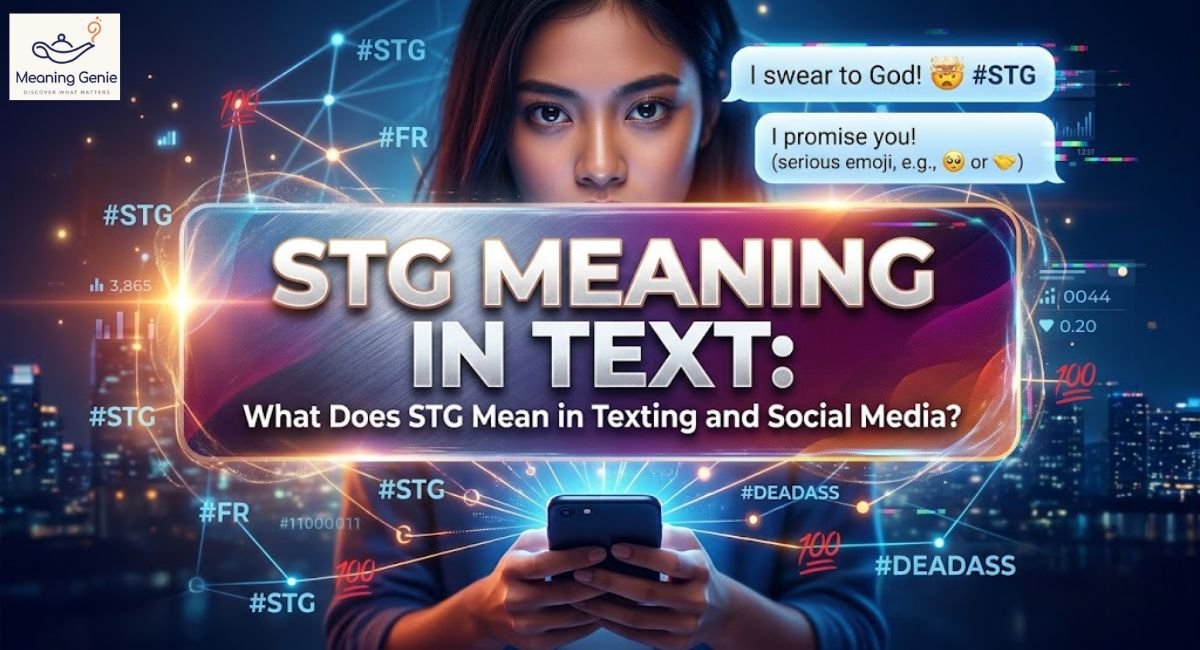
Have you ever received “STG” in a text and wondered what those three letters mean? The STG meaning in text is usually “Swear to God,” a casual phrase used to add emphasis. People use this STG slang meaning to show honesty, frustration, surprise, or strong feelings. You may see STG in chat with friends, on social media, or in everyday text messages.
However, its exact tone depends on the surrounding words and situation. In this guide, you’ll discover what does STG mean, how people use it naturally, and what it means across popular platforms. Understanding the context makes this popular abbreviation much easier to recognize and use.
STG Meaning at a Glance
| STG Element | Meaning |
| STG full form | Swear to God |
| Main meaning | Used to emphasize truth or sincerity |
| Type | Internet slang / texting abbreviation |
| Common tone | Casual, serious, emotional, or playful |
| Common platforms | Snapchat, TikTok, Instagram, WhatsApp |
| Best used in | Informal conversations |
| Usually avoided in | Professional and formal communication |
What Does STG Mean in Text?
At its core, STG meaning refers to “Swear to God.” The STG full form is therefore “Swear to God,” while STG stands for a shortened version of that phrase. People use this STG abbreviation to stress that they are being truthful, serious, or emotionally sincere.
In STG in chat, the phrase often works like an emotional underline. For example, “STG I didn’t take your charger” adds more force than “I didn’t take your charger.” The writer wants you to believe the claim. That is the basic STG usage you will encounter in everyday messages.
Quick Definition of STG
The simplest STG meaning in texting is “Swear to God.” It can emphasize honesty, emphasize truth, or add strong emotion. In casual digital communication, it often means “I really mean this” rather than a literal religious oath.
What Does “STG” Stand For?
When someone asks what does STG mean, the answer depends on the setting. In ordinary texting, it means “Swear to God.” However, STG slang can have other meanings in specialized fields. The surrounding conversation helps reveal the intended meaning.
Simple Examples of STG in Texting
Common STG examples include “STG I didn’t do it,” “STG that movie was amazing,” and “STG I’m exhausted.” Each sentence uses the abbreviation to strengthen the speaker’s message. Notice how the meaning stays similar while the emotional tone changes.
What Does STG Mean in Different Contexts?
Although the basic STG social media meaning stays consistent, its emotional purpose can shift. A friend may use it to emphasize honesty, while another person may use it to express frustration. Therefore, never judge the phrase by its letters alone.
For instance, “STG you’re hilarious” can sound warm and playful. Meanwhile, “STG stop doing that” may sound irritated. The words surrounding STG create the mood. In other words, the phrase is a small signal whose meaning becomes clearer through tone and situation.
| Context | What STG Communicates | Example |
| Honesty | Strongly claiming something is true | “STG I didn’t take it.” |
| Promise | Showing commitment | “STG I’ll call you later.” |
| Frustration | Showing annoyance | “STG this keeps happening.” |
| Excitement | Showing strong enthusiasm | “STG that concert was amazing!” |
| Surprise | Showing disbelief | “STG, I can’t believe that happened.” |
| Humor | Adding dramatic effect | “STG you ate the whole pizza 😂.” |
STG for Emphasizing the Truth
People often use STG when they want others to believe them. A message like “STG I was home all night” acts as a verbal guarantee. Here, the speaker wants to emphasize truth because they expect doubt.
STG When Expressing Frustration
During an argument, STG can express frustration or express anger. For example, “STG this traffic is driving me crazy” adds emotional pressure. The phrase does not necessarily change the facts. Instead, it makes the speaker’s irritation more noticeable.
STG in Excited or Emotional Messages
STG can also express excitement or another emotional reaction. Someone might write, “STG that concert was incredible!” The phrase makes the reaction feel bigger and more spontaneous. It works almost like an exclamation mark with extra emotional weight.
STG as a Casual Expression
Among friends, STG can function as a casual expression with little solemnity. Someone might say, “STG you’re impossible 😂” while joking. The words and emojis make the playful intention obvious. Here, the phrase feels dramatic rather than deeply serious.
How Is STG Used in Text Messages?
In STG in text messages, people usually choose the abbreviation because it is quick and expressive. It fits the speed of modern texting culture, where short phrases can communicate complicated feelings. The abbreviation saves typing while keeping the emotional punch.
You may see STG at the beginning, middle, or end of a sentence. “STG I forgot” sounds defensive. “That was wild, STG” sounds more like a reaction. The placement can subtly change the rhythm without changing the core meaning.
STG Between Friends
Friends commonly use STG during casual conversation. They might use it to defend themselves, exaggerate a story, or react to something funny. Because friends understand each other’s personalities, playful exaggeration often causes little confusion.
STG in Relationships
In romantic relationships, STG can reinforce feelings, promises, or frustration. Someone might write, “STG I missed you all day.” In another situation, “STG you never listen” may sound much sharper. The relationship and surrounding words determine the emotional weight.
STG in Everyday Conversations
Everyday STG conversation examples can involve school, work, food, entertainment, errands, or plans. “STG this coffee is terrible” simply adds emphasis. The phrase rarely needs a formal explanation among people who already understand internet slang.
STG in Serious Conversations
STG can appear in a serious statement when someone wants to sound sincere. For example, “STG I’m telling you everything” signals strong reassurance. Still, STG does not automatically prove honesty. It only communicates how strongly the speaker wants to be believed.
STG Meaning on Snapchat, TikTok, Instagram, and WhatsApp

The STG social media meaning generally remains “Swear to God” across major platforms. What changes is the setting. A Snapchat message may feel private, while a TikTok comment can reach thousands of people. Each platform creates a slightly different communication environment.
Because social media platforms favor quick reactions, abbreviations fit naturally into comments, captions, DMs, and chats. STG is especially useful when someone wants to react quickly without typing the entire phrase. Its emotional impact can therefore matter more than its literal wording.
| Platform | Common STG Usage | Example |
| Snapchat | Chats and quick replies | “STG that was hilarious.” |
| TikTok | Comments and reactions | “STG I’ve watched this ten times.” |
| DMs, comments, and Stories | “STG this outfit looks amazing.” | |
| Private and group chats | “STG I forgot about the meeting.” | |
| Discord | Gaming and community chats | “STG that match was crazy.” |
STG on Snapchat
STG on Snapchat commonly appears in chats, replies, and quick reactions. A user might write, “STG this filter is hilarious.” Snapchat’s fast messaging style makes short expressions particularly convenient.
STG on TikTok
STG on TikTok often appears in comments or reactions. Someone might comment, “STG I watched this five times.” Here, the abbreviation intensifies the viewer’s reaction and gives the comment a more conversational feel.
STG on Instagram
STG on Instagram can appear in DMs, comments, captions, or Story replies. For example, “STG this picture is perfect” uses the phrase to add enthusiastic emphasis rather than make a solemn promise.
STG on WhatsApp
On WhatsApp, STG commonly appears in private chats and group messages. Friends may use it while discussing plans, jokes, arguments, or daily events. Its meaning usually remains clear when the surrounding conversation provides enough context.
STG Examples in Real Conversations
Seeing STG inside a realistic exchange makes the STG meaning in text easier to understand. Consider how the same abbreviation changes personality when the surrounding words change. That difference matters because text removes facial expressions and vocal cues.
The following examples show four common situations. Read the entire sentence rather than focusing only on STG. That approach helps you identify whether the writer sounds sincere, annoyed, excited, or playful.
Friendly Conversation
Alex: “Did you eat my leftover pizza?”
Jordan: “STG I didn’t touch it.”
Here, STG strengthens Jordan’s denial. The speaker wants to emphasize honesty.
Emotional Conversation
Alex: “How was the concert?”
Jordan: “STG it was the best night ever!”
The phrase highlights a powerful emotional reaction. Jordan is expressing excitement rather than defending a factual claim.
Angry or Frustrated Conversation
Alex: “He changed the plan again.”
Jordan: “STG I’m done dealing with this.”
Here, STG helps express frustration. The sentence sounds stronger because the speaker feels emotionally exhausted.
Funny or Playful Conversation
Alex: “You really ate the whole cake?”
Jordan: “STG it disappeared somehow 😂”
The phrase becomes humorous because the situation is obviously exaggerated. The emoji also softens the message and creates a sarcastic tone.
What Tone Does STG Have?
There is no single tone attached to STG. It can sound calm, sincere, dramatic, annoyed, or funny. Readers should examine the entire message before deciding how the abbreviation feels.
Punctuation can also change the impression. “STG, that’s amazing!” feels excited. “STG. Stop.” feels much more forceful. Capitalization, emojis, surrounding words, and relationship dynamics can all influence interpretation.
| Tone | How STG Sounds | Example |
| Neutral | Simple emphasis | “STG I didn’t know.” |
| Serious | Strong sincerity | “STG I’m telling you the truth.” |
| Emotional | Strong feelings | “STG I’m so happy right now.” |
| Angry | Frustration or irritation | “STG stop doing that.” |
| Sarcastic | Exaggerated or playful | “STG, great idea…” |
| Funny | Dramatic humor | “STG that was the best sandwich ever.” |
Neutral Tone
A neutral tone appears when STG simply adds emphasis without obvious anger or excitement. “STG I didn’t know about the meeting” sounds like a straightforward defense.
Serious Tone
A serious tone appears when someone uses STG to make a promise or strongly defend a claim. “STG I’ll call you tonight” carries more weight than a casual “I’ll call you.”
Emotional Tone
An emotional STG message can communicate excitement, shock, sadness, disbelief, or affection. The abbreviation acts as an intensifier. The actual emotion comes from the rest of the sentence.
Angry or Aggressive Tone
An aggressive tone can appear when STG sits beside commands or accusations. “STG leave me alone” sounds considerably harsher than “STG that was funny.”
Sarcastic Tone
A sarcastic tone appears when the speaker deliberately exaggerates. “STG, what a brilliant idea…” can mean the exact opposite. Here, punctuation and surrounding circumstances reveal the joke.
Is STG Always Serious?

Not at all. STG can communicate sincerity, but it can also become playful shorthand. Online speakers often exaggerate for humor. Therefore, assuming every STG message represents a solemn promise can lead you straight into a misunderstanding. For example, someone might say, “STG, this is the funniest video ever 😂,” without literally making a solemn promise. In these situations, STG works more like an emphasis word that makes the speaker’s reaction stronger.
The tone of the conversation is important when understanding STG. A message such as “STG, I didn’t tell anyone” may be completely serious, while “STG, I’m never eating pizza again 😭” could simply be playful exaggeration. Friends and people who regularly joke with each other may use STG casually without expecting the other person to interpret it literally. This is why assuming every STG message represents a serious promise can easily lead to a misunderstanding.
Think of STG like verbal seasoning. A little can strengthen a sentence. Too much can make the message feel theatrical. Your relationship with the sender and the surrounding context matter more than the abbreviation itself.
Why Do People Use STG in Texting?
People use STG because digital messages lack facial expressions, gestures, and vocal emphasis. A short abbreviation can compensate for some of that missing emotional information. It helps writers make a statement feel stronger without adding several explanatory sentences.
The phrase also fits informal communication because it is fast and familiar. In a busy chat, “STG” takes far less effort than writing the complete expression. That convenience helps explain why abbreviations remain common in modern online communication.
To Emphasize Honesty
STG can reassure someone who doubts a claim. “STG I didn’t see him” signals that the speaker strongly wants to be believed. It adds credibility rhetorically, although it does not independently prove the statement is true.
To Show Strong Emotion
A short STG can amplify strong emotion. Excitement, disbelief, irritation, and shock can all become more noticeable when the abbreviation appears.
To Make a Statement More Convincing
When people want to sound persuasive, STG can make their words feel more forceful. It functions like verbal emphasis. However, using it repeatedly can weaken that effect.
To Express Frustration or Surprise
STG can quickly communicate that something has pushed the speaker emotionally. “STG this keeps happening” tells the reader that the problem has become genuinely irritating.
Where Did STG Come From?
The phrase “Swear to God” existed long before smartphones and social media. People used it in spoken English to stress sincerity, defend themselves, or reinforce promises. The abbreviation developed naturally from a longer expression as digital communication became faster.
As texting culture expanded, users began shortening familiar phrases to save time and characters. Online communities then helped these abbreviations travel between groups. Current sources consistently identify “Swear to God” as the dominant texting meaning.
Origin of the STG Abbreviation
STG is best understood as a shortened form of an already familiar expression. It was not created because the phrase itself was new. Instead, digital communication compressed familiar language into convenient shorthand.
How STG Became Popular Online
SMS, instant messaging, gaming communities, forums, and social platforms all helped abbreviations spread. STG suited these environments because it was short, recognizable, and emotionally expressive.
The Influence of Texting and Social Media
Modern social media slang often favors speed and personality. STG works well because three letters can replace a longer phrase while preserving its emotional force. Platforms such as Snapchat and TikTok further normalized quick, expressive shorthand.
STG Meaning and Usage Among Different Generations

The STG meaning generally stays the same across generations. What changes is frequency and style. Younger users may combine STG with emojis, memes, and other slang, while older users may recognize the phrase but use it less often.
Internet slang also travels quickly between age groups. A phrase can begin inside one online community and become familiar to millions of people. So, age alone cannot reliably tell you whether someone understands STG.
Gen Z Usage
Gen Z users may use STG as quick emotional shorthand in DMs, comments, group chats, and casual messages. It can appear beside expressions such as FR, no cap, or other contemporary slang.
Millennials and Older Users
Many Millennials and older users already recognize “Swear to God” from everyday speech. They may understand STG easily even if they prefer writing the complete phrase.
How Internet Slang Spreads Across Generations
Social platforms remove many traditional barriers between age groups. A viral phrase can move from creators to viewers, friends, workplaces, and family chats within a short period.
STG vs. Similar Slang Terms
STG overlaps with several expressions, but each one carries a slightly different flavor. Similar slang terms can all emphasize truth or emotion, yet they are not perfect substitutes.
| Expression | Full Form | Main Function |
| STG | Swear to God | Strong emphasis or sincerity |
| ISTG | I Swear to God | More personal emphasis |
| FR | For Real | Agreement or sincerity |
| OMG | Oh My God | Surprise or excitement |
| SMH | Shaking My Head | Disapproval or disbelief |
| TBH | To Be Honest | Introduces honesty |
| ONG | On God | Emphasizes truth or agreement |
The most useful distinction is STG vs ISTG. STG is the shorter form, while ISTG explicitly includes “I.” STG vs FR also matters because FR often means “seriously” or “for real,” without the oath-like wording. Likewise, STG vs OMG differs because OMG primarily signals surprise, while STG emphasizes sincerity or intensity. STG vs SMH differs even more because SMH expresses disapproval or disbelief rather than a truth claim.
What Are the Other Meanings of STG?
Although “Swear to God” dominates casual texting, STG can represent other terms in specialized settings. For example, reference sources list meanings such as “Shoot ‘Em Up” in gaming and other domain-specific uses.
Therefore, readers should not assume every STG abbreviation has the same meaning. In a gaming discussion, technical document, or specialist conversation, alternate meanings may be more appropriate. The subject of the conversation usually provides the strongest clue.
STG as a Non-Slang Abbreviation
Outside texting, STG can appear as a slang abbreviation or technical shorthand for unrelated concepts. Gaming is one example where STG can refer to a “Shoot ‘Em Up” genre.
Why Context Matters When Reading STG
Imagine seeing “STG” beside words about gaming. The meaning could differ from a message saying, “STG I didn’t do it.” The surrounding vocabulary gives you the clue. Always read the sentence before choosing an interpretation.
How to Identify the Intended Meaning
First, look at the platform. Next, check the topic. Then examine the surrounding words and emotional tone. If someone is casually chatting with friends, “Swear to God” is usually the safest interpretation.
Common Misunderstandings About STG
One common mistake is assuming that STG always sounds serious. In reality, people use STG in different ways depending on the situation. It can express genuine honesty, casual emphasis, dramatic frustration, or even humor.
Another mistake is focusing only on the abbreviation instead of reading the complete sentence. The words around STG, along with emojis, punctuation, and the overall tone of the conversation, can completely change how the message should be understood.
People may also confuse STG with ISTG because the expressions are closely related. The difference is small but useful. Intended meaning comes from the complete message, not from three isolated letters.
When Should You Avoid Using STG?
STG works best in casual settings where everyone understands informal slang. In formal situations, clarity usually beats clever shorthand. A phrase that sounds natural between friends can look careless inside a professional email.
Consider your audience before typing it. Some readers may also dislike religious expressions, even when the writer uses them casually. When in doubt, choose clearer professional alternatives that communicate the same idea without unnecessary ambiguity.
Professional or Workplace Communication
In professional communication, replace STG with direct language such as “I assure you” or “I can confirm.” These options sound clearer and more appropriate when speaking with clients, managers, or colleagues.
Formal Messages and Emails
Formal communication usually benefits from complete words. Instead of “STG I’ll finish this,” write “I will finish this by Friday.” The second version sounds clearer and more professional.
Sensitive or Serious Situations
During sensitive conversations, slang can accidentally minimize the seriousness of the situation. Choose careful language when discussing grief, conflict, health, finances, or other personal matters.
When Someone May Not Understand the Slang
If the reader rarely uses internet slang, STG may create confusion. Clear wording removes that barrier. Good communication is not about using the shortest phrase. It is about making your meaning easy to understand.
How to Respond When Someone Says STG

Your response should match the sender’s mood. If a friend says, “STG I didn’t eat your fries,” you might respond playfully. If someone uses STG during a serious argument, a calm answer makes more sense.
There is no universal reply to this STG expression. Think about what the speaker is actually trying to communicate. Are they asking you to believe them, sharing an emotion, joking, or expressing frustration? Your response should address that underlying message.
Casual Responses
For everyday chats, you can reply with “I believe you,” “Fair enough,” or “Okay, I got you.” These responses acknowledge the speaker without making the exchange overly formal.
Funny Responses
If the conversation is playful, humor can work well. “Okay, dramatic 😂” or “I believe your sworn testimony” can keep the mood light when both people understand the joke.
Serious or Mature Responses
During a serious discussion, respond to the actual issue. “I hear you” or “Okay, I understand” can be better than matching emotional intensity.
Respectful Responses
If the speaker uses STG sincerely, avoid mocking the expression. A simple acknowledgment can show respect. This matters especially when religious language has personal significance for someone.
Is STG Appropriate for Kids and Teens?
STG is generally an informal slang expression rather than an obscene term. Still, young users should understand what the phrase literally refers to and where it may sound inappropriate. Context and audience remain important.
Parents and teens can treat STG as a digital-language issue rather than a mysterious code. Learning common slang helps young people understand messages, but they should also know when casual language does not fit.
Where Kids May Encounter STG
Young users may encounter STG in text messages, gaming chats, group conversations, TikTok comments, Snapchat messages, and Instagram DMs. The phrase can appear in both serious and humorous exchanges.
Is STG Offensive?
STG is not generally considered an offensive swear word. However, its reference to God can feel inappropriate or disrespectful to some people. Personal beliefs and conversational settings can influence that reaction.
What Parents and Teens Should Know
The key lesson is context. Teens should understand both the slang meaning and the literal phrase behind it. Parents can explain why a term may work among friends but sound unsuitable in school or professional settings.
STG Meaning: Quick Summary and Examples
The easiest way to remember the STG meaning in texting is this: STG usually means “Swear to God.” It adds emphasis when someone wants to sound sincere, emotional, frustrated, excited, or strongly convinced.
| Category | STG Meaning |
| STG full form | Swear to God |
| Main purpose | Emphasis and emotional intensity |
| Common setting | Casual texting and social media |
| Common platforms | Snapchat, TikTok, Instagram, WhatsApp |
| Formality | Informal |
| Similar terms | ISTG, FR, OMG, SMH |
| Professional use | Usually avoid |
| Main clue | Surrounding context and tone |
For a quick memory trick, think of STG as a verbal highlighter. It does not usually introduce a completely new idea. Instead, it makes the speaker’s existing idea feel stronger.
FAQS
What does STG mean in Gen Z slang?
In Gen Z slang, STG usually means “Swear to God.” It is used to emphasize honesty, seriousness, frustration, or strong emotion.
What does STG mean in text from a girl?
If a girl texts STG, it usually means “Swear to God.” The exact tone depends on the conversation and can express sincerity, excitement, frustration, or emphasis.
What does “STG” stand for in slang?
STG stands for “Swear to God” in slang. People commonly use it in casual texts, chats, and social media conversations.
What are other meanings of STG?
Outside slang, STG can have different meanings depending on the field or context. In everyday texting, however, “Swear to God” is by far the most common meaning.
What does STG stand for in text messages?
In text messages, STG stands for “Swear to God.” It is commonly used to emphasize that someone is being truthful or making a strong statement.
What does STG mean in Urban Dictionary?
On Urban Dictionary, STG is generally associated with “Swear to God,” although user-submitted entries may include variations or additional interpretations.
Conclusion: What Does STG Mean?
So, what does STG mean in texting? In most casual digital conversations, it means “Swear to God.” People use it to reinforce honesty, make promises, show emotion, or add dramatic emphasis. Its exact feeling depends on the surrounding words.
The important takeaway is simple: STG is internet slang built for informal communication. You will likely encounter it in texts, chats, comments, and social media. Read the full message before judging the tone, and remember that casual slang does not belong in every setting.
Discover More
Slang moves fast — don’t get left behind! For further reading on contemporary internet slang and its usage across digital platforms, explore the following articles:
WTW Meaning in Text: What Does WTW Mean on Snapchat, TikTok & Social Media?
AMAO Meaning Slang: What It Means in Text, TikTok, Snapchat & Social Media
Snatched Meaning Slang: What Does “Snatched” Mean in Text, TikTok & Social Media?

Words can be confusing—but understanding them shouldn’t be. I’m Muhammad Umair, an AI-powered SEO & content writer at Meaning Genie, helping readers decode slang, abbreviations, and internet language with simple, clear explanations.
2 thoughts on “STG Meaning in Text: What Does STG Mean in Texting and Social Media?”