
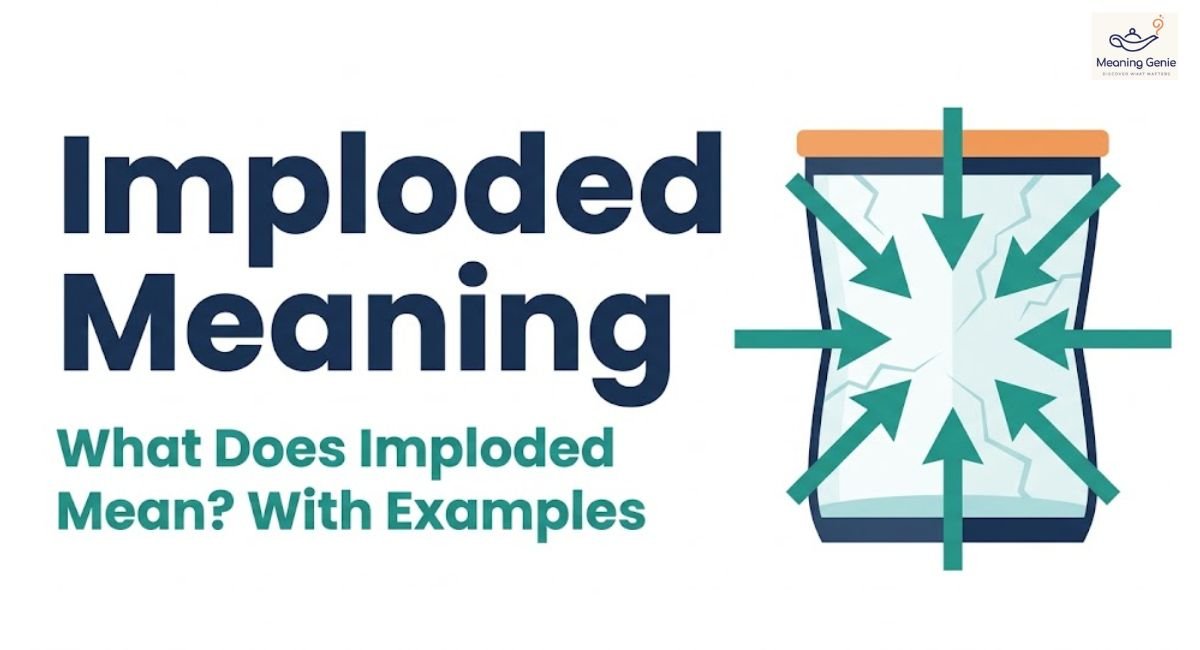
Have you ever heard someone say, “My life completely imploded,” or read that a company’s business imploded? The word can sound dramatic, but its meaning depends on the situation. It can describe something physically collapsing inward or a situation falling apart suddenly.
Quick Answer: Imploded means collapsed inward or failed suddenly and completely. It can describe a physical object or a situation that falls apart dramatically. For example: “Their relationship imploded after months of arguments.”
Understanding the imploded meaning helps you recognize how people use this word in everyday conversations, news reports, relationships, and professional settings. It also helps you distinguish imploded from similar words such as exploded and collapsed.
What Does “Imploded” Mean?
Imploded means collapsed inward with force or failed suddenly and completely. In science, it describes a physical process in which an object collapses inward under certain pressure conditions. In everyday language, it often describes a person, relationship, organization, or situation that falls apart dramatically.
For example, a container may implode when the pressure outside becomes much greater than the pressure inside. In a figurative sentence, someone might say, “Their relationship imploded after months of arguments.” Here, the word describes a sudden breakdown rather than a physical collapse.

Imploded Meaning in Simple Words
In simple English, imploded means fell inward or completely fell apart. Think of something that cannot hold itself together anymore. Physically, it may collapse toward its center. Figuratively, a situation may deteriorate until it no longer works.
Consider these two examples: “The container imploded under pressure” describes a physical event. “The team’s plan imploded after everyone disagreed” describes a plan that failed because of internal problems. The word often suggests a dramatic breakdown, sometimes after pressure or difficulties have built up.
Origin and Word Forms of “Imploded”
The word imploded comes from the verb implode, which means to collapse inward or fail suddenly. According to the Oxford Learner’s Dictionaries, implode dates to the late nineteenth century and was formed using in-, meaning “within,” alongside a Latin-derived element associated with clapping or striking. Its formation followed the pattern of explode.
The related noun implosion appeared earlier. The Online Etymology Dictionary records it in 1829, while the verb implode is recorded around 1870. Over time, the word developed physical and figurative uses. Today, people use it for inward collapse as well as the sudden failure of systems, businesses, and relationships.
Common Forms of the Word
| Word form | Meaning | Example |
| Implode | Present-tense verb | The container may implode. |
| Implodes | Present tense with he, she, or it | The system implodes under pressure. |
| Imploded | Past tense and past participle | The structure imploded yesterday. |
| Imploding | The action happening now | The damaged container is imploding. |
| Implosion | Noun describing the event | The implosion damaged the object. |
Imploded Meaning in Different Contexts
The word imploded has both literal and figurative meanings. The literal meaning describes an inward physical collapse. The figurative meaning describes something that fails from within, often because of pressure, conflict, or serious weaknesses.
The context tells you which meaning applies. A scientific report may describe a physical event, while a friend talking about a breakup may use the word emotionally. The basic idea remains similar: something loses its ability to hold together.
1. Physical or Scientific Implosion
In science, implosion happens when an object collapses inward because of forces acting on it. One possible cause is a large pressure difference between the outside and inside of an object. If the object cannot withstand that difference, it may buckle or collapse toward its center.
For example, a sealed container with very low internal pressure can collapse when the external pressure becomes sufficiently greater. The exact outcome depends on the object’s material, shape, strength, and surrounding conditions. Not every structural collapse is an implosion, and the term should not be used for every object that breaks.

2. Imploded in a Figurative Sense
In everyday speech, imploded often means that something failed suddenly and dramatically. A plan, organization, or public campaign might implode because of poor decisions, internal disagreements, financial pressure, or lost trust. The failure may appear sudden even when the underlying problems have existed for a long time.
For example, “The campaign imploded after several major mistakes became public.” No physical object collapsed in this sentence. Instead, the campaign lost support and became unable to function effectively. This figurative meaning is common in news reports, commentary, and everyday discussions.
3. Imploded Meaning in Relationships and Emotions
When someone says a relationship imploded, they usually mean it broke down badly or very quickly. Long-running arguments, dishonesty, jealousy, poor communication, or a serious betrayal may push the relationship toward a breaking point. The word emphasizes the seriousness of the breakdown rather than an ordinary disagreement.
People also use the term to describe an emotional reaction. For instance, “I felt like I imploded when I heard the news” suggests intense internal distress or feeling overwhelmed. It is a figurative expression, not a clinical diagnosis, and it does not automatically mean the person experienced a mental health crisis.
4. Imploded Meaning in Business and Work
In business, imploded describes a company, project, team, or market that fails because its problems become too serious to manage. Causes may include financial losses, weak leadership, internal conflict, poor planning, or a loss of customer confidence.
For example, “The startup imploded after its investors withdrew their funding.” The sentence suggests that the business fell apart rapidly after losing essential financial support. The word is stronger than saying the company had a difficult month because it implies a major breakdown in its ability to continue operating.
Imploded vs. Exploded: What Is the Difference?
Imploded and exploded describe opposite physical directions. An object implodes by collapsing inward, while an object explodes by bursting outward. In figurative language, both words can describe dramatic events, but the type of failure or change depends on the context.
| Feature | Imploded | Exploded |
| Physical meaning | Collapsed inward | Burst or expanded outward violently |
| Figurative meaning | Failed or fell apart internally | Increased rapidly, erupted, or became openly intense |
| Common example | The container imploded under pressure. | The device exploded with a loud bang. |
| Emotional example | He felt as though he had imploded inside. | She exploded with anger. |
| Main idea | Inward collapse or internal breakdown | Outward burst or sudden eruption |
Easy way to remember: Imploded points inward; exploded points outward. However, figurative uses are not always exact opposites. A company can implode because of internal problems, while a rumor can explode in popularity because it spreads rapidly.
Imploded vs. Collapsed
Imploded and collapsed are related, but they are not interchangeable in every situation. Collapsed is a broader word that can describe falling down, losing support, becoming unconscious, or failing. Imploded specifically emphasizes inward collapse or a dramatic failure from within.
| Feature | Imploded | Collapsed |
| Core meaning | Collapsed inward or failed dramatically | Fell down, gave way, or stopped functioning |
| Physical use | Often emphasizes inward movement caused by pressure | Can describe a structure falling for many reasons |
| Figurative use | Often suggests a dramatic internal breakdown | Can describe a wide range of failures |
| Example | The container imploded under external pressure. | The old roof collapsed during the storm. |
| Best use | When inward collapse or internal failure is important | When describing a general fall or breakdown |
For example, a roof may collapse because its supports weaken under heavy snow. Calling it an implosion would be appropriate only if the actual event involved inward collapse in a way that fits the term. In figurative language, both words may work, but imploded often sounds more dramatic and emphasizes internal problems.
What Does “My Life Imploded” Mean?
When someone says, “My life imploded,” they mean that several important parts of their life suddenly fell apart or became difficult to manage. They might be dealing with a breakup, financial problems, job loss, family conflict, or several painful events at once.

The phrase is usually metaphorical. The person’s life has not physically collapsed; instead, their routines, plans, relationships, or sense of stability may have been disrupted. For example, “After I lost my job and ended my relationship, it felt like my whole life imploded.” The phrase communicates a feeling of overwhelming change.
What Does “Everything Imploded” Mean?
“Everything imploded” means that a situation, plan, or group of circumstances fell apart dramatically. People may use it when multiple problems happen together or when one major problem causes a wider breakdown.
For instance, “Everything imploded when the client canceled the contract” suggests that the cancellation triggered further difficulties. The team may have lost funding, missed deadlines, or abandoned the project. The exact meaning depends on what happened before and after the statement.
Real-Life Examples of “Imploded”
The following examples show how people might use imploded in different situations. Each example is illustrative and demonstrates a common way the word can appear in conversation or writing.
| Context | Example sentence | Meaning |
| Science | The container imploded when the pressure difference became too great. | It collapsed inward. |
| Relationship | Their relationship imploded after trust disappeared. | The relationship broke down badly. |
| Business | The company imploded after years of poor financial decisions. | The company failed dramatically. |
| Work | The project imploded when the key team members quit. | The project fell apart. |
| Family | The family gathering imploded after an argument began. | The gathering became chaotic and broke down. |
| Personal life | My plans imploded when the flight was canceled. | The plans fell apart unexpectedly. |
| Politics | The campaign imploded after a series of public controversies. | The campaign lost support and effectiveness. |
| Sports | The team’s season imploded after several key players were injured. | The team’s performance or prospects deteriorated badly. |
| Social situation | The group chat imploded after a private message was shared. | The group experienced serious conflict. |
| Emotions | He felt as if he had imploded after hearing the criticism. | He felt deeply distressed or overwhelmed. |
How to Use “Imploded” in a Sentence
Use imploded when you are describing a past event involving inward physical collapse or a major breakdown. The word is especially useful when the failure feels sudden, severe, or connected to pressure and internal problems. Choose a more general word, such as failed or collapsed, if the dramatic meaning is unnecessary.
Here are a few natural examples: “The old tank imploded under the pressure.” “Their partnership imploded after months of disagreement.” “My weekend plans imploded when the weather turned bad.” “The organization imploded because its leaders could no longer work together.” Each sentence uses the word to describe a breakdown, but the context determines whether that breakdown is physical or figurative.
Synonyms and Antonyms of “Imploded”
The best synonym depends on what has imploded. For a physical object, collapsed inward may be the clearest alternative. For a company or relationship, fell apart, broke down, or failed may communicate the meaning more naturally.
| Word or phrase | How it relates to “imploded” |
| Collapsed inward | A close description of the physical meaning |
| Fell apart | An informal alternative for a situation or relationship |
| Broke down | Useful for systems, communication, or relationships |
| Failed | A broad alternative for a plan, business, or system |
| Disintegrated | Suggests breaking into parts or losing cohesion |
| Deteriorated | Means became worse over time; not always as sudden |
| Stabilized | A possible contrast when a situation becomes steady |
| Recovered | A possible contrast when something returns to a workable state |
| Expanded outward | A physical directional contrast, not a universal antonym |
| Succeeded | A possible contrast to failure, depending on context |
There is no single antonym that works in every sentence. For example, recovered may contrast with a business that imploded, while expanded outward contrasts more directly with the physical idea of inward movement. Choose a word that matches the specific meaning you want to express.
Common Mistakes When Using “Imploded”
One common mistake is using imploded as if it simply means exploded. The two words describe different physical directions, even though both can describe dramatic events figuratively. If an object bursts outward, exploded is usually the better word; if it collapses inward, imploded may be correct.
Another mistake is using imploded for every ordinary problem. A delayed meeting or a small disagreement does not necessarily qualify as an implosion. The word usually suggests a serious breakdown, particularly when pressure or internal problems contribute to the failure. In scientific writing, make sure the physical event actually fits the definition instead of using the term as a dramatic substitute for broke.
Imploded Meaning at a Glance
| Question | Quick answer |
| What does imploded mean? | Collapsed inward or failed suddenly and completely. |
| Is imploded past tense? | Yes. It is the past tense and past participle of implode. |
| What does imploded mean in simple English? | Fell inward or fell apart dramatically. |
| What does “my life imploded” mean? | Major parts of someone’s life suddenly became difficult or fell apart. |
| Is imploded the same as exploded? | No. Physical implosion is inward; explosion is outward. |
| Can a relationship implode? | Yes. It means the relationship broke down badly. |
| Can a business implode? | Yes. It means the business failed dramatically or became unable to operate. |
| Is imploded slang? | It is a standard English word that is also used informally and figuratively. |
You can also learn what the word “increase” means, with a clear definition, examples, and uses.
Conclusion
The word imploded has two main meanings: collapsing inward physically or failing suddenly and completely in a figurative sense. The context helps you determine which meaning applies, whether you’re reading a scientific explanation, discussing a relationship, or describing a business failure.
Remember the main distinction: imploded means inward collapse or dramatic internal failure, while exploded usually suggests an outward burst. Once you understand that difference, you can recognize the word in everyday conversations and use it accurately in your own writing.
FAQS
What does imploded mean in simple English?
Imploded means something collapsed inward or fell apart dramatically. It can describe a physical object or a figurative situation, such as a relationship, plan, or business.
What is the difference between imploded and exploded?
Imploded describes inward collapse, while exploded describes an outward burst. Figuratively, imploded often means failed internally, whereas exploded can mean erupted or increased rapidly.
What does it mean if someone imploded?
It means they experienced an emotional breakdown or felt overwhelmed by stress, pressure, or personal problems. The meaning depends on the context.
What is another word for implode?
Synonyms for implode include collapse inward, cave in, or fall apart. For figurative situations, “break down” or “fail” may also fit.
Does implode mean collapse?
Yes, but implode specifically means to collapse inward. It can also describe a situation, relationship, or business that fails dramatically.
Is imploded a slang word?
No. Imploded is a standard English verb form, not slang. However, people often use it informally and figuratively to describe emotional distress, failed plans, relationship problems, and other dramatic situations.

Words can be confusing—but understanding them shouldn’t be. I’m Muhammad Umair, an AI-powered SEO & content writer at Meaning Genie, helping readers decode slang, abbreviations, and internet language with simple, clear explanations.