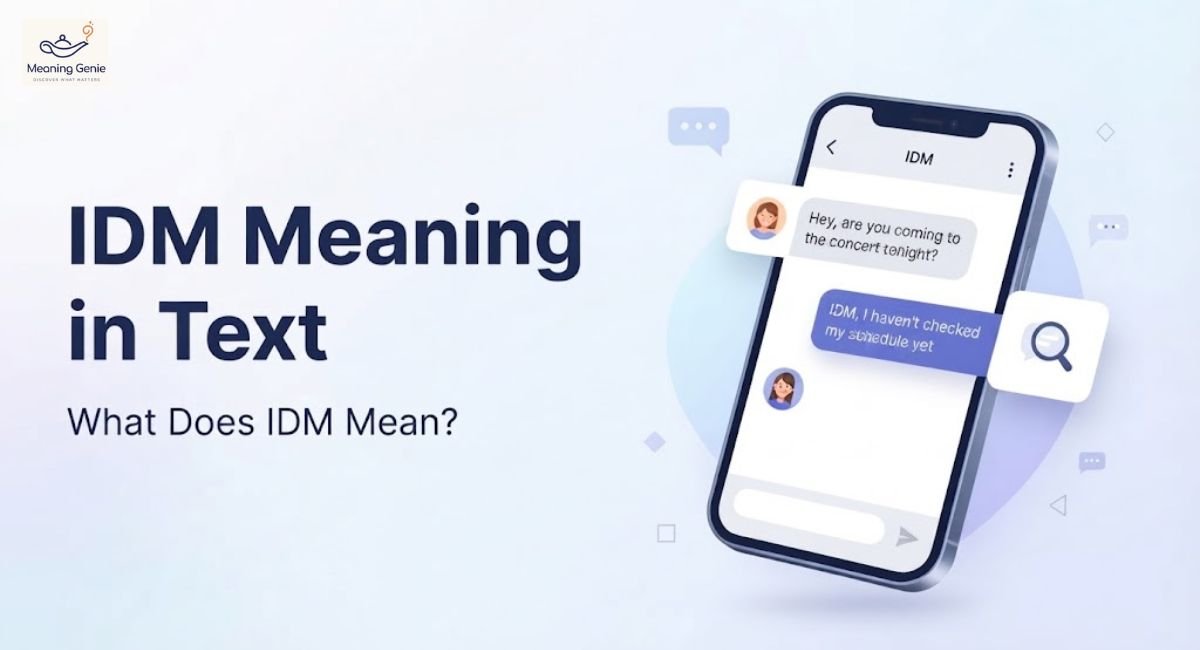
IDM usually means “I Don’t Mind” in text messages, chats, and social media. People use this texting abbreviation when they have no strong preference between two or more choices.
For example, someone might ask, “Pizza or burgers?” You could simply reply, “IDM, you pick.” Here, IDM meaning in text shows that either choice is fine with you.
You will often see IDM in casual messages, group chats, DMs, and everyday online conversations. However, its meaning can change when you see it outside texting. In technology, for example, IDM can refer to Internet Download Manager.
This guide explains what IDM means, how people use it, how it compares with similar abbreviations, and when you should avoid using it.
What Does IDM Mean in Text?
In texting, IDM means “I Don’t Mind.” It tells the other person that you have no particular preference or that you are comfortable with either option.
If someone asks, “Should we meet at 6 or 7?” replying “IDM” means the choice does not matter much to you. You are essentially saying, “Either time works for me.”
The IDM meaning in chat is usually straightforward. However, your tone and the surrounding conversation can affect how the reply feels.
IDM Meaning at a Glance
| Question | Answer |
| IDM meaning in text | I Don’t Mind |
| IDM stands for | I Don’t Mind |
| IDM full form | I Don’t Mind |
| Main use | Showing no strong preference |
| Tone | Casual and informal |
| Common setting | Texting, chats, DMs, social media |
| Example | “IDM, you choose.” |
| Formal alternative | “I don’t have a preference.” |
What Does IDM Stand For in Texting?
IDM stands for “I Don’t Mind.” It is an IDM abbreviation that shortens a common phrase for quicker communication.
Instead of typing “I don’t mind, you can choose,” someone may type “IDM, you choose.” This saves time while keeping the message easy to understand.
Like many texting abbreviations, IDM works best when the people involved already understand casual chat language. You would generally use it with friends, family, classmates, or people you regularly message.
Why Do People Use IDM in Text Messages?
People use IDM because it quickly communicates flexibility. When you genuinely have no preference, there is little reason to write a long response.
For example, imagine your friend asks, “Want coffee or tea?” If you like both equally, “IDM” gives them permission to choose. It can also keep a conversation moving without turning a simple decision into a lengthy discussion.
This is one reason IDM in text messages fits naturally into casual texting. It expresses a neutral response without sounding overly formal.
How Is IDM Used in Conversations?
The meaning stays the same in most conversations, but the purpose can vary slightly. You might use IDM when choosing between options, accepting a suggestion, or simply showing that you are flexible.

The key idea is simple: you are comfortable with the available choice or situation.
IDM When Choosing Between Options
IDM works naturally when someone gives you two or more choices.
“Do you want pizza or tacos?”
“IDM. You pick.”
Here, the speaker has no strong preference. They are leaving the decision to the other person.
IDM When Accepting a Suggestion
You can also use IDM when someone suggests an activity, location, or plan.
“Want to watch a movie tonight?”
“Sure, IDM. Pick one.”
The reply communicates openness without requiring you to make the final decision.
IDM When Showing Flexibility
Sometimes you already have a plan but remain flexible about the details.
“Can we meet around 6 instead?”
“IDM.”
In this context, IDM shows that the change is acceptable.
IDM in Casual Texting
IDM is especially suited to informal conversations. You might see it in messages between friends, family members, classmates, gaming groups, or online communities.
It can sound less formal than writing “I have no particular preference.” That makes IDM useful when you want a quick, relaxed response.
IDM Meaning on WhatsApp, Instagram, TikTok & Snapchat
The IDM meaning on WhatsApp, Instagram, TikTok, Snapchat, and other messaging platforms is generally the same: “I Don’t Mind.”
The platform does not normally change the meaning. Instead, the surrounding conversation gives you the context.
For example, someone could send “IDM” in an Instagram DM after being asked which restaurant they prefer. On Snapchat, the same abbreviation might appear when friends are deciding what time to meet.
Because these are forms of online communication, abbreviations such as IDM help people keep messages short and conversational.
Seen ‘WTW’ in a text and had no clue what it meant? You’re not alone — here’s the full guide to WTW meaning in text.
Is IDM Formal or Informal?
IDM is an informal abbreviation. It belongs to the casual side of internet slang and is better suited to everyday conversations than professional writing.
You can use it comfortably with people who already communicate casually with you. However, formal communication usually calls for complete phrases because abbreviations can seem too relaxed or ambiguous.
When IDM Is Appropriate
Use IDM when you are chatting with friends, family, classmates, or other people who understand your usual texting style.
For example:
“Dinner at 6 or 7?”
“IDM, either works.”
That sounds natural in a casual conversation.
When You Should Write “I Don’t Mind” Instead
In professional or formal communication, writing the full phrase is usually clearer.
Instead of sending:
“IDM.”
You could write:
“I don’t mind. Either time works for me.”
This small change makes your response clearer and more polished without changing its meaning.
How to Use IDM Correctly in a Sentence
You can place IDM at the beginning or use it as a short standalone response. The exact placement depends on how casual the conversation is.
For example, “IDM, you choose” sounds natural when someone asks you to decide between two options. “IDM if we go tomorrow” can also mean that you are comfortable with a suggested change.
If you want to sound warmer, add a little context. “IDM, whatever works for you” communicates the same idea while making your intention clearer.
IDM Texting Examples in Real Conversations
Real conversations make IDM texting examples easier to understand because the abbreviation depends heavily on context.
Example 1 — Choosing Food
Friend: “Where should we eat?”
You: “IDM, you pick.”
Here, IDM means you have no preference about the restaurant.
Example 2 — Picking a Movie
Friend: “Comedy or horror?”
You: “IDM. Both are fine.”
The response shows that either genre works.
Example 3 — Making Plans
Friend: “Want to hang out Friday or Saturday?”
You: “IDM. Which day works better for you?”
This use combines flexibility with a question that lets the other person decide.
Example 4 — Choosing a Time
Friend: “Can we meet at 6 instead of 5?”
You: “Yeah, IDM.”
Here, the speaker is comfortable with the proposed change.
Example 5 — Group Chat
Friend 1: “Should we order pizza or Chinese?”
You: “IDM.”
Friend 2: “Pizza it is.”
In a group chat, IDM can quickly signal that you do not need a say in the final decision.
Example 6 — Social Media DM
Friend: “Want to go Saturday or Sunday?”
You: “IDM, either day works.”
The added phrase makes the response especially clear.
IDM vs IDK, IDC, IMO & Other Similar Abbreviations
Several similar texting abbreviations can look confusing because they appear in the same casual conversations. However, they do not mean the same thing.

IDM vs IDK
IDM means “I Don’t Mind.”
IDK means “I Don’t Know.”
Compare these:
“Pizza or burgers?”
“IDM.”
This means either option is acceptable.
“Do they serve pizza here?”
“IDK.”
This means you do not know the answer.
IDM vs IDC
IDM means that you have no strong preference.
IDC means “I Don’t Care.”
The distinction matters because IDC can sound more blunt depending on context.
“Pizza or tacos?”
“IDM.”
This usually means both are fine.
“Pizza or tacos?”
“IDC.”
This may suggest that the choice does not matter to you, but it can also sound dismissive.
IDM vs OK
“OK” usually shows acceptance or acknowledgment.
“IDM” specifically communicates that you have no preference.
For example, if someone asks, “Is 7 PM okay?” then “OK” directly confirms the time. “IDM” instead suggests that you are not particularly concerned about which time is selected.
IDM vs “I’m Fine With Either”
“I’m fine with either” is essentially the longer, clearer version of IDM when two choices are involved.
The difference is mostly style. IDM is quick and informal, while “I’m fine with either” works in a wider range of conversations.
If you’ve come across other short forms in online conversations, you can also see IG meaning in text to learn how this abbreviation is used in different contexts.
What Is the Difference Between IDM and IDC?
The main difference between IDM vs IDC is what each phrase communicates about your attitude.
IDM means “I Don’t Mind,” which usually expresses flexibility or a lack of preference. IDC means “I Don’t Care,” which focuses more strongly on the fact that the subject does not matter to you.
That distinction can affect tone. “IDM, you choose” often sounds cooperative. “IDC” may sound neutral in some conversations but dismissive in others.
Context matters, especially when the reply contains only three letters. If you want to avoid misunderstanding, a slightly longer response can make your intention obvious.
If you want to understand a stronger expression of indifference, you can also see IDGAF meaning in text, which can sound more intense than IDC.
Can IDM Sound Rude?
Usually, IDM is not rude. However, a very short reply can sometimes feel distant because it gives the other person little emotional context.
Compare these responses:
| Reply | Possible impression |
| “IDM.” | Neutral, possibly distant |
| “IDM, you choose!” | Friendly and flexible |
| “Yeah, IDM.” | Relaxed and casual |
| “I don’t mind. Either works.” | Clear and neutral |
Your relationship with the other person also matters. A close friend may understand “IDM” immediately, while someone you barely know might interpret a one-word reply differently.
If you are worried about sounding dismissive, add a few words. “IDM, whatever works for you” feels more conversational than simply sending “IDM.”
Other Meanings of IDM
Although IDM meaning in texting is usually “I Don’t Mind,” the abbreviation has other meanings in different fields.

Context is therefore essential. If someone writes “IDM, you pick,” they almost certainly mean “I Don’t Mind.” If someone discusses downloading software, music, or technology, another meaning may be intended.
IDM in Technology
In technology, IDM can refer to Internet Download Manager, a download-management program.
For example, someone might say, “I installed IDM to manage my downloads.” In that sentence, IDM clearly does not mean “I Don’t Mind.”
The surrounding words usually make the intended meaning obvious.
IDM in Music
IDM can also refer to Intelligent Dance Music, a term associated with a style or category of electronic music.
A sentence such as “I listen to IDM artists” has nothing to do with texting. The topic tells you which meaning applies.
IDM in Other Contexts
IDM can have additional meanings in business, education, technology, and other specialized fields.
That is why you should never interpret an abbreviation in isolation. Look at the sentence, conversation, and topic before deciding what IDM means.
Common IDM Mistakes and When to Avoid It
One common mistake is assuming IDM always means “I Don’t Mind.” Context can point to completely different meanings, especially in technical or professional discussions.
Another mistake is treating IDM and IDC as interchangeable. They can communicate similar ideas in some situations, but their tone is not identical.
You should also avoid using IDM when the other person needs a clear decision. If your manager asks which meeting time you prefer, “IDM” may not provide the specific answer they need.
In those situations, a direct response such as “Either time works for me” is clearer.
How to Reply When Someone Says “IDM”
Your response depends on what the person is communicating. If they are giving you the choice, simply make the decision yourself.
Casual Replies
If a friend says “IDM,” you can respond naturally with something like “Cool, let’s do 7” or “Okay, pizza it is.”
These replies move the conversation forward without unnecessary explanation.
Friendly Replies
You can make your response warmer when the conversation is social.
“Perfect, I’ll pick!”
“Sounds good, let’s go with Saturday.”
These responses acknowledge their flexibility while keeping the conversation lively.
Funny Replies
With close friends, you can playfully take advantage of their lack of preference.
“IDM? Great. I’m choosing the expensive place.”
That kind of response works because both people understand the joke.
When You Need Clarification
Sometimes “IDM” does not tell you enough.
If the decision matters, ask a direct follow-up:
“Do you genuinely not mind, or do you have a slight preference?”
That avoids guessing what the other person means.
Is IDM Still Common in Texting and Social Media?
IDM remains understandable in casual texting and online conversations, but its frequency can vary between people, age groups, platforms, and social circles.
You should not assume every person uses the abbreviation regularly. Some people prefer complete phrases, while others use several texting abbreviations in nearly every conversation.
For that reason, context is more useful than assuming a fixed level of popularity. If someone writes “IDM” in a casual message, I Don’t Mind is usually the intended meaning.
IDM Meaning: Quick Comparison Table
| Abbreviation or phrase | Meaning | Typical tone | Main idea |
| IDM | I Don’t Mind | Casual | No strong preference |
| IDK | I Don’t Know | Casual | Lack of knowledge |
| IDC | I Don’t Care | Casual | The matter does not concern me |
| OK | Okay | Neutral | Acceptance or acknowledgment |
| I’m Fine With Either | No strong preference | Neutral | Both choices work |
| I Don’t Mind | No objection | Neutral | Either option is acceptable |
Final Takeaway: What IDM Means in Text
In most texting and chat contexts, IDM means “I Don’t Mind.” People use it when they have no strong preference or are happy to let someone else choose.
For example, “Where should we eat?” followed by “IDM, you pick” means the speaker is comfortable with the other person deciding.
Remember that IDM is informal, so it fits casual messages better than professional communication. Also, do not confuse it with IDC, which means “I Don’t Care” and can carry a different tone.
When you see IDM, check the surrounding conversation. In texting, it usually means “I Don’t Mind,” but in technology or music, the abbreviation can mean something completely different.
FAQS
What does IDM stand for?
IDM usually stands for “I Don’t Mind” in texting and online conversations. It means you have no strong preference between options.
What does IDM mean in Gen Z?
In Gen Z texting, IDM usually means “I Don’t Mind.” It is a quick, casual way to say either option is fine.
What does “IDM” mean in urban slang?
In casual or urban slang, IDM generally means “I Don’t Mind.” The exact tone depends on the conversation and the people using it.
What does IDM mean on IG?
On Instagram (IG), IDM usually means “I Don’t Mind.” You might see it in DMs when someone has no preference about a choice or plan.
What does “IDM” mean on TikTok?
On TikTok, IDM generally means “I Don’t Mind,” especially in comments, captions, or private messages. It indicates that either option is acceptable.
What does IDMS stand for?
IDMS can have different meanings depending on context. In texting, it may be used as a variation of “I Don’t Mind,” but it is far less common than IDM.

Words can be confusing—but understanding them shouldn’t be. I’m Muhammad Umair, an AI-powered SEO & content writer at Meaning Genie, helping readers decode slang, abbreviations, and internet language with simple, clear explanations.
1 thought on “IDM Meaning in Text: What Does IDM Mean in Chat & Social Media?”